

Government of Rajasthan Updates: Labour Welfare to be Strengthened Through the Code Of Wages (Rajasthan) Rules 2026

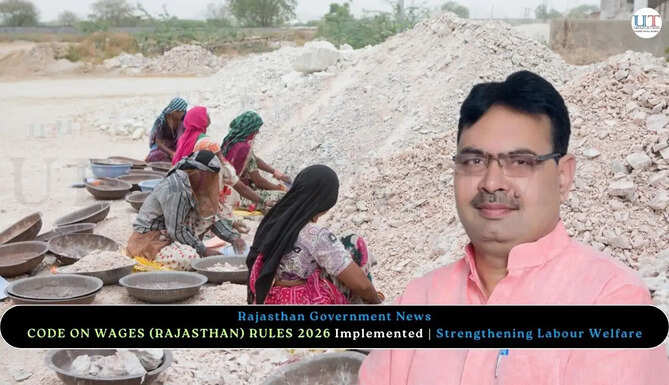
UdaipurTimes, Aug 8, 2026 | Rajasthan Government News: The Cabinet of the Government of Rajasthan has approved the Code on Wages (Rajasthan) Rules, 2026, which are aimed at safeguarding workers' interests and welfare; and at the same time, ensuring the orderly functioning of commercial and industrial establishments across Rajasthan. This was informed by the Parliamentary Affairs Minister Jogaram Patel after the meeting at the CMO on August 7.
The Rules provide for transparent determination of minimum wages and standardised working hours. A scientific formula, coupled with a skill-based classification system, will now be adopted for fixing minimum wages. Dearness Allowance (DA) will be linked to the Consumer Price Index (CPI) and revised twice annually, on April 1 and October 1, ensuring that wages remain aligned with inflation.
Standard Working Hours
The Rules also prescribe standard working hours, mandatory rest intervals and adequate safeguards for employees working night shifts.
A maximum of 48 working hours per week has been prescribed. Under a six-day work week, the total working period, including rest intervals, shall not exceed 10.5 hours per day, while the seventh day shall be a paid weekly holiday. Employees will be entitled to a 30-minute rest break after every five consecutive hours of work.
Employees required to work on weekly holidays shall be paid overtime wages in accordance with the prescribed rates. Employers will also be required to issue wage slips, while the Rules clearly specify permissible statutory deductions from wages and provide for the maintenance of digital registers. Rajasthan Government Updates
Rajasthan Industrial Relations Rules - Faster Resolution of Disputes
Col. Rajyavardhan Rathore stated that the Cabinet has approved the Rajasthan Industrial Relations Rules, 2026 with the objective of simplifying and modernising the State's labour administration framework.
Under the new Rules, all labour compliance procedures and dispute-related grievances will be shifted entirely to online platforms. Defined timelines have been prescribed for the expeditious resolution of industrial disputes, while the election of negotiating trade unions will be conducted through a mandatory secret ballot system to ensure fairness and transparency.
The Rules also provide clear guidelines regarding the constitution and functioning of Works Committees and workplace grievance redressal mechanisms. In addition, legal procedures and prescribed forms relating to retrenchment of employees and closure of industrial establishments have been simplified and made more transparent to enhance the ease of doing business.
