

Moissanite: Rare Mineral and a Scientific Marvel
It possesses certain unique properties that have led experts in material science to call it a “material of the future.”

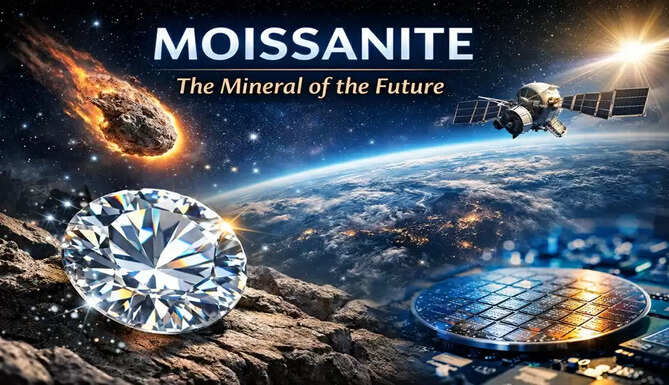
Udaipur, Feb 09, 2026: The title of this article poses a question, and the answer lies within the question itself. How can something be both a natural mineral and a product of science? In reality, it can be either—or both. The term mineral is generally given to a naturally occurring substance with specific physical and chemical properties. Another definition, however, considers materials that are created, discovered, or developed through scientific methods. Moissanite satisfies both definitions. It occurs naturally as a mineral, and it is also created in laboratories.
So, what is so special about it?
It is a common saying that anything rare in nature becomes more valuable. This applies well to diamonds, gold, silver, platinum, and other rare metals. The same is true for this material. It possesses certain unique properties that have led experts in material science to call it a “material of the future”. How it reached this status is a very interesting story.
Although information about moissanite is available in technical literature filled with complex scientific terminology, here it is presented in a simplified form.
To be very honest, as a student of mineralogy, I had never heard about this mineral during my student days. There was no mention of it in textbooks because very little was known about it. This material was first identified as a mineral by the French chemist Dr. Henri Moissan in 1893 while he was studying meteorite samples from Arizona, USA. Until then, it had not been observed or identified in any rock on Earth. It was therefore assumed to be an extraterrestrial material.
Initially, Dr. Moissan thought it was diamond, but he later corrected his observation in 1904. He discovered that the material was actually silicon carbide (SiC). Later, the mineral was named in his honor.
During this time, some members of the scientific community suggested that if proper experiments were conducted, silicon–carbon bonding could be developed and this compound could be grown in laboratories. Early attempts were not very successful because complete crystals could not be produced.
In 1958, moissanite was identified for the first time in diamond-bearing rock called kimberlite in Russia. Later, in the 1960s, it was also found in rocks in the Wyoming state of the USA. Mineralogists subsequently observed it as inclusions in diamonds and in rocks such as kimberlites and lamproites. However, it was found in extremely small quantities, making extraction impossible and limiting its practical use.
The 2-decade Gap
In the 1980s, interest in this material revived as scientific research progressed. In 1987, a laboratory in the USA successfully grew a perfect crystal, and this achievement marked a major scientific breakthrough. The properties of the material were accurately determined. It was revealed that moissanite possesses certain optical, physical, and thermal characteristics that make it suitable for various applications.
One of its foremost physical properties is hardness. It ranks between 9.25 and 9.5 on the Mohs scale, just below diamond. Its optical properties are also remarkable. Transparent moissanite crystals are very similar to diamonds. The brilliance of diamonds is based on their refractive index and total internal reflection of light. Moissanite has a slightly lower refractive index, but it has another property called birefringence. When light passes through the stone, it splits into two beams, producing a special colorful sparkle that is different from diamond. Lab-grown crystals range in color from colorless to various hues.
An Alternative to Lab-grown Diamonds
Due to its high hardness and unique optical character, moissanite is now considered the most appropriate alternative to both natural and lab-grown diamonds. This material was first marketed in 1995, but as a gemstone it was sold commercially only in 1998.
Apart from jewelry, the hardness of moissanite is also being utilized by an American company to produce hard, resistant body armor for defense forces. Another important characteristic is its high thermal conductivity. Because of this, it is used in semiconductor devices, LED lights, automobile components in high-end luxury cars, solar panels, astronomical telescopes, nuclear reactors, and even space applications. It is also used in the lapidary industry as an abrasive and in high-speed cutting tools.
In terms of cost, moissanite as a gemstone is cheaper than lab-grown diamonds. Whether natural or synthetic, this material is likely to play an important role in the future welfare and advancement of human society.
#Moissanite #GemstoneScience #Mineralogy #DiamondAlternative #SiliconCarbide #MaterialOfTheFuture #ScienceExplained #Geology #GemstoneEducation
