

How Much Can You Borrow Against 50g Gold on a Gold Loan App

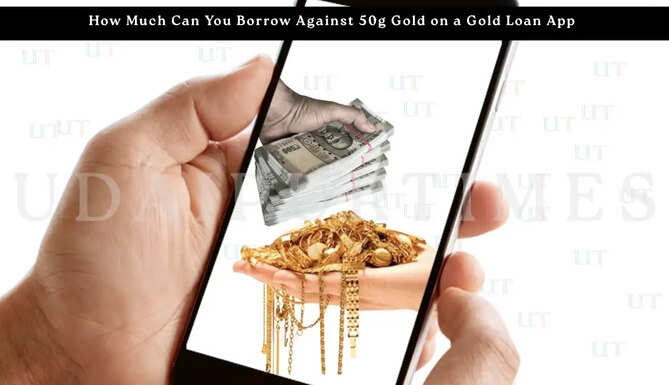
UdaipurTimes, August 26, 2026 | Gold Loans Explainer: If you own 50 grams of gold jewellery and need quick funds, you're sitting on a reasonably valuable asset. But the amount you can actually borrow against it depends on several factors, and the final number might surprise you in either direction.
Understanding the gold loan calculation
The loan amount you receive against gold is not simply the market value of your gold multiplied by some percentage. That's where it starts, but there are a few deductions along the way.
First, the price of gold in the market. Gold prices in India are currently around ₹15,000 to ₹15,600 per gram for 24-carat gold. But here's the catch: your jewellery is almost certainly not 24-karat. Most Indian gold jewellery is 22-karat, and some pieces are 18-karat. The purity of your gold directly affects its assessed value.
The value of 22-karat gold per gram is about 91.6% of the 24-karat cost. So if the cost of 24-karat gold is ₹15,300 per gram, your 22-karat gold has a value of about ₹14,000 per gram. For 50 grams at 22-karat purity, the total gold value works out to about ₹7 lakh.
But you won't get ₹7 lakh as a loan. Not even close, in most cases.
The LTV ratio is your real ceiling
The Reserve Bank of India caps the loan-to-value (LTV) ratio for gold loans on a tiered scale: up to 85% for loans below ₹2.5 lakh, 80% for loans between ₹2.5 lakh and ₹5 lakh, and 75% for anything above ₹5 lakh. What this means is that no regulated lender – a bank or NBFC or even a gold loan app, can lend you more than the applicable slab of your gold’s assessed value.
For example, if you have 50 grams of 22-karat gold at ₹7 lakh, your loan will be in the top slab and the maximum you will get is about ₹5.25 lakh at 75% LTV. This is the theoretical maximum.
In practice, lenders don't always lend right up to the cap for a given slab. Some digital platforms and NBFCs are closer to the maximum to attract borrowers, while some banks may be more conservative. You may end up with a loan offer ranging anywhere between ₹4.5 lakh and ₹5.25 lakh for 50 grams of 22-karat gold.
What happens in gold assessment?
This normally means a visit to your home or a visit to a branch, where a trained appraiser will check your gold to see if it is pure using XRF testing or acid testing, and then weigh the pure gold weight after removing stones, enamel and any non-gold elements such as clasps or hooks.
The numbers can vary here. If your 50 gram necklace has 3 grams of stones and non-gold elements, then you are actually pledging 47 grams of gold and not 50. This difference alone can reduce your loan eligibility by about ₹30,000 at current prices.Lenders are also cautious about hallmarked versus non-hallmarked jewellery. Hallmarked gold with a BIS stamp generally receives a better valuation because the purity is already certified. Non-hallmarked pieces might be assessed at a slightly lower purity than their actual content, simply as a margin of safety for the lender.Interest rates and repayment terms
Lenders are also cautious about hallmarked versus non-hallmarked jewellery. Hallmarked gold with a BIS stamp generally receives a better valuation because the purity is already certified. Non-hallmarked pieces might be assessed at a slightly lower purity than their actual content, simply as a margin of safety for the lender.
Interest rates and repayment terms
Getting a large loan amount matters, but what you pay to borrow that money matters just as much. The interest rates of gold loans vary from 7% to 17% per annum in India, depending on the scheme of the loan and the lender.
Public sector banks usually offer lower rates, generally between 7% and 10%. NBFCs that specialise in gold loans will generally charge between 10% and 15%. Digital-first lenders operating as an instant loan app can have rates all across this spectrum, but will often make up for it with faster disbursal and more flexible repayment options.
If you take a loan of ₹5 lakh at 12% annual interest for a year, it will cost you an interest outgo of ₹60,000 alone. That's a significant amount, so borrowing the maximum available just because you can is not always the smartest move.
Processing fees and hidden costs
Beyond the interest rate, look at processing fees. Most lenders charge a processing fee of 0.5% to 2% of the loan amount. On a ₹5 lakh loan, that's ₹2,500 to ₹10,000 upfront. Some lenders waive this fee during promotional periods, but don't count on it.
There are also charges for late payment, prepayment (though many gold loans allow free prepayment), and gold valuation. Always read the terms before you sign up.
A realistic estimate for 50 grams
Summing up, for 50 grams of 22-karat gold jewellery, with a net gold weight of around 47 to 49 grams after deductions and the gold price hovering at around ₹15,300 per gram for 24-karat, you can expect a loan of around ₹4.9 lakh to ₹5.2 lakh.
The exact figure depends on the lender's LTV policy, the purity of your gold ascertained by the assessment, the net weight of the gold (less non-gold components) and the current market prices on the day of assessment. Gold prices fluctuate daily, so even a week's delay in applying can shift your loan amount by a few thousand rupees.
If you need a precise figure, the fastest way is to check with two or three lenders and compare their offers. The variation between lenders for the same gold can be significant, and spending thirty minutes comparing could mean an extra few thousand rupees in your pocket.
Disclaimer:This Post is not written or produced by UdaipurTimes writers/journalists. UdaipurTimes follows ASCI guidelines for Online Advertising. The information may involve financial or health risk and UdaipurTimes does not endorse or promote any claims made in this post.
