

Growth-oriented Investing: Comparing Mid-cap vs Multi-cap Funds
Mid-cap funds have the potential to give returns when the market is favourable, but they also undergo sharper price swings at the time of market corrections

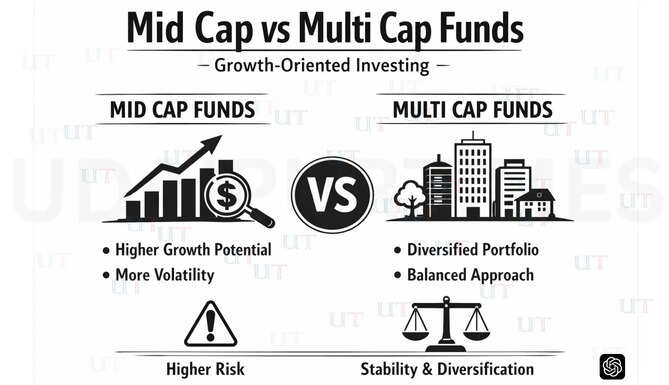
Udaipur, Mar 15, 2026: Growth-oriented investing is based on developing long-term capital growth by investing in companies that can grow faster than the market in general. The objective is not regular income, but a gradual increase in portfolio value with time.
Equity mutual funds are significant in this strategy since they provide diversification and professional management. This article will address the major distinctions between mid-cap and multi-cap funds and learn about which ones could be applicable in various growth-oriented investing strategies.
What are mid-cap funds?
According to SEBI, mid-cap funds invest in mid-sized companies that rank within the range of 101-250 by market capitalisation. Such companies are normally at the growth stage of the business cycle. They are already established, and yet they can expand a lot. Due to this, most investors consider them to have more growth potential.
Mid-cap funds have the potential to give returns when the market is favourable. But they also undergo sharper price swings at the time of market corrections. This increased volatility implies that the investors ought to have a long-term investment horizon, preferably of five years or more.
Investors need to consider consistency, risk-adjusted returns, and portfolio quality when choosing the best mid cap mutual funds instead of short-term performance.
What are multi-cap funds?
Multi cap funds invest in large-cap, mid-cap and small-cap companies. According to the SEBI regulations, these funds are required to have a minimum allocation of 25% each in large, mid and small cap stocks. This arrangement will make sure that it has a balanced exposure to various market segments. It minimises reliance on one capitalisation category of a market.
Due to this diversification, multi-cap funds provide stability and growth. Large caps offer some stability, whereas mid and small caps offer greater growth potential. These funds are appropriate when an investor desires a wide market exposure in a single scheme.
Mid-cap vs multi-cap funds: key differences
The knowledge of differences enables investors to make a decision in accordance with their financial objectives and risk tolerance. Both types of funds aid in growth; however, they respond differently to market cycles.
Risk and volatility
Mid-cap funds are more volatile since they concentrate on one segment of the market. Both rallies and corrections may be accompanied by sharp price movements.
Multi-cap funds tend to be relatively balanced due to diversification across company sizes. Large-cap exposure can cushion downside risk during uncertain periods. Multi-cap funds are usually quite balanced because of diversification across the sizes of the company.
Growth potential
Mid-cap funds can provide better returns in periods of robust economic growth. A company that is expanding can gain immensely from improving business conditions.
Multi-cap funds offer stable growth as it takes part in various segments. Returns might be relatively moderate, but are usually more consistent.
Diversification
Mid-cap funds provide a concentrated exposure to mid-sized companies. This accelerates the potential of returns and the segment-related risk.
Multi-cap funds diversify capital between large, mid and small caps. This wider exposure assists in minimising the concentration risk.
Investor suitability
Mid-cap funds could be appropriate for investors with a longer time horizon and higher risk tolerance. They must be at ease with short-term fluctuations.
Multi-cap funds can be suitable for those investors who want growth in a balanced manner. They normally attract the interest of individuals who are creating a diversified long-term portfolio.
What should investors choose for growth-oriented investing?
The decision will mostly be based on the risk tolerance and the investment goals. There is no single correct answer for every investor. Mid-cap exposure can provide growth potential in case an investor is able to manage volatility and has a long horizon. It must, however, be consistent with overall asset allocation.
In case stability and growth are the main focus, multi-cap funds could offer diversification exposure in a single scheme. There are also some investors who combine the two to balance risk and returns. But one should always base their decision on their financial goals, time horizon and overall portfolio strategy.
Conclusion
The objective of growth-oriented investing is to accumulate wealth in the long term through capital appreciation. Both mid-cap and multi-cap funds are helpful in this purpose, but vary in risk, diversification and returns pattern. Mid-cap funds provide better growth potential and more volatility, and multi-cap funds offer diversified and relatively balanced exposure. Before making a decision, investors are advised to consider their risk-taking capacity as well as long-term objectives.
