

Why Today's Biggest Games Turn In Digital Hangouts
Why Fortnite and Roblox Are Becoming Digital Cities

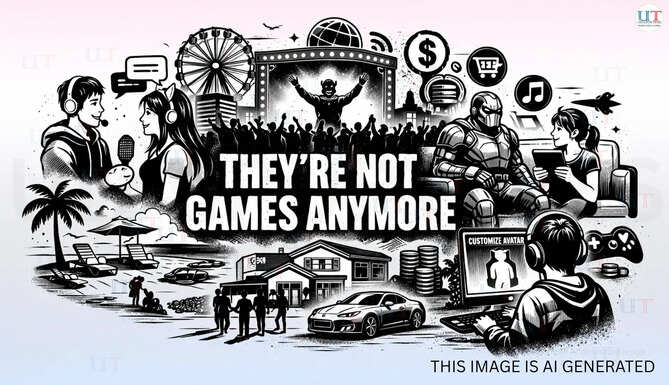
February 27, 2026: My younger cousin loaded into Fortnite the other night while I was over for dinner. I sat down expecting to watch a shootout. Instead, he and his squad spent a solid twenty minutes wandering around the island doing absolutely nothing. Just talking. About a teacher they all hated, about some kid who got caught vaping, about whose emote dance was the worst. Nobody fired a shot. At one point, one of his friends started doing the default dance next to a tree and they all lost it laughing.
I asked what the point was. He gave me this look, the kind teenagers reserve for adults who ask painfully obvious questions. "We're hanging out," he said. Like I'd asked him why people go to the park.
That interaction stuck with me because I think it captures something most adults still haven't caught up to. Fortnite, Roblox, Minecraft — we keep calling them games, but that word doesn't really fit anymore. They've quietly turned into the places where young people spend their social lives. The gaming part is almost incidental. Even traditional online gaming platforms are constantly expanding their lists of available items, many of which have a social component. Shooting games, roulette, and blackjack are still there, but it's just one option on an odds96 menu that keeps growing.
The Numbers
The numbers back this up in ways that honestly caught me off guard when I started digging. Roblox reported 151 million daily logins as of late 2025, with the average person spending about 2.8 hours per day on the platform. Not per week. Per day. At one peak moment, 45 million people were on Roblox at the same time. For context, the Super Bowl gets around 115 million viewers across the entire broadcast. Roblox hits nearly half that number on a single idle Tuesday afternoon, and those people aren't passively watching anything. They're in there together, doing stuff.
Fortnite crossed 100 million monthly active users and kept going. Minecraft has over 170 million. But the interesting part isn't the raw headcount. It's what people are actually doing once they log in.
My nephew asked me to watch him play Brookhaven last weekend. If you don't know Brookhaven, it's the most popular thing on Roblox, which makes it one of the most popular things in gaming, full stop. You get a house. You drive around a little suburban neighborhood. You go to a pizza place. That's it. There is nothing to win. There is no boss. I sat there for twenty minutes watching him rearrange furniture in a fake living room with his friend from school, and at some point I realized I was the one who didn't get it.
I've been covering games long enough to remember when we argued about whether walking simulators counted. Now the most-played experience on one of the biggest platforms in the world is a game about being a guy who lives in a house. And it's not a fluke — it's been at the top for years.
Fortnite's trajectory is maybe even weirder. Epic took their battle royale and basically hollowed it out and rebuilt it as an operating system. There's a rhythm game mode now. A LEGO survival thing. Racing. Thousands of community maps. And then every few months they do something like the "Remix: The Finale" concert last November — Snoop Dogg, Ice Spice, Eminem, 14.3 million concurrent players — and I have to sit with the fact that the biggest live music event of the year happened inside a game I still associate with dance emotes. The Travis Scott thing in 2020 hit 27 million uniques. The Daft Punk event in 2025 was reportedly bigger. These numbers are insane and we've already gotten bored of being amazed by them, which is itself kind of insane.
Third Places
There's this concept from sociology — Ray Oldenburg's "third places." The spaces that aren't home and aren't work where people actually form community. Diners, barbershops, parks, whatever. The observation a lot of people have made, and I think it's correct, is that for a huge chunk of young people these platforms are the third place now. Your hangout spot has a loading screen.
The optimistic read is genuinely compelling. These spaces don't care about geography, money, disability, social anxiety. Everyone's an avatar. You pick how you show up. Roblox says its users change their avatars 274 million times a day, and they ran a study with Ipsos claiming Gen Z kids are six times more likely to feel their avatar represents them better than their social media photos. I want to take that at face value but I also remember that Roblox has every incentive in the world to frame avatar customization as identity expression rather than, you know, a monetization funnel. Both things can be true at once. Usually are.
The Economy Side
Here's where the real contradictions start to arise for me: Roblox reportedly paid out nearly $600 million to content creators in the first half of 2025 alone. Many of these creators are teenagers. The press release version of this story is inspiring—kids are learning to code, running small businesses, becoming entrepreneurs! The version that didn't make it into the press release is that Roblox takes a huge cut of the profits, that the labor relations are unclear at best, and that the phrase "we pay teenagers to create content that adds value to our platform" sounds less inspiring the more you think about it. Last year, 558 brands ran campaigns in virtual worlds, a 72 percent increase from the previous year. This isn't a community. It's an advertising market disguised as a community.
I'm not saying this to be depressing. I genuinely think something real and important is happening. When Tim Sweeney talks about cross-platform compatibility—about carrying your identity and data between Fortnite, Roblox, and Minecraft—I believe he means it, and I think if it happens, it will have a bigger impact than most things the industry has done in the last decade. The "garden" model, where every game is a sealed box, has always been bad for players. If that ends, great.
And the design lesson here is so obvious I'm almost ashamed to write it down: people don't come back for the daily login rewards. They come back because their friends are there. A product isn't a game. A product is a place. Every designer I've spoken to over the past year has said something similar, and those who speak honestly add that they don't really know how to design it. You can build a space, but you can't produce something that makes people want to be there. That's the challenge. That's always been the challenge.
The Biggest Games Aren't Really Games Anymore
Here's what I keep coming back to, though. My nephew on Brookhaven — he's also the kid who had a meltdown when his mom set a screen time limit last month. He's the kid who told me his Roblox friend group is "more real" than school, which, okay, maybe, but also he's ten. I watched him learn some basic scripting in Roblox Studio and I was proud of him. I also watched him play for five straight hours on a Saturday while it was nice outside and felt the specific guilt of an adult who knows they should say something but doesn't want to be that guy.
The biggest games aren't really games anymore. They're places — messy, noisy, commercially compromised, occasionally magical places where millions of people are building something that doesn't have a precedent. I think that's mostly good. I also think the platforms that run these places have enormous power over the people who gather in them, and that we're extending a lot of trust to companies that have not historically earned it.
But my nephew's in there right now, rearranging his fake living room, and his friend moved to another state last year and this is how they hang out. I'm not going to tell him that's not real. I just hope somebody's paying attention to who owns the building.
