


Why Price Alone Is the Worst Way to Buy a Used Car
For decades, used car buyers in India have been conditioned to chase the lowest price
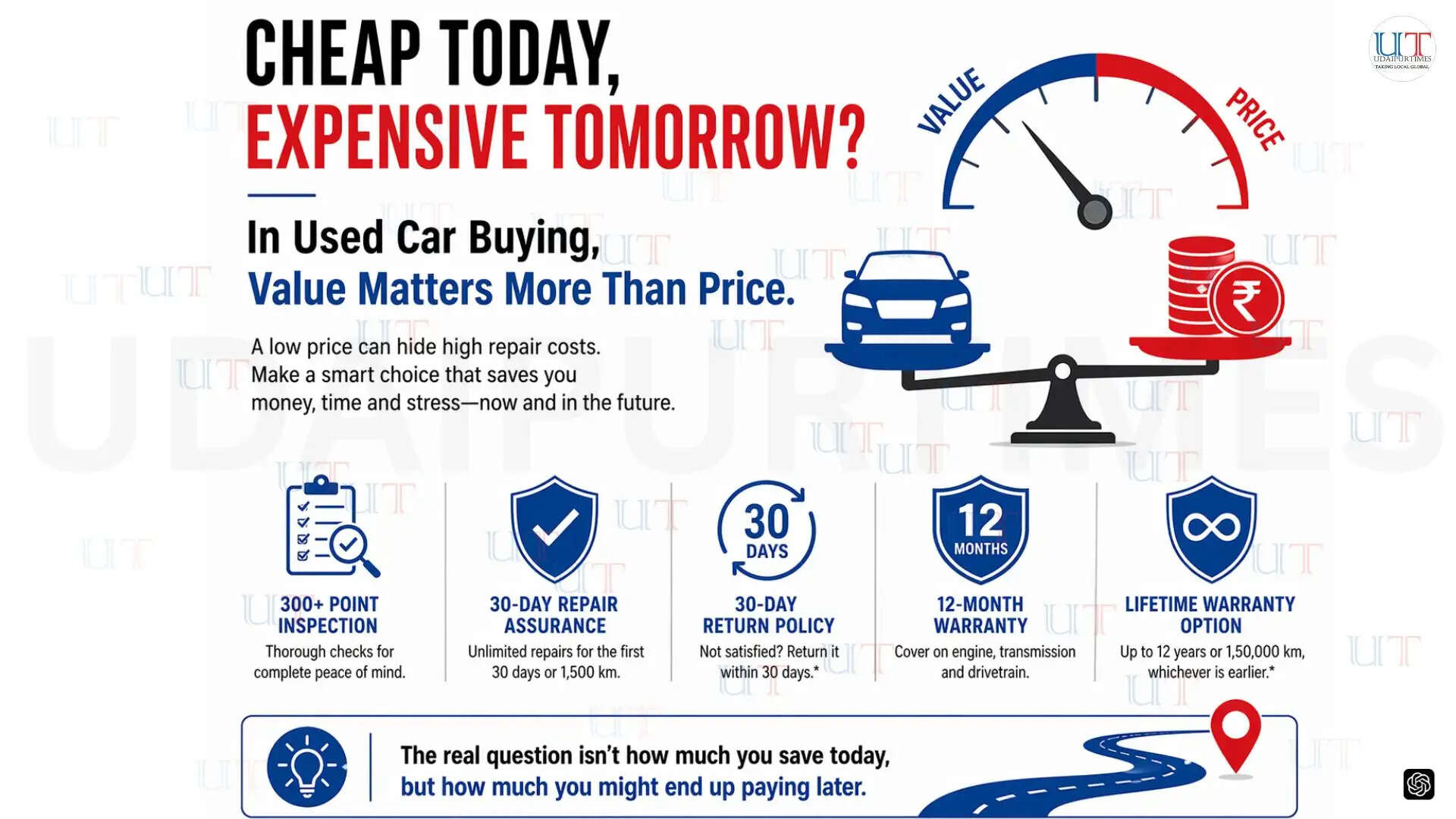
Udaipur, April 23, 2026: For as long as the used car market has existed in India, price has been one of the most important things buyers consider. Long before organised used car platforms came into the picture, buyers and sellers negotiated their way into the deal at roadside lots, through newspaper classifieds, and eventually across online portals. No matter the platform, in almost every transaction, the single most powerful force at the negotiating table was the sticker price. A lower price drew attention. A significantly lower price drew crowds.
Decades of this dynamic have conditioned buyers to approach the used car market with one primary filter: cost. For most households, a car is among the largest purchases made in a year. When a car that meets the basic requirements on paper appears at a price thousands of rupees below the usual rate, the instinct is to move fast before someone else does.
This pull of price is not irrational in isolation. Value consciousness is a virtue. But in the used car market specifically, the gap between the quoted price and the true cost of ownership is often wide enough to drain every rupee saved. Yet the attraction of a low number has historically been strong enough to make buyers overlook red flags, skip due diligence, and walk away from better options simply because they carried a higher price.
The Psychology of a Good Deal: When Price Becomes a Blindfold
When it comes to buying a used car in India, the perception of a bargain often blurs decision-making. When a buyer encounters a car priced noticeably below market rate, the brain registers it as an opportunity, and opportunities feel urgent. The emotional reward of 'getting a deal' can be powerful enough to override rational analysis.
Buyers in this state often begin rationalising rather than evaluating. The slightly rough engine idle is explained away as a minor flaw. The misalignment in the bonnet gap is attributed to normal wear. The seller's reluctance to share service records is dismissed as laziness.
Each individual concern, on its own, might genuinely be minor. But together, they form a pattern that a dispassionate buyer would recognise as a warning. Under the spell of a low price, however, these signals are selectively filtered out.
A used car that appears to offer two lakh rupees in savings over comparable options creates a perception that is difficult to ignore. Even when friends, family, or mechanics raise concerns, the buyer is already emotionally invested.
This is the mechanism through which price, far from being a straightforward signal of value, becomes a blindfold, one that the buyer puts on willingly, sometimes almost enthusiastically.
The True “Cost” of a Cheap Car
The most painful lesson many used car buyers learn is that the price paid at the time of purchase is only the beginning of the financial story. A car that appears to offer a significant saving can, within months of ownership, reveal hidden costs that outweigh the initial discount.
Consider a common scenario: a buyer chooses a cheaper car over a slightly more expensive alternative, passing up the pricier option because the numbers did not seem justifiable at the time. The cheaper car, however, turns out to harbour latent mechanical defects like worn suspension components, ageing brake lines, and an air conditioning compressor on the verge of failure. These are the kinds of issues that experienced sellers are pro at masking during a test drive and a visual inspection. Once the sale is complete, the seller's accountability ends. No amount of follow-up calls can get you a refund or a repair. The buyer is left alone with a repair bill that quickly surpasses the amount they saved by choosing the cheaper car in the first place.
What Actually Determines Long-Term Value in a Used Car
If price alone is an insufficient guide, what should buyers be evaluating instead? The answer lies in a set of factors that collectively determine not just what a car costs today, but what it will cost and deliver over time. Each of these factors carries an emotional utility that no quoted price can replicate.
In-Depth, Standardised Inspection
A thorough inspection, one conducted by trained professionals against a rigorous, standardised checklist, is the single most effective solution to the risks of used car buying. When a car has been examined across hundreds of parameters covering mechanical health, structural integrity, electrical systems, and cosmetic condition, the buyer is not relying on a seller's word or their own untrained eye. They have independent evidence that replaces anxiety with confidence. A buyer who knows exactly what they are purchasing can make a truly informed decision, rather than an optimistic one.
Reliable Warranty Coverage
A warranty on a used car is not merely a policy document. When a seller or platform backs its vehicles with genuine warranty coverage on critical components, it communicates that they stand behind the quality of what they sell. For the buyer, this translates into a form of ownership confidence that a cheaper, unwarranted car simply cannot provide. The peace of mind of knowing that the engine and transmission, the two most expensive components to repair or replace, are covered is worth far more than a headline discount.
Post-Purchase Repair Assurance
The weeks immediately after a used car purchase are often when buyers feel most vulnerable. Early issues, however minor, can give birth to doubt. A post-purchase repair assurance that guarantees repairs during this initial period transforms what could be an anxious experience into a reliable one. It tells the buyer that they have not been abandoned after the transaction, that the responsibility for the car's condition does not fall entirely on their shoulders.
The Freedom to Return
Perhaps the most underappreciated element in used car buying is the ability to change one's mind. A return policy that gives the assurance that if the car does not meet expectations, the buyer can walk away with a refund fundamentally changes the psychology of used car purchase. It removes the irreversibility that has historically been linked to the used car market. When a buyer knows they have a genuine exit option, they can commit to a purchase with clarity rather than anxiety, and evaluate the car in their own life on their own terms.
Long-Term Ownership Protection
A used car is not a short-term commitment. Buyers intend to drive their vehicles for years, and the financial and emotional stakes of long-term ownership are considerable. Coverage that extends meaningfully into the future, protecting against major mechanical failures years down the line, delivers peace of mind that no initial discount can match.
How Organised Online Platforms Are Redefining Used Car Value
The rise of organised online used car platforms has introduced a new change to an industry long characterised by information asymmetry. These platforms do not merely aggregate listings; they create structured, verifiable buying experiences that address the fundamental vulnerabilities of the traditional used car market.
Transparent, data-backed pricing ensures that buyers are not navigating a maze of inflated asks and unclear baselines. But pricing transparency, while necessary, is only part of the proposition. The more substantive shift that organised platforms bring is the host of assurances that convert a transaction into an experience.
Several organised platforms in India have begun addressing these concerns through inspections, warranties, and return policies. Among them, Cars24 is one example that has built a comprehensive buyer-focused experience.
An Experience That Goes Beyond The Price
The platform's approach to quality begins before a car ever reaches a buyer. Every vehicle listed undergoes a 300-point inspection. A systematic, professional-led assessment that covers mechanical systems, structural condition, electrical components, and cosmetic condition, along with in-depth financial, legal and ownership verification.
-
Once a purchase is made, the platform's 30-day repair assurance ensures that any issues arising in the first 30 days or 1,500 kilometres, whichever comes earlier, are resolved through guaranteed, unlimited repairs at no additional cost to the buyer. This is the critical early-ownership window during which buyers are most prone to problems and most susceptible to regret. By standing behind every car during this period, the platform eliminates the worst version of the post-purchase experience: the discovery of a problem and the realisation that there is nowhere to turn.
-
The platform also offers a 30-day return policy: a provision that, in the context of the used car market, is genuinely transformative. If, within 30 days of purchase, a buyer finds that the car does not meet their expectations, they can return it for a refund, subject to nominal deductions. It means the commitment to purchase is not absolute. The buyer can live with the car, experience it in their daily life, and make a final decision with the benefit of real-world use, not just a showroom inspection and a test drive.
-
Beyond the immediate post-purchase period, the platform also offers a 12-month extended warranty that covers the most critical and expensive components of the engine, transmission, and drivetrain. These are precisely the components whose failure carries the highest repair costs and the greatest disruption to daily routine. Knowing that these systems are covered for an entire year after purchase means that buyers can use their car with confidence rather than regret.
-
For buyers who wish to extend this protection further, the platform even offers what is believed to be the world's first Lifetime Warranty Plan: a warranty coverage of up to 12 years or 1,50,000 kilometres from the date of registration, whichever is earlier. This is a remarkable commitment in an industry where post-sale accountability has traditionally been measured in days, not years.
Chasing Long-Term Value
A used car bought from a local dealer at a price two lakh rupees below the market price may feel like a big win at the time of the purchase. But if that car hides an undisclosed accident history, carries mechanical issues the seller was careful to conceal, and comes with no recourse once the keys are handed over, the win can turn into a loss quite soon. The true cost, financial, emotional, and practical, may far exceed upfront savings.
What the organised used car platform model offers is not a compromise on price. It offers something more valuable: the conditions under which a buyer can make a genuinely informed decision, protected by real assurances, supported through the ownership journey, and free from the anxiety that has historically been the silent companion of every used car purchase.
When leading used car platforms like Cars24 subject vehicles to multi-point inspections, guarantee repairs for the first month of ownership, offer a genuine return policy, back its vehicles with a 12-month warranty, and provide the option of protection that spans up to 12 years, it is not simply selling used cars. It is selling peace of mind. For the modern used car buyer in India, the most important shift is to stop asking which car is the cheapest and to start asking which purchase will offer long-term value. The real question isn’t how much you save today, but how much you might end up paying later.
#UsedCarsIndia #CarBuyingTips #SecondHandCars #AutoAdvice #Cars24 #SmartBuying #CarOwnership #IndianAutoMarket #RajasthanCars #UdaipurAuto #CarDealsIndia #VehicleInspection #CarWarranty #AutoFinance #CarBuyersGuide