

The Minds and Lives That Shaped India: Achievement, Courage and the Responsibility to Remember

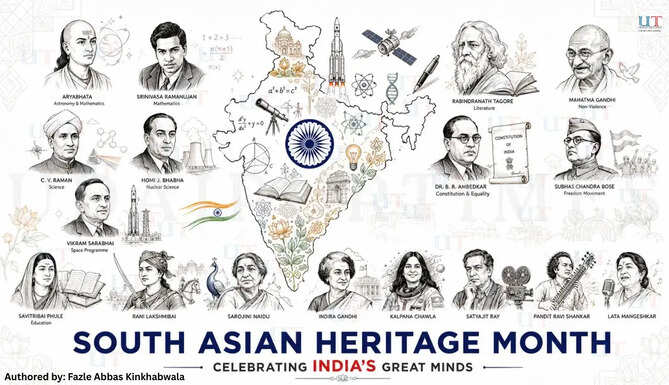
Udaipur, July 24, 2026: South Asian Heritage Month provides an opportunity to celebrate the individuals whose ideas, courage and determination have shaped India and influenced the wider world.
India’s history is filled with scientists, mathematicians, writers, reformers, political leaders, artists and pioneers whose work transformed society. Some became internationally recognised. Others remain far less familiar outside specialist circles.
Their achievements raise an important question. How do we decide who deserves to be remembered?
History often focuses upon a small number of celebrated figures. Yet behind every national movement, scientific breakthrough or social transformation stand countless individuals whose contributions made progress possible.
India’s story is not the story of one leader, one region or one generation. It is the collective story of people who imagined a different future and had the courage to pursue it.
One of the earliest examples is Aryabhata, the mathematician and astronomer born in the fifth century.

Aryabhata made significant advances in mathematics, algebra, trigonometry and astronomy. He calculated an approximation of pi, developed methods for solving mathematical problems and explained that the apparent movement of the stars was caused by the rotation of the Earth.
At a time when scientific understanding was still developing across the world, Aryabhata was asking questions about the universe using observation, logic and calculation.
His work reminds us that India’s intellectual traditions did not begin with modern universities. They stretch back centuries and demonstrate a long-standing respect for knowledge, scholarship and enquiry.
Many centuries later, Srinivasa Ramanujan continued this remarkable mathematical tradition.
Born in Tamil Nadu in 1887, Ramanujan had limited access to formal mathematical training. Nevertheless, he developed extraordinary theories and formulas that continue to influence mathematics today.
His notebooks contained thousands of mathematical results, many of which were produced without the conventional proofs expected by academics. His instinctive understanding of numbers was so unusual that it attracted the attention of the British mathematician G. H. Hardy at the University of Cambridge.
Ramanujan travelled to England, where he continued his research despite illness, cultural isolation and the challenges of living far from home.

His life was tragically short, but his contribution was immense.
Ramanujan’s story is not simply about natural genius. It is also about the importance of recognising talent wherever it appears. Had Hardy ignored his letter, how much of Ramanujan’s work might have remained unknown?
India’s contribution to science continued through figures such as Sir Chandrasekhara Venkata Raman.
C. V. Raman’s research into the behaviour of light led to the discovery of what became known as the Raman Effect. The discovery transformed scientific understanding of how light interacts with matter and remains important in chemistry, physics, medicine and material science.
In 1930, Raman became the first Asian scientist to receive the Nobel Prize in Physics.
His success challenged assumptions about where world-changing scientific research could take place. It demonstrated that Indian scientists could make discoveries of the highest international importance, even while working with fewer resources than many Western institutions.
Science in India was also shaped by individuals who understood that knowledge must be connected to national development.

Dr Homi Jehangir Bhabha played a central role in establishing India’s nuclear research programme. He helped create institutions that would train future generations of scientists and strengthen the country’s technological capability.
Dr Vikram Sarabhai became known as the father of the Indian space programme. He believed that space technology should not exist simply to demonstrate national power. It should be used to improve communication, education, weather forecasting and development.
That vision helped lay the foundations for the Indian Space Research Organisation.
Today, India’s space achievements attract global attention. However, every successful launch stands upon decades of patient institution-building, scientific education and public investment begun by earlier pioneers.
This is an important lesson.
Great achievements rarely begin with the final moment of success.
They begin with someone creating the conditions in which others can succeed.
India’s influence has not been limited to mathematics and science.

Rabindranath Tagore transformed literature, music, education and social thought. In 1913, he became the first non-European recipient of the Nobel Prize in Literature.
Tagore was not simply a poet. He was a philosopher, composer, educator and critic of narrow nationalism. He believed that education should encourage creativity, freedom of thought and a deeper relationship with nature.
His compositions later became the national anthems of both India and Bangladesh, an extraordinary reflection of his cultural influence.
Tagore’s life demonstrates that words can shape national identity just as powerfully as political movements.
Literature gives people language through which to understand freedom, dignity, grief, belonging and hope.

Few individuals are more closely associated with India’s independence than Mahatma Gandhi.
Gandhi developed and practised the principle of satyagraha, the pursuit of truth through disciplined non-violent resistance. His campaigns challenged British rule while also asking individuals to examine their own conduct, courage and responsibility.
His methods influenced civil rights movements around the world, including the work of Martin Luther King Jr and Nelson Mandela.
Yet Gandhi’s legacy, like the legacy of many historical figures, should be examined thoughtfully rather than treated as beyond question. His achievements were immense, but history also requires us to consider complexity, disagreement and the perspectives of those whose experiences differed from his own.
Dr Bhimrao Ramji Ambedkar offers one of the most powerful examples.
Born into a community subjected to severe caste discrimination, Ambedkar became an economist, lawyer, scholar, social reformer and principal architect of the Constitution of India.
He argued that political independence would remain incomplete without social equality.
Freedom could not simply mean replacing foreign rule with national government. It had to include dignity, education, legal protection and opportunity for people who had been excluded and oppressed.
Ambedkar’s life reminds us that democracy is not sustained by elections alone.

It depends upon institutions, rights, accountability and a commitment to treating every citizen as equal before the law.
India’s freedom movement also included leaders such as Subhas Chandra Bose, whose methods differed sharply from those of Gandhi.
Bose believed that armed resistance was necessary to overthrow British rule. He organised the Indian National Army and sought international support for India’s independence.
His legacy continues to generate debate, but his determination and willingness to sacrifice personal comfort for national freedom remain central to his place in Indian history.
The contrasting approaches of Gandhi, Ambedkar and Bose demonstrate that history is rarely shaped by a single idea.
Change emerges through debate, disagreement, protest, negotiation and sacrifice.
Women also played indispensable roles in India’s transformation, although their contributions have often received less attention.
Savitribai Phule was one of India’s pioneering female educators. Alongside her husband, Jyotirao Phule, she helped establish schools for girls and children from marginalised communities.
She faced abuse and opposition for challenging accepted social customs. Yet she continued teaching because she understood that education was one of the most powerful routes to freedom.
Rani Lakshmibai of Jhansi became an enduring symbol of resistance during the uprising of 1857. Her courage entered national memory, representing determination in the face of overwhelming force.
Sarojini Naidu combined poetry with political activism. She campaigned for independence and women’s rights and later became the first woman to serve as governor of an Indian state.
Indira Gandhi became India’s first female Prime Minister and one of the most powerful political figures of the twentieth century. Her record remains debated, particularly because of the Emergency imposed between 1975 and 1977. Her career nevertheless demonstrates the scale of authority that an Indian woman could exercise in an era when political leadership across the world remained overwhelmingly male.
More recently, Kalpana Chawla became a symbol of scientific ambition and human possibility.
Born in Karnal, she developed a passion for flight and space. She later became an astronaut and the first woman of Indian origin to travel into space.
Her death aboard the Space Shuttle Columbia in 2003 was a profound tragedy. Yet her journey continues to inspire young people, particularly girls, to pursue careers in science, engineering and aviation.
Her story carries a simple but powerful message - Our place of birth does not have to limit the scale of our dreams.
India has also given the world artists whose influence crossed borders.
Satyajit Ray became one of cinema’s most respected directors. His films explored human relationships, poverty, social change and moral complexity with extraordinary sensitivity.
Pandit Ravi Shankar introduced audiences across the world to Indian classical music and demonstrated how artistic traditions could cross cultures without losing their depth or identity.
Lata Mangeshkar’s voice became part of the emotional memory of generations. Her songs accompanied celebrations, heartbreak, patriotism and reflection across India and far beyond it.
These individuals remind us that a nation is not shaped by politics and science alone.
It is shaped by the stories people tell, the music they share and the images through which they understand themselves.
The achievements of famous Indians offer many reasons for pride. However, pride should not become a substitute for learning.
The purpose of remembering these individuals is not simply to place them upon pedestals. It is to understand the problems they confronted, the values they represented and the work that remains unfinished.
Aryabhata and Ramanujan remind us to nurture curiosity.
C. V. Raman, Homi Bhabha and Vikram Sarabhai remind us to invest in research and institutions.
Tagore reminds us that education should develop the whole person.
Gandhi reminds us of the power of disciplined non-violence.
Ambedkar reminds us that liberty without equality is incomplete.
Savitribai Phule reminds us that education can challenge generations of exclusion.
Kalpana Chawla reminds us that aspiration can travel beyond every visible boundary.
South Asian Heritage Month should therefore be more than a celebration of famous names. It should encourage us to discover those who remain unknown.
Behind every recognised leader stood teachers, colleagues, families, campaigners, technicians, writers, workers and supporters whose names may never appear in history books.

Recognition is never distributed equally.
Some individuals gain awards, statues and international fame. Others make contributions of equal value but remain known only within their families, professions or communities.
This does not make their work less important.
A teacher who changes the life of one child may never become famous.
A researcher whose experiment helps another scientist make a breakthrough may never receive public recognition.
A community volunteer who creates opportunity for others may never be mentioned in a newspaper.
Yet history is built through such contributions.
The lives of India’s great figures remind us that significance is not determined by fame alone. It is determined by the knowledge we create, the injustice we challenge, the opportunities we provide and the lives we improve.
As we celebrate the famous Indians who helped shape science, democracy, literature, culture and human progress, we should also ask a final question:
Which minds, voices and acts of courage are being overlooked today, and what responsibility do we have to ensure that future generations remember them?
