

"Mewar's Sun Has Begun to Rise Beyond a Veil", A Brief on Udaipur's Air and Our Responsibility
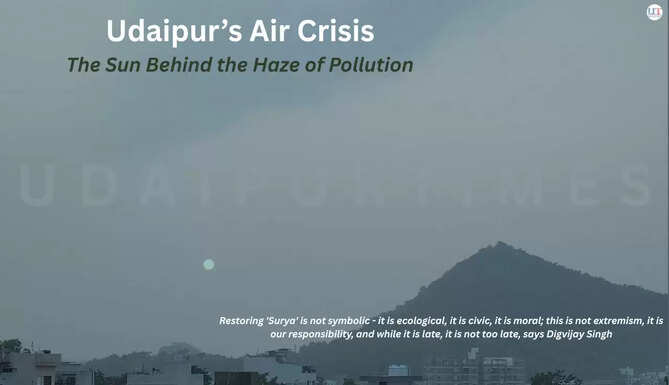
Restoring 'Surya' is not symbolic - it is ecological, it is civic, it is moral; this is not extremism, it is our responsibility, and while it is late, it is not too late, says Digvijay Singh
Udaipur, Nov 30, 2025: The Maharanas of Mewar traced their lineage to 'Surya'. In the City Palace, he appears again and again — in brass, in paint, in stone. Courtyards, doorways, and homes across the old city were aligned to welcome light. This was never decorative. It was an identity, built into architecture - the jharokhas for exampls.
Udaipur was shaped with an understanding of climate, air, heat, shadow, and breath. Today, that relationship is thinning - neither by war nor by attack, but purely and sadly, by neglect. The Sun, still rises, but increasingly, it rises behing a veil.
Dust and smoke now sit between the sky and the city. The white of marble looks grey. The horizon looks tired. This is air pollution.
Udaipur is officially classified as a Non-Attainment City under India’s National Clean Air Programme. Non-attainment cities in India are urban areas that have consistently failed to meet the National Ambient Air Quality Standards (NAAQS) for five consecutive years. In simple terms, the air here regularly fails to meet national safety standards for particulate matter - PM10 and PM2.5 two pollutants dominate.
- PM10 – coarse dust from broken roadsides, unpaved shoulders, construction, debris, and disturbed soil
- PM2.5 – fine, invisible particles from diesel engines, generators, burning waste and combustion
These particles enter the body with every breath. One scratches the lungs and the other goes into the blood. This is not an industrial crisis. It is a design failure, a mobility failure, and an enforcement failure. And that means it is reversible.
The Risk: Cigarettes We Never Smoked
There is a way to understand air pollution that is impossible to ignore. A widely accepted measure states that 22 micrograms per cubic metre (μg/m³) of PM2.5 for one day is roughly equal to smoking one cigarette. On the worst days in Delhi, breathing the air is compared to smoking 40–50 cigarettes a day. Udaipur is not Delhi. BUT Udaipur has repeated days in the “unhealthy” range. This means many people here, including children, the elderly, students, the traffic policce, vendors, workers of every kind, are effectively “smoking” several cigarettes a day — without ever touching one. The Damage is quiet, but it is constant.
What are the Health Risks
Operating in this polluted air, undoubtedly results in lower lung capacity, higher risk of heart diseases, increased asthma and respiratory illness, shorter life expectancy - among others. Air does not negotiate, the body absorbs what the air contains.
What is Actually Polluting Udaipur's Air
Udaipur’s pollution is not complex. It is local and it is man-made. The major sources are:
- Road dust from broken shoulders, unpaved edges, loose soil, debris
- Uncovered transport of sand, marble, soil, and construction materials
- Diesel vehicles — especially old buses, trucks, tempos
- Uncontrolled Tourism
- Generators in hotels and construction sites
- Open burning of waste, leaves and debris
- Poor traffic flow and long idling times
- Uncontrolled construciton in green belts and cutting of the hills
- Depletion and Lack of green cover and inadequate dust-trapping vegetation
- Unsafe or absent footpaths forcing even short journeys onto vehicles
Every passing vehicle disturbs dust. Every uncovered truck spreads it further. Every idle engine releases fine toxic particles. This is not a by-product of development. It is a gap in planning of the stakeholders and discipline of the residents. Hence, it is within control.
The Real Solution: Air is Infrastructure
To reduce PM10 and PM2.5, the city must directly address the physical and behavioural sources:
- Stabilise road edges – no loose soil, no crumbling shoulders
- Plant continuous green buffers – trees, shrubs, groundcover that trap dust
- Create permanent, shaded pedestrian paths – so people stop using vehicles for short distances
- Build safe cycle corridors – separated from traffic
- Strictly enforce covers on all construction and debris transport
- Eliminate open burning completely
- Phase out the worst diesel vehicles and generators
- Improve traffic flow to reduce idling
- Increase urban tree cover in high-pollution corridors
- Commission a scientific source-apportionment and health-impact study for Udaipur
These steps together can realistically deliver a 30–50% reduction in particulate pollution within three years, in priority zones.
This is not a technological challenge.It is an administrative and cultural one.
Political Will
The Central Pollution Control Board (CPCB) has identified 131 such cities under the National Clean Air Programme (NCAP). Udaipur is among the five cities of Rajasthan that have been classified under this category. The other cities are Jaipur, Jodhpur, Kota and Alwar. Udaipur is among the cities funded under the 15th Finance Air Quality Performance Grant in 2019. The total fund released to Udaipur was Rs 28.39Cr, of which Rs. 16.84Cr has been utilised as per the NCAP records. The utilisation for Udaipur (59.32%) is the lowest among all the five cities of Rajasthan. The fund release and utilisation till date (Nov 30, 2025) of all the five non-attainment cities of Rajasthan is as follows:
| City | Fund Released | Fund Utilised | % Utilised |
| Udaipur | 28.39Cr | 16.84Cr | 59.32% |
| Kota | 135.72Cr | 104.38Cr | 76.91% |
| Alwar | 25.15Cr | 21.94Cr | 87.24% |
| Jodhpur | 153.49Cr | 106.1Cr | 69.13% |
| Jaipur | 344.7Cr | 346.2Cr | 100% |

What Returns When the Air Returns
Cleaner air is not just about numbers on a chart. It is about:
- Children developing full lungs
- Elderly breathing without hardship
- Workers no longer inhaling poison all day
- The Aravallis visible again on the horizon
- Palaces and temples standing clear, not dissolved in haze
- The sky turning blue instead of pale white
The sun returning to full brilliance over Mewar that can see its horizon, can remember who it is. And when people can walk its streets, breathe its air, and see its sky, something intangible comes back - Pride, Belonging and Continuity.
Restoring Surya is not symbolic - it is ecological, it is civic, it is moral. This is not extremism, it is our responsibility. And while it is late, it is not too late.
#Udaipur #UdaipurNews #Mewar #CityOfLakes #Rajasthan #UdaipurAirQuality #CleanAirUdaipur #UdaipurEnvironment #RajasthanEnvironment #AirPollutionIndia #PM25 #PM10 #SustainableUdaipur #SaveUdaipur #UdaipurHeritage
This Study has been contributed by Digvijay Singh, a resident of Udaipur and Founder of Saraam Chocolates
FAQs
1. Why is Udaipur classified as a Non-Attainment City?
Because it has failed to meet India’s National Ambient Air Quality Standards (NAAQS) for PM10 and PM2.5 for five consecutive years.
2. What are the biggest sources of air pollution in Udaipur?
Road dust, uncovered transport of materials, diesel vehicles, generators, waste burning, and poor pedestrian infrastructure.
3. What are the health effects of PM2.5 and PM10 exposure?
Reduced lung capacity, higher risk of heart disease, asthma, respiratory illness, and shorter life expectancy.
4. Can Udaipur’s air quality be improved?
Yes. Pollution sources are local and controllable. With road stabilization, green buffers, cleaner mobility, and enforcement, Udaipur can reduce particulate levels by 30–50% in three years.
5. Why is clean air linked to Udaipur’s cultural identity?
Udaipur’s architecture and heritage were designed around Surya, light, and clear skies. Polluted air dims its cultural and visual identity.
Sources & Basis of all Data
- Central Pollution Control Board (CPCB), Government of India — official PM10, PM2.5 data, Continuous Ambient Air Quality Monitoring (CAAQMS), and National Ambient Air Quality Standards (NAAQS)
- National Clean Air Programme (NCAP), MoEFCC — Udaipur’s official classification as a Non-Attainment City and related City Action Plans
- Rajasthan State Pollution Control Board (RSPCB) — regional air quality and emissions documentation
- World Air Quality Index / OpenAQ / AQI India — real-time and historical AQI, PM10 and PM2.5 trends for Udaipur
- World Health Organization (WHO) — health impact guidelines for particulate matter exposure
- Indian Council of Medical Research (ICMR) & Global Burden of Disease studies — links between air pollution and morbidity/mortality in India
- Peer-reviewed research (The Lancet, Nature, TERI, IIT Kanpur/IIT Bombay/IITM) — source apportionment, emission patterns, and health effects
- Udaipur District Environment Plan & NCAP City Action Plan — officially recognised local pollution sources (road dust, vehicles, construction, waste burning, generators)
