

Combating Air Pollution | First Cloud Seeding Did Not Induce Immediate Rain in Delhi
The possibility of cloud seeding was first initiated by the AAP government in Delhi in 2024, vide letters from Gopal Rai, the then Minister of Environment, Forest and Wildlife
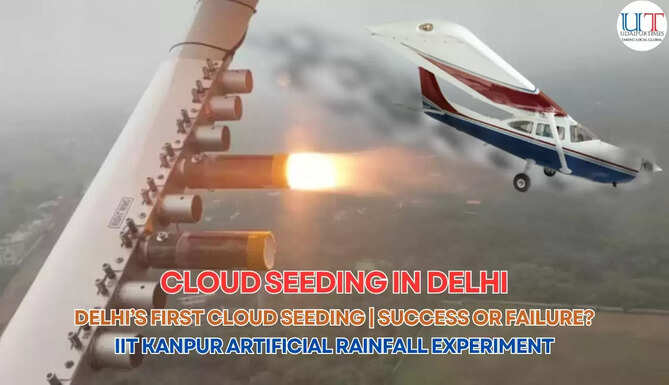
Udaipur, Oct 28, 2025: In an effort to combat pollution, the Delhi government initiated its first cloud seeding procedure in order to impress artificial rainfall. This operation as per details provided by Environment Minister Manjinder Singh Sirsa, was conducted by the team from IIT Kanpur using Cessna aircraft. The aircraft was fitted with salt-based silver iodide flares to induce rain.
Poor visibility led to a slight delay in the operation, which began from the Meerut end of Delhi. This operation follows the trial conducted on October 23 and todays experiment is likely to induce rain. Mayur Vihar, Khekra, North Karol Baug and Burari were covered in this operation. As per a statement given by Sirsa to the media, 8 flares weighing 2-2.5 kg each released content into the clouds, which had 5-20% humidity. Each flare lasted for 2.5 minutes. More such procedures were carried out till evening today. The induction is expected to produce rainfall lasting between 15 minutes to 4 hours of the cloud seeding.
However, till the time of writing this report, no rainfall was witnessed in the said areas of the Capital. This experiment has been conducted after 53 years. The first such trial as per PTI was conducted in 1957 and the second attempt took place in the early 1970s as per climate scientist Roxy Matthew's statement to PTI. Today's experiment, costing Rs. 3.21Cr was approved by the Delhi cabinet in May 2025 and a MoU was signed between the Delhi government and IIT Kanpur to carry out this operation. No rain was experienced till the time of writing this report, and the stakeholders attributed it to the low atmospheric pressure of 20% as compared to the needed 50% required for successful cloud seeding.
An initiative by the AAP Government in 2024
It was in December 2024 at the time of the AAP government, that the Minister of Environment Forest and Wildlife of the Govt of the National Capital Territory of Delhi initiated the need for cloud seeding as an emergency measure to improve the air quality of Delhi during the winter months, as per a Press Release by the PIB. The letters were sent over a period of three months viz. October, November and December of 2024. In this regard, expert opinions were sought from India Meteorological Department (IMD), Commission for Air Quality Management in NCR and Adjoining areas (CAQM) and Central Pollution Control Board (CPCB) regarding feasibility of cloud seeding for artificial rainfall in the Delhi during winter.
Why it did not Rain
The IMD, in response to the instructions received to give expert opinions, said the following:
Winter clouds in the region are primarily formed due to Western Disturbances (WD), which are short-lived and travel from West to East. When low clouds form due to WDs, they typically result in natural rainfall over Northwest India, eliminating the need for cloud seeding. High- altitude clouds, which are typically at elevations above 5-6 km, cannot be seeded due to aircraft limitations. Furthermore, effective cloud seeding requires specific cloud conditions, which are generally absent during Delhi’s cold and dry winter months. Even if suitable clouds were present, the dry atmospheric layer beneath them could cause any developed precipitation to evaporate before reaching the surface. Additionally, concerns about the uncertainties, efficacy, and, potential adverse effects of cloud seeding chemicals remain. - IMD
This opinion was shared by IMD with the Delhi government then. The report also adds...
"Air pollution in Delhi and NCR is a collective result of multiple factors including high level of anthropogenic activities in the high-density populated areas in NCR, arising from various sectors viz. Vehicular Pollution, Industrial Pollution, Dust from Construction and Demolition activities, Road and Open Areas Dust, Biomass Burning, Municipal Solid Waste burning, Fires in Landfills and air pollution from dispersed sources, etc. During post-monsoon and winter months, lower temperature, lower mixing heights, inversion conditions and stagnant winds lead to trapping of the pollutants resulting in high pollution in the region. This is further aggravated due to the emissions from episodic events like stubble burning, firecrackers etc."
What Measures to Combat Pollution Did AAP implement in the Past
- Air Quality Monitoring and Network
- Air Quality Monitoring and Network (GRAP)
- Measures for control of emissions from Stubble Burning in Delhi-NCR
- Measures for control of vehicular emissions
- Measures for control of industrial emission
- Construction & Demolition (C&D) Waste
- Close Monitoring & Ground level implementation in Delhi-NCR
- National Clean Air Programme
