

Dharmendra Pradhan's Resignation: Was BJP's Move Driven by Uttar Pradesh Poll Calculations?
Dharmendra Pradhan's resignation as Union Education Minister has sparked political debate over whether the BJP acted to contain mounting student protests and protect its prospects ahead of the crucial Uttar Pradesh Assembly elections.

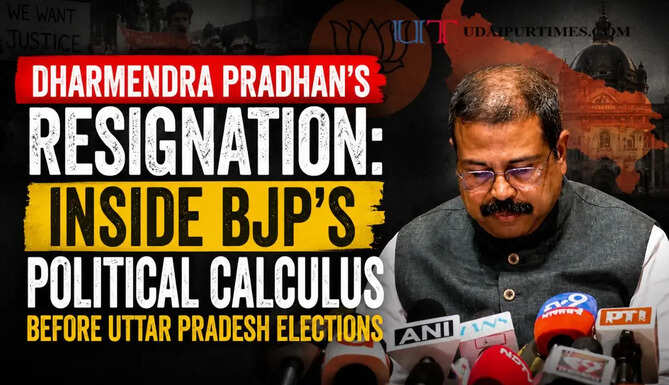
July 26, 2026: Union Education Minister Dharmendra Pradhan resigned on Saturday following sustained pressure from a nationwide student movement. Students celebrated his resignation at Jantar Mantar in New Delhi, while the Bharatiya Janata Party (BJP) strongly defended his record as Education Minister and praised his contribution to the country's education system.
Soon after the resignation, Parliamentary Affairs Minister Kiren Rijiju expressed his support for Pradhan on social media. He wrote, "Dharmendra Pradhan has been working for the improvement of the country's education system for decades. He has dedicated his life to public service and the overall welfare of students."
Rijiju said Pradhan's commitment to strengthening India's education system was reflected in every decision he took as Education Minister. He added that leading such an important ministry required determination and that Pradhan had discharged his responsibilities with dedication.
"Thank you, Dharmendra Pradhan, for your steadfast service, commitment to education reforms, and contribution to building a strong India. I hope you will continue to serve the nation with the same dedication and integrity," Rijiju wrote.
BJP President Nitin Naveen also praised Pradhan's tenure, saying he played a key role in implementing the National Education Policy (NEP) 2020 and introducing several education reforms.
Naveen described the resignation as a decision taken in the larger national interest and said it reflected Pradhan's integrity and selfless service. He also reiterated that the BJP stood firmly behind the former Education Minister.
Pradhan submitted his resignation to Prime Minister Narendra Modi on Saturday morning after facing intense criticism over the controversy surrounding the student protests.
In a statement on social media, Pradhan wrote, "The future of the country's students and a developed, corruption-free education system are my highest priorities. I have never avoided my responsibilities. I accepted responsibility for the question paper leak from the very first day."
He further claimed that certain "anti-national elements" were trying to exploit the student movement for political purposes.
"My resignation is to ensure that such elements cannot take advantage of the situation in any way. This resignation is for the nation," he wrote.
— Dharmendra Pradhan (@dpradhanbjp) July 25, 2026
Political Impact and Uttar Pradesh Calculations
Pradhan's resignation has triggered widespread political debate, with many observers suggesting that the BJP's decision was influenced as much by electoral considerations as by public accountability.
For several days, the BJP leadership publicly defended Pradhan despite growing criticism from the Opposition. However, as the student agitation expanded beyond university campuses and gained wider political attention, the party reportedly reassessed the potential electoral impact, particularly ahead of the crucial Uttar Pradesh Assembly elections.
According to political observers, the BJP became increasingly concerned that the protests could alienate young and first-time voters, a demographic that has been central to the party's electoral success over the past decade.
The Samajwadi Party (SP) successfully positioned itself as the political voice of the protesting students. Party chief Akhilesh Yadav and Mainpuri MP Dimple Yadav actively supported the demonstrations from the beginning.
While Akhilesh Yadav criticised the Centre both inside and outside Parliament, Dimple Yadav emerged as one of the most visible Opposition leaders on the ground.
Following the violence during the students' march to Parliament on July 20, Dimple Yadav visited Jantar Mantar, met injured protesters, comforted students, and helped coordinate medical assistance. Videos showing her assisting injured demonstrators and interacting with protesters quickly went viral on social media.
Speaking at the protest site, Dimple Yadav said, "The government's attitude towards the sentiments of the country's youth is concerning. The Samajwadi Party stands firmly with the students. This is not NEET, it is CHEAT."
Her repeated visits marked a noticeable shift from her traditionally low-profile political role and helped the Samajwadi Party strengthen its connection with young voters.
Akhilesh Yadav reinforced the party's campaign by arguing that the protests reflected growing frustration among India's youth over examination irregularities and unemployment. Both leaders demanded Pradhan's resignation while accusing the government of using excessive force against students, including women protesters.
The BJP is believed to have viewed this emerging narrative as a potential political challenge in Uttar Pradesh, where nearly one-third of the electorate is below the age of 35.
Ironically, Pradhan has been regarded as one of the BJP's most successful election strategists.
He is widely credited with managing the BJP's successful campaign in the 2022 Uttar Pradesh Assembly elections, where the party retained power by winning 255 of the state's 403 seats. He later played a key organisational role in the BJP's victories in Haryana in 2024 and Bihar in 2025.
The Haryana election was particularly challenging because of anti-incumbency, farmers' protests, dissatisfaction among Jat voters, and concerns over the Agniveer recruitment scheme. Despite these challenges, Pradhan's organisational skills and booth-level management helped the BJP secure victory.
Over the years, Pradhan has also handled key election responsibilities in Karnataka, Uttarakhand, Uttar Pradesh, Odisha, and West Bengal. During the 2021 West Bengal Assembly election, he was entrusted with overseeing the politically significant Nandigram constituency, reflecting the central leadership's confidence in him.
Within the BJP, Pradhan has long been known as a disciplined organisational leader rather than a high-profile public figure. His resignation has therefore attracted significant political attention.
The timing of his exit has raised an important political question: was Pradhan asked to step down because of administrative accountability, or because the BJP believed his resignation would help contain political damage ahead of the Uttar Pradesh Assembly elections?
With the Opposition determined to keep issues such as youth unemployment and examination controversies at the centre of its campaign, the BJP appears to have chosen political damage control over standing by one of its most experienced election managers. Whether that strategy succeeds will become clear when Uttar Pradesh goes to the polls.
