

First-Ever National Household Travel Survey; Check Findings
NSO survey covered 14,274 villages and 10,377 urban blocks; information was collected from 4,92,023 households, covering 20,34,371 persons

UdaipurTimes, Oct 6, 2026 - The National Statistics Office (NSO), under the Ministry of Statistics and Programme Implementation (MoSPI), has released the key indicators and findings from the first-ever National Household Travel Survey (NHTS), conducted during July 2025 to June, 2026, through a Factsheet.
Note: For the purpose of the survey, a trip is defined as travel covering a distance of more than 1 km.
Objectives of Survey
The primary objective of the survey was to generate robust, data-driven insights into domestic travel patterns and dynamics to support regional transport planning, infrastructure development and evidence-based policy formulation. The survey captures key aspects of domestic travel, including:
- Purpose of travel: Employment, education, social engagements, cultural and leisure activities, tourism, domestic work, caregiving and other purposes.
- Mode of transport: Modes of transportation used by different demographic groups for undertaking trips.
- Travel duration and distance: Average time taken and distances travelled during trips.
In addition to meeting the specific data requirements of the Ministry of Railways, the survey is expected to provide valuable insights into how, when and why people travel. The information collected on travel patterns and public transport usage will help identify gaps in existing transport systems, assess accessibility, optimise transport routes and improve service frequency and scheduling.
The findings will also provide an important evidence base for regional transportation planning, infrastructure investment and the formulation of informed transport policies.
NSO conducted the first-ever all-India survey on household travel, covering 14,274 villages and 10,377 urban blocks. The survey collected information from 4,92,023 households, covering 20,34,371 persons.
Key Findings
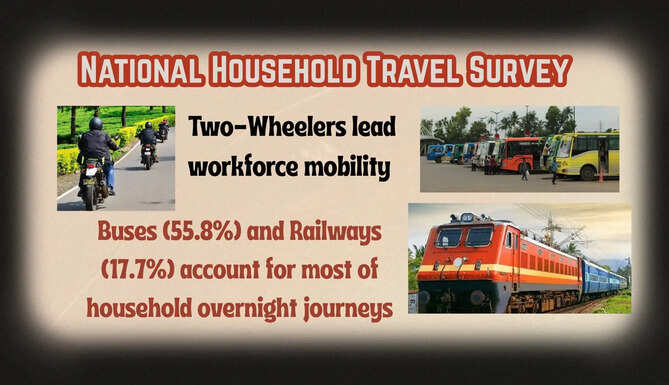
Workforce Mobility: Two-wheelers are the predominant mode of transport for commuting to fixed workplaces, accounting for 42.6% of workers. States such as Rajasthan, Gujarat and Madhya Pradesh show average travel times of around 20–23 minutes, with higher travel times in parts of southern India.
Overnight & Non-Work Travel: 73.5% of overnight trips rely on bus and rail. Buses (55.8%) and inter-city railways (17.7%) are the primary modes for household overnight travel, followed by cars (15.1%) and two-wheelers (8.8%). Overnight trips undertaken by households are primarily for social and religious purposes, with buses being the predominant mode of transport.
Commute Time: Around 87.6% of students reach their educational institutions within 30 minutes, while 83.4% of workers commute to their fixed workplaces in less than 30 minutes.
Commute Expenditure: The average monthly expenditure on commuting to a fixed workplace is Rs 785 per worker. Urban workers incur a substantially higher average monthly cost of Rs 1,044, compared with Rs 612 for rural workers. Male workers spend an average of Rs 835 per month on fixed-workplace commutes compared to Rs 533 per month for female workers. Urban students spend an average of Rs 617 per month on trips to and from educational institutions, compared to Rs 361 per month in rural India.
