

Freedom to Walk Must be Accorded Greater Importance Than the Movement of Motor Vehicles, SC
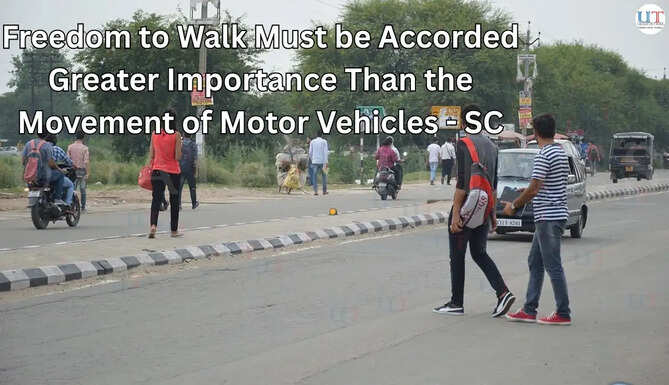
Udaipur, June 20, 2026 | Legal Story: In a significant ruling on June 19, 2026, the Supreme Court held that the freedom to walk on safe and well-maintained footpaths is a fundamental right under Article 19(1)(d) of the Constitution—a right that must be accorded greater importance than the movement of motor vehicles. This judgment followed a tragic incident in which a five-year-old child was struck and killed by a tanker while walking to school with his father. The Court emphasized the necessity of safe spaces for pedestrians, noting that while reasonable restrictions on the right to walk may exist, such spaces should not be monopolized by vehicular traffic. While recognizing the right to walk as essential, the bench stressed that this fundamental right must be protected and respected for all citizens.
Takes Precedence Over Vehicular Movement
The Bench underscored the fundamental right to walk and strongly urged the public to recognize that this right takes precedence over vehicular movement. They emphasized the need for safe, clearly defined footpaths and advocate for prioritizing pedestrians over vehicles. The Bench also criticized the outdated practices of municipal bodies that favored motorized transport while often disregarding pedestrians or treating them as mere obstructions. Interestingly, they pointed out that the Motor Vehicles Act of 1988 created a significant social issue by undermining this right rather than protecting it. The Bench described how properly constructed pedestrian pathways could improve both urban and rural areas; and that it should be the duty of municipal bodies, ensuring that all citizens have equal access to them.
Deep-rooted Values
The Bench highlighted the deep-rooted cultural, social, religious, political, and reformist values associated with walking in India, citing examples such as Nagar Sankirtan, Pandharpur Wari, Kanwar Yatra, the Dandi March, and the Bhoodan movement. Recognizing walking as a vital expression of rights, the Bench emphasized the need to enforce the fundamental right to walk on designated footpaths and places and the responsibility for maintaining these pathways on local authorities. It asserted that the existence of roads implies the necessity of safe footpaths that prioritize the rights of pedestrians over motor vehicles; thus, it called for a shift in perspective to view walking as a dignified and essential activity.
Responsibility of Municipal Bodies
The Bench held urban authorities and local governments responsible for ensuring the construction and maintenance of these footpaths. If this right is violated, citizens can—in addition to the remedies available under the Motor Vehicles Act—also seek constitutional remedies for restitution and compensation.
How the Bench Calculated Compensation in the Ruling
The Supreme Court bench, in its ruling, also recalculated the compensation to be awarded to the father of the five year old who was cruched to death. It said that the HC committed an error in reducing the compensation granted by the MACT. The Bench invoked earlier rulings on similar grounds and recalculated the compensation.
Step 1: The daily wage as per the Minimum Wages Act 1948 was calculated to be Rs 233/- which comes to Rs 6,690/- per month as of 2014.
Step 2: The deceased's annual income amounted to Rs. 80,280/-.
Step 3: 40% of the amount was added as future prospects, and the annual income was re-calculated to Rs. 1,12,392/- ((80,280 + 32,112).
Step 4: Deduct 50% towards personal and living expenses - the annual loss of dependency was determined to be Rs. 56,196.
Step 5: A multiplier of 18 took the total loss to be computed as Rs. 10,11,528/-.
Step 6: To this amount, loss of consortium of Rs. 96,800/-, loss of estate Rs. 18,150/- and funeral expenses Rs 18,150/- was added to take the total compensation to Rs. 11,44,628/- which was court directed was to be paid within 2 months of the order.
