

SC Acquits Rape and Murder Accused; Issues Directives for Handling DNA Evidence
SC has issued a slew of binding nationwide guidelines to ensure proper collection, preservation and processing of DNA and other biological materials in criminal investigations with the requisite procedural safeguards.

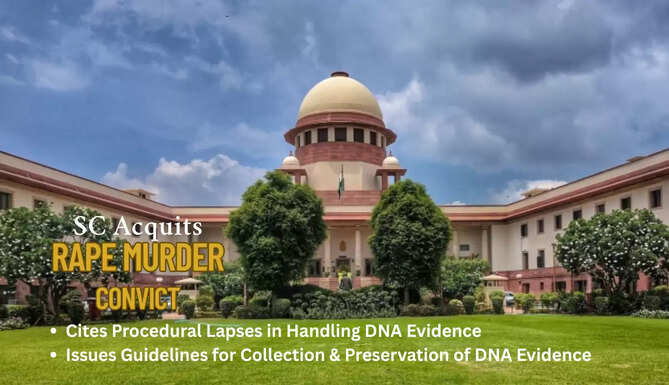
Udaipur, July 17, 2205: The Supreme Court, in its recent judgment on July 15, 2025, in the case of Kattavellai @ Devakar vs State of Tamil Nadu, has acquitted a man sentenced to death for the murders of a couple and the rape of the woman in 2018. The Court identified significant procedural errors in the handling of DNA evidence and has issued nationwide guidelines for the proper collection, preservation, and processing of DNA in criminal cases. The judgment also directed dissemination of the ruling to all High Courts and state police chiefs to ensure compliance. Justice Sanjay Karol, along with Justices Vikram Nath and Sandeep Mehta, emphasized the need for a thorough examination of evidence, highlighting that a criminal trial must focus on factual realities rather than conjecture.
The Background
The case revolves around a tragic incident from May 14, 2011, when two young individuals, Ezhil Muthalvan and a young woman, went missing after leaving their homes under false pretenses. They were found at a popular location, Suruli Falls, where they were confronted by the appellant-convict. Allegedly demanding money and jewelry, the convict killed both victims when they refused. The investigation began after the young woman's father reported her missing. Following various proceedings, the prosecution presented extensive evidence, including testimonies from 56 witnesses. The appellant maintained innocence but did not offer additional evidence.
The Ruling
The ruling by the Bench emphasized the insufficiency of the prosecution's evidence against the appellant-convict, leading to the vacating of his conviction. The court highlighted that the circumstantial evidence did not support the singular hypothesis of the accused's guilt. Additionally, the ruling drew attention to comments made regarding the potential violation of Article 21 of the Constitution due to prolonged detention of undertrials. Specifically, the Bench noted that lengthy pre-trial incarceration without a clean acquittal could infringe upon an individual’s right to a speedy trial, emphasizing the need for timely judicial processes. The appellant, having been in custody for over 15 months under the Prevention of Money Laundering Act, is ordered to be released unless needed for other cases.
Kattavellai @ Devakar has achieved a clean acquittal, raising questions about the reliability of previous convictions, particularly in cases of wrongful prosecution, a concept explored in the Law Commission of India’s 277th report. This report limits the definition of wrongful prosecution to malicious intent and lack of good faith, failing to address situations like this, where the accused was unjustly held for years despite insufficient evidence. Contrasting this with foreign jurisdictions, such as the United States, where long-term wrongful incarcerations have resulted in compensation for the innocent, it highlights the need for legislative consideration regarding compensation claims. The judgment's implications require the Registry to disseminate this decision to all High Courts and State Police Directors, with a recommendation for training Investigating Officers to adhere to compliance standards. Pending applications are to be disposed of as stated.
Handling DNA Evidence
The recent judgment highlights crucial guidelines for handling DNA evidence in legal cases. Key directives include the proper collection of DNA samples, with thorough documentation including FIR details and signatures of relevant personnel. Investigating Officers must ensure swift transportation of samples to forensic labs within a 48-hour timeframe, with any delays properly recorded. During storage, evidence must remain unaltered unless authorized by a Trial Court. A detailed Chain of Custody Register is mandated to track the evidence throughout the judicial process, holding the Investigating Officer accountable for any lapses in its maintenance. Authorities are tasked with creating and distributing necessary documentation to uphold these standards. Details of the procedure is as follows:
SC Guidelines on Handling DNA Evidence
1. The collection of DNA samples once made after due care and compliance of all necessary procedure including swift and appropriate packaging including:
- FIR number and date;
- Section and the statute involved therein;
- details of I.O., Police station; and
- requisite serial number shall be duly documented. The document recording the collection shall have the signatures and designations of the medical professional present, the investigating officer and independent witnesses. Here only we may clarify that the absence of independent witnesses shall not be taken to be compromising to the collection of such evidence, but the efforts made to join such witnesses and the eventual inability to do so shall be duly put down in record.
2. The Investigating Officer shall be responsible for the transportation of the DNA evidence to the concerned police station or the hospital concerned, as the case may be. He shall also be responsible for ensuring that the samples so taken reach the concerned forensic science laboratory with dispatch and in any case not later than 48-hours from the time of collection. Should any extraneous circumstance present itself and the 48-hours timeline cannot be complied with, the reason for the delay shall be duly recorded in the case diary. Throughout, the requisite efforts be made to preserve the samples as per the requirement corresponding to the nature of the sample taken.
3. In the time that the DNA samples are stored pending trial appeal etc., no package shall be opened, altered or resealed without express authorisation of the Trial Court acting upon a statement of a duly qualified and experienced medical professional to the effect that the same shall not have a negative impact on the sanctity of the evidence and with the Court being assured that such a step is necessary for proper and just outcome of the Investigation/Trial.
4. Right from the point of collection to the logical end, i.e., conviction or acquittal of the accused, a Chain of Custody Register shall be maintained wherein each and every movement of the evidence shall be recorded with counter sign at each end thereof stating also the reason therefor. This Chain of Custody Register shall necessarily be appended as part of the Trial Court record. Failure to maintain the same shall render the I.O. responsible for explaining such lapse. The Directors General of Police of all the States shall prepare sample forms of the Chain of Custody Register and all other documentation directed above and ensure its dispatch to all districts with necessary instruction as may be required.
