

NEET Paper Leak: Centre Plans Up to 10-Year Jail, ₹1 Crore Fine Under Tough New Law
The Centre is likely to strengthen anti-paper leak laws with tougher jail terms and heavy fines. The proposal is expected to be discussed in the Cabinet as PM Modi assures strict action against those responsible.

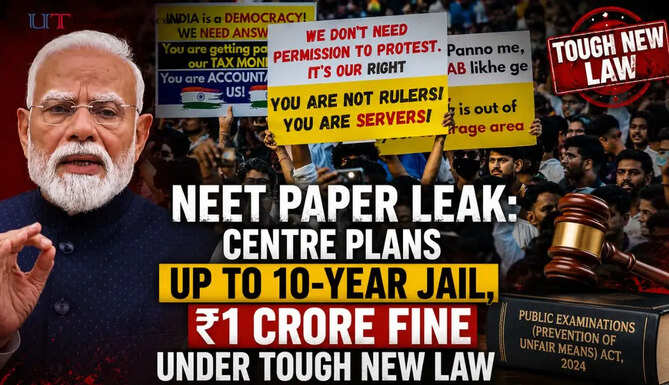
July 24, 2026: Prime Minister Narendra Modi has reaffirmed that the Centre will take strict action against those responsible for question paper leaks, saying that playing with the future of students will not be tolerated. In a video message shared on his official X account on Thursday night, the Prime Minister said the issue was not an ordinary one and had deeply affected lakhs of students and their families across the country.
Modi said the government fully understood the anxiety and frustration faced by students who prepare for competitive examinations with years of hard work. He stressed that protecting the interests of students remains the government's top priority. According to him, several legal and administrative steps have already been taken in the last two and a half months following the paper leak controversy. The accused have been identified, arrested, and sent to jail, while efforts are underway to ensure that students do not lose an academic year because of the incident.
The Prime Minister also announced that the Centre is preparing stronger legal measures to prevent such incidents in the future. According to government sources, the Union Cabinet is likely to discuss and approve amendments to the Public Examinations (Prevention of Unfair Means) Act, 2024 during its meeting on Friday. If approved, the proposed amendments will later be introduced in Parliament.
Proposed Amendments Include Jail Terms, Heavy Fines and Tough Action Against Institutions
According to sources, the proposed amendments will significantly strengthen the punishment for those involved in question paper leaks. Individuals found guilty could face a minimum prison sentence of three years, which may extend to five years depending on the seriousness of the offence. They could also be fined up to ₹10 lakh, making the law one of the strictest measures introduced against examination malpractice in the country.
The Centre is also planning to hold institutions conducting examinations directly accountable. If an examination authority or institution is found guilty of negligence or involvement in a paper leak, its officials could face imprisonment ranging from five to ten years. In addition, such institutions may also be fined up to ₹1 crore under the proposed amendments.
The government believes these stricter provisions will act as a strong deterrent against organised paper leak rackets and restore confidence in the country's examination system. Earlier, following the Prime Minister's announcement, a fast-track court was also set up to ensure speedy investigation and trial of cases related to question paper leaks.
CJP Delegation to Meet Union Ministers as Protest Continues
Meanwhile, discussions between the Centre and representatives of the Cockroach Janata Party (CJP) are expected to take place after noon on Friday. The meeting comes after weeks of nationwide protests demanding accountability, stronger laws, and reforms in the examination system following the alleged paper leak.
According to sources, senior leaders from the Central government will represent the Centre during the meeting. The protesters had requested that the talks be held at a neutral venue instead of BJP president J.P. Nadda's residence or office. Accepting the demand, the government has scheduled the meeting at the Constitution Club in New Delhi.
Sources said J.P. Nadda is likely to attend the discussions along with Union Minister Jitendra Singh and other senior leaders. The meeting is expected to focus on the protesters' demands, including stricter punishment for those involved in paper leaks, greater transparency in recruitment and entrance examinations, and long-term reforms to the examination system.
While the Cabinet is expected to consider the proposed amendments on Friday, it remains unclear when the legislation will be formally introduced and debated in Parliament. The outcome of both the Cabinet meeting and the Centre's discussions with the CJP delegation is likely to play a crucial role in shaping the government's response to one of the biggest examination controversies in recent years.
