

Legal: Rajasthan HC Quotes National Security While Dismissing Petition Challenging Demolition of Religious Sites

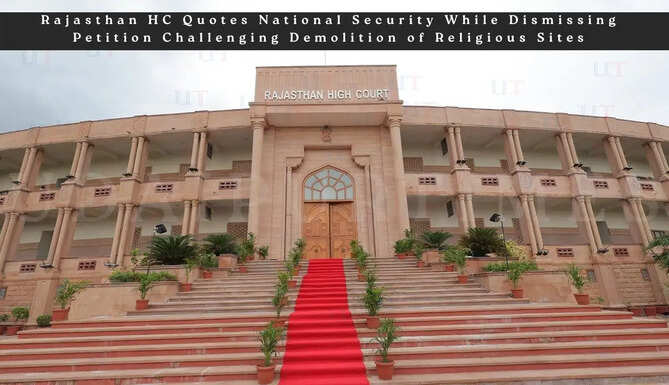
Udaipur, July 14, 2026 | Legal News Rajasthan: A single Judge bench of the Rajasthan High Court, in its order dated July 13, 2026 in SB Civil Petition 13243/2026 has dimissed the petition challenging the proposed demolition of mosques and dargahs situated within 50 kilometers of the India-Pakistan border.
The judgement, authored by Justice Sameer Jain, validates the Union Government’s decision to enhance and rationalize the territorial jurisdiction and operational powers of the Border Security Force (BSF), stating that it manifests a proactive and well-calibrated approach to address emerging security challenges. It was unequivocally held by the Bench that the “attempt to attribute communal color” to the proposed evictions or demolitions was wholly misplaced and devoid of factual foundation. Further, it was underscored explicitly by the Bench that since the properties are situated near the international border, there was a need for heightened vigilance and regulatory oversight. The judgement has been made applicable on mutatis mutandis basis on all connected petitions.
Bench Observation
The case involved show-cause notices issued under the Rajasthan Land Revenue Act and the Rajasthan Colonization Act. The bench observed that the petitioners, who manage places like Madrasas and Mosques, have constructed buildings on government land without the necessary permissions, particularly within 0-50km of the the Indo-Pak border, where such activities are restricted. The government (respondents) claims these structures might pose a risk to national security based on various records and intelligence reports, leading to the notices demanding the removal and recovery of the properties in question.
The court observed that the petitions filed under Article 226 of the Constitution had significant flaws, particularly regarding the identity and standing of the petitioners and a lack of credible evidence linking them to the relevant religious sites. The bench emphasized that previous cases cited were different in context and do not apply to this situation, which involves national security and properties near a border. They noted that proper procedures were followed and no harm was done to the petitioners, who chose not to engage in the process. As a result, the petitions were deemed not maintainable and dismissed.
The Court, as per the judgements cited at the Bar, recorded its opinion, noteworthy record and adjudicatory determinations, ad-seriatm:
"The line between safety and vulnerability is often a thin, trembling cord. When our borders become heavy with the breath of unease, the law cannot merely be a cold document, it must become the beating heart of our protection.
Sovereignty is not an abstraction; it is the collective, aching desire to keep our home whole, defended not by silence, but by a vigilant, sleepless love for the soil we walk upon.
We must understand that even stones placed in the name of faith cannot hold sacred ground. Our land is a living testament to a shared promise, a Republic’s covenant that demands, prioritizing the safety of the many over the quiet demands of the few.
True security is not a cage for the spirit; it is the soft, sturdy wall that allows freedom to sleep soundly at night. It is the embrace that keeps our liberty from being torn away by the winds of chaos. When the voice of our nation calls out, urgent, and true we must answer with a unified strength, understanding that the deepest devotion we can offer to our state, is commitment, and the sense of security, that our land shall always remain sans any bloodshed.”
Additional Directions Given by the Bench
In addition to the judgement, the Bench gave some directions in this matter to the concerned authorities. These include:
- A Committee comprising the District Collector, Superintendent of Police, and representative of the Border Security Force (BSF) of the area concerned, shall be constituted to examine cases (on individual basis) involving sensitive properties;
- The Committee comprising, inter alia, an officer of the Border Security Force should ensure that any decision taken is informed by relevant intelligence, ground realities, and security considerations;
- The Committee, in discharge of its mandate and having regard to the exigencies of the situation, may order eviction, dispossession, demolition, or adopt any other appropriate course of action, as deemed necessary, considering the material available, and as per the warrants of the situation and circumstances.
