

Rajasthan to Apply AI in Agriculture for Smarter Farming
Wadhwani AI trains State agricultural officials on the use, potential and practical applications of AI in agriculture

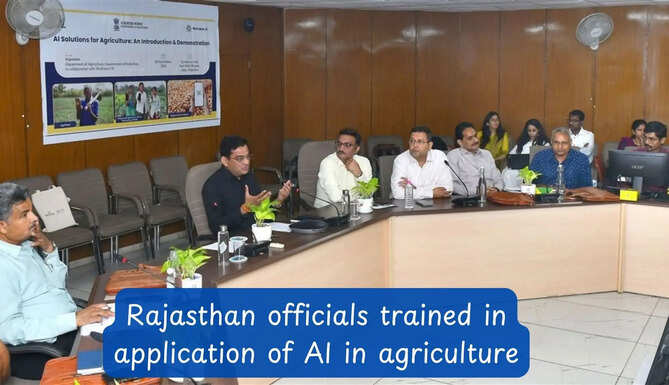
UdaipurTimes, Sept 26, 2026 - Rajasthan’s Department of Agriculture is undertaking a major initiative to connect the agricultural sector with modern technology, innovation and data-driven decision-making systems. The department aims to make AI an integral part of the agricultural system and farmer service delivery rather than limiting it merely to technological experiments.
As part of this initiative, a one-day workshop was organised on Friday, September 25, at Pant Krishi Bhawan in Jaipur, where experts from the Wadhwani Institute for Artificial Intelligence (Wadhwani AI) trained agricultural officials on the use, potential and practical applications of Artificial Intelligence (AI) in agriculture.
Agriculture Commissioner Naresh Kumar Goyal said AI-based technologies could prove extremely useful across the entire agricultural value chain, from sowing to harvesting and marketing of produce. AI can play an important role in providing weather-based agricultural advisories, assessing crop conditions, identifying pests and diseases, forecasting production, improving irrigation and resource management and providing market-related information.
Efforts are underway to use AI and Data Analytics to analyse the vast amount of available agricultural, weather and crop-related data and develop possibilities for providing farmers with more accurate, localised and timely advice.
Based on weather forecasts and the actual condition of crops in the field, farmers can be assisted in making timely decisions regarding sowing, irrigation, fertiliser management, pest control and harvesting. This can help control production costs, reduce risks and improve crop productivity.
AI can also play an important role in the implementation of the Pradhan Mantri Fasal Bima Yojana (PMFBY). The use of remote sensing, image analytics, drones and other modern technologies for assessing crop conditions and losses caused by natural disasters can make crop damage assessment more scientific, transparent and timely.
Efforts are being made to promote solutions based on Artificial Intelligence, Machine Learning and Data Analytics. Key areas with significant potential include:
- Crop- and weather-based advisories
- Early detection of pests and diseases
- Forecasting crop production and yields
- Efficient use of irrigation and agricultural resources
- Rapid assessment of crop damage
- Better monitoring of agricultural schemes
- Market and price-related information
- Timely resolution of farmer grievances and delivery of services
