

RBI Pauses at 5.25% Amid Coordinated Policy Push to Attract Foreign Capital
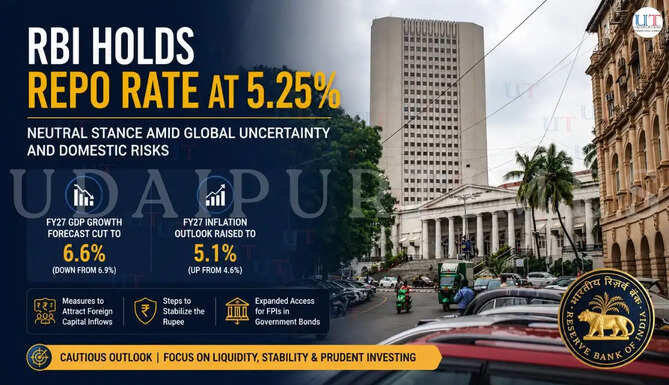
Udaipur, June 5, 2026 | RBI Policy Update: The Reserve Bank of India’s Monetary Policy Committee unanimously voted to maintain the benchmark repo rate at 5.25% under a ‘Neutral’ stance, adopting a data-dependent, "wait-and-watch" approach to counter severe global headwinds and domestic risks. Reflecting these challenges, the RBI downgraded its FY27 Real GDP growth projection to 6.6% (down from 6.9%) and raised its FY27 inflation outlook to 5.1% (up from 4.6%). Simultaneously, a highly coordinated fiscal and monetary strategy was deployed to attract foreign capital inflows, stabilize the rupee, and bridge the Balance of Payments deficit.
Monetary Policy Outcome and Capital Flow Interventions
The RBI expanded the Fully Accessible Route to include all new 15, 30, and 40 year government securities, entirely removed investment and concentration limits for FPIs under the General Route, increased equity caps for NRIs/OCIs, and introduced tactical liquidity facilities like a four-month concessional forex swap window and an FCNR(B) hedging mechanism. Complementing these central bank actions, the Central Government eliminated all short-term and long-term capital gains taxes, alongside the withholding tax on interest income, for Foreign Institutional Investors to maximize the competitive appeal of Indian sovereign bonds.
Macroeconomic Risk Assessment and Fixed-Income Strategy
The Reserve Bank of India has explicitly acknowledged that these prolonged global geopolitical tensions, with no meaningful resolution in sight, have significantly heightened risks to both inflation and economic growth. Domestically, the trajectory of future interest rate actions will be heavily dictated by a sub-normal monsoon forecast and emerging El Niisks, their subsequent impact on agricultural output, and any signs of generalized inflationary pressures. To counter this, the RBI has proactively managed and ensured appropriate liquidity in the banking system to meet the productive requirements of the economy and facilitate smooth monetary policy transmission.
Given these compounding headwinds, the fixed-income risk-reward matrix has decisively shifted away from aggressive duration positions. Until global crude prices and the Indian Rupee exhibit clear stabilization, investors should limit duration additions to slow, tactical phases. Until then, compressing portfolio duration, deploying high-yield accrual strategies, and maintaining a short-term maturity focus remain the most prudent paths to achieving optimal risk-adjusted returns. Furthermore, structural inflows into the domestic bond market will depend heavily on index inclusion flows, the movement of global yields, and the behavior of international yield spreads relative to domestic debt.
Disclaimers: Views expressed herein cannot be construed to be a decision to invest. The statements contained herein are based on current views and involve known and unknown risks and uncertainties. Any reliance on the accuracy or use of such information shall be done only after consultation to the financial consultant to understand the specific legal, tax or financial implications. This Post is not written or produced by UdaipurTimes writers/journalists. UdaipurTimes follows ASCI guidelines for Online Advertising. The information may involve financial or health risk and UdaipurTimes does not endorse or promote any claims made in this post.
