

Supreme Court Keeps 'Aravalli Definition' Judgement in Abeyance
The Supreme Court has issued a notice saying that the hearing will be held again on Januay 21, 2026; CJI forms new Committee to study the Aravalli Hills

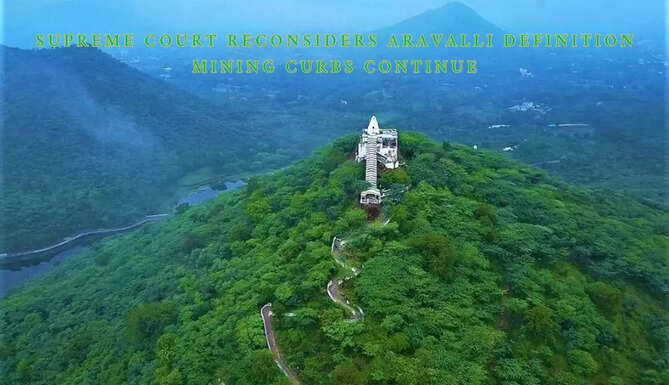
Udaipur, Dec 29, 2025: The Supreme Court has put its November 2025 judgement on the definition of Aravalli Hills in abeyance. The matter will be heard afresh on January 21, 2025. The Chief Justice of India said that a new committee will be constituted to do another survey and conduct a scientific review of the definition, boundaries, and ecological impact of the Aravallis. The matter is scheduled to be heard again on January 21, 2026 after the Bench revisits the definition based on the new surveys and study.
Most importantly, the court will re-examine whether the restriction on the Aravallis to be defined as landforms more than 100 metre in height will lead to unregulated mining.
The Apex Court stayed the implementaion of its earlier directions and the expert reports on the definition of the Aravallis. It cited concerns that the revised definition may facilitate unregulated mining in the ecologically sensitive areas.
Earlier on November 20, 2025, after passing its order on the uniform definition of Aravallis, the Supreme Court had placed a ban on the grant of new mining leases inside the relevant areas, including Rajasthan, Gujarat, Delhi and Haryana till the experts report was submitted. The court has also clarified that no action will be taken on new mining leases or the renewal of old leases without the permission of the Supreme Court.
Environmentalists Appreciate SC Order
Meanwhile, in Bhilwara, environmentalist Babulal Jaju welcomed the decision and termed it a necessary and necessary and positive step towards the conservation of the Aravallis. He said that the court has acknowledged that there are ambiguities in the new definition of the Aravallis, and this could have caused serious damage to a fragmented and extremely sensitive ecological region.
Jaju said that under pressure from public outrage across the country regarding the destruction of the Aravallis and illegal mining, the central government had only made a formal announcement of a ban on mining. The ground reality is that neither illegal mining has stopped nor have the Aravalli hills been protected.
Jaju questioned why permission should be given to cut down the Aravalli hills, whether they are 9 meters or 99 meters high. This is tantamount to giving a free hand to the destruction of nature. He warned that the continuous destruction of the Aravallis is leading to a decline in groundwater levels, loss of biodiversity, and disruption of the climate balance, which could increase the risk of disasters like earthquakes in the future.
He called the central government's claim that only 0.19 percent of the area would be affected by the new definition misleading. According to Jaju, even 0.19 percent of the Aravallis, which spans 1.44 lakh square kilometers, is approximately 274 square kilometers, or more than 27,000 hectares. He demanded that the old definition of the Aravallis be retained and a complete ban on mining be imposed.
