

What Are The Provisions of The Waqf Act That Have Been Stayed by the Supreme Court
The petitioners in this case include Asaduddin Owaisi, AAP MLA Amanatullah Khan, JUH President Arshad Madani, Communist Party of India, DMK, TMC MP Mahua Moitra, among others

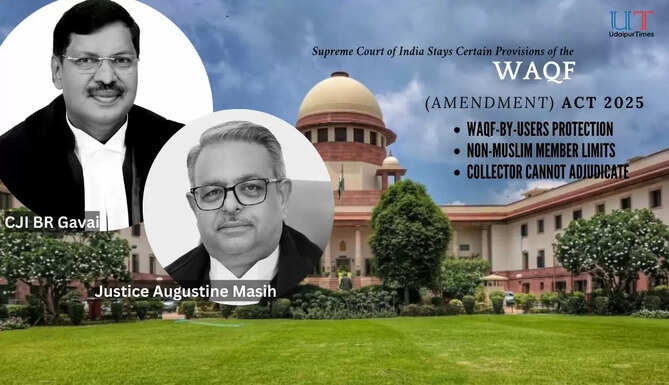
Sept 15, 2025: The Supreme Court of Chief Justice BR Gavai and Justice Augustine G Masih, today (September 14) passed an interim order staying certain provisions of the Waqf (Amendment) Act 2025. This stay will be in place till a final decision is taken on the various petitions challenging the validity of the amendments. The provisions of the Amendment that have been thus stayed are as follows:
1. Practising Islam for 5 Years
The requirement of the Amendment, that a person should be a practitioner of Islam for at least 5 years to create a Waqf, has been stayed till valid rules are framed by the State governments, to provide a mechanism to determine this period. This provision, in the absence of such mechanism, can lead to arbitrariness, the Court concluded.
2. Allowing Collector to Decide the Dispute
The SC stayed the provisions of permitting the Government to derecognise a Waqf property, pending decision by the Govt officer on the dispute of encroachment. The Court said that it will be against the separation of powers if the Collector is allowed to decided the dispute on the said property, as the Collector cannot be permitted to adjudicate the rights of individuals. The title has to be decided by either the Tribunal or the Court and till the time this is done, the status of the disputed Waqf land will not be affected.
"Permitting the Collector to determine the rights of the properties is against the doctrine of separation of powers as the Executive can't be permitted to determine the rights of citizens" - CJI BR Gavai
Further, no third-party rights will be created on the disputed land till the matter is settled, the Court added.
The other salients points from the interim order are as follows:
- Non-Muslim Members
The Court directed that the number of non-Muslim members in the Central Waqf Council cannot be more than 4 and the State Waqf Boards cannot have more than 3 non-Muslim members. Further, the Court said that while there is no compulsion that the CEO of the State Waqf Board should be a Muslim, it said that as far as possible, a Muslim should be appointed to this position.
- The Court refused to stay the requirement of registration of Waqf properties, stating that this aspect was present in the original laws (1995 and 2013) as well.
- Though the Court has not stayed the decision to delete "waqf by user" from the statutory definition of 'Waqf', it has granted interim protection to "Waqf-by-Users", which means that a property has been long standing used publicly for religious or charitable purposes without formal legal documentation.
The petitioners in this case include Asaduddin Owaisi, AAP MLA Amanatullah Khan, JUH President Arshad Madani, Communist Party of India, DMK, TMC MP Mahua Moitra, among others. The common provisions that have been challenged in all the petitions apart from those mentioned above, include application of Limitation Act to Waqf Act, invalidating Waqf created over ASI protected monuments, restrictions on creating Waqf over scheduled areas, limiting women members to two, renaming of the Waqf Act 1995, providing appeal against Tribunal's order, diluting waqf-alal-aulad, etc. among others.
