

SC Bench Disapproves Earlier Judgment Denying Bail To Umar Khalid: Grants Bail in Similar Case
Udaipur, May 19, 2026: For nearly six long years, a man sat behind bars — not convicted, not sentenced, but still waiting.
And now, in a judgment that could echo across India’s legal system, the Supreme Court has sent out a powerful message: the law cannot become a prison before guilt is even proven.
In a landmark ruling, the apex court has strongly defended one of the most fundamental promises of the Constitution — personal liberty. At the heart of this case was a difficult question: Can someone accused under tough anti-terror laws like UAPA be kept in jail endlessly while the trial drags on? The Supreme Court’s answer is both clear and deeply human — No constitutional democracy can justify indefinite incarceration without trial.
The case involved a Jammu & Kashmir government employee who had been in custody since June 2020, accused of links to terror funding and narcotics networks. The allegations were serious. Investigators claimed he had connections with Pakistan-based operatives and involvement in drug trafficking. But here’s where the story takes a dramatic legal turn.
The Supreme Court looked beyond the allegations and asked a question many ordinary people silently wonder: “How long can someone be made to wait for justice?”
The judges found something deeply troubling. Despite spending almost six years in jail, the trial had barely moved forward. Shockingly, over 350 witnesses were still left to testify, making any conclusion in the near future almost impossible.
And that’s when the court made an observation that could become the soul of this judgment:
A law meant to fight terrorism cannot be allowed to crush constitutional liberty.
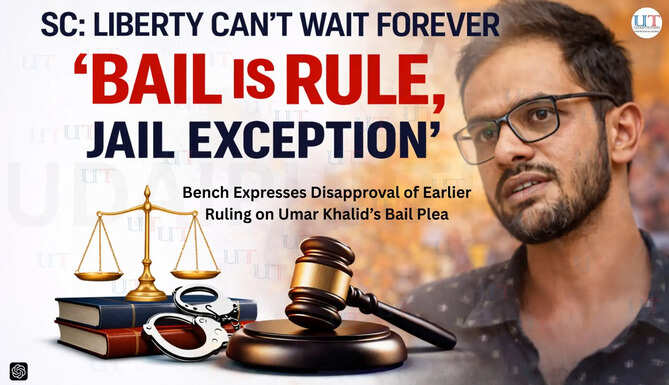
The bench firmly reminded courts across the country that “bail is the rule and jail is the exception” — not just a slogan from criminal law, but a constitutional promise flowing from Article 21, the right to life and personal liberty.
More importantly, the Supreme Court took serious objection to earlier judgments that had effectively made bail under UAPA nearly impossible. Without naming emotions, the court almost sounds alarmed that smaller benches were slowly weakening a stronger Supreme Court precedent — the landmark K.A. Najeeb judgment — which had clearly held that when trials are endlessly delayed, even harsh anti-terror restrictions on bail cannot override constitutional rights.
Supreme Court Bench expressed significant concerns regarding the January 2026 ruling in Gulfisha Fatima v. State, which denied bail to Umar Khalid and Sharjeel Imam in connection with the Delhi riots conspiracy case. The Bench criticized the two-Judge decision for failing to adhere adequately to the precedent set by the three-Judge Bench in Union of India v. KA Najeeb (2021), which established that a prolonged trial delay can be grounds for granting bail under the Unlawful Activities Prevention Act.
In simple words, the judges said something profound: the law cannot punish people by making them wait forever.
The bench also highlighted critical facts in favour of the accused. No cash or drugs were recovered directly from him or his property. Much of the case rested on police statements and confessions, which courts traditionally treat with caution. He had no prior criminal history, had earlier obeyed interim bail conditions, and had even surrendered back to authorities voluntarily.
Then came perhaps the most striking reality check from the court — the conviction rate in UAPA cases remains extremely low, with acquittal rates touching 90–95% in several instances. In other words, many spend years imprisoned, only to eventually be found not guilty.
That harsh possibility appears to have weighed heavily on the judges.
Finally, the Supreme Court ordered that the accused be released on bail, while imposing safeguards — surrendering his passport, regular police reporting every 15 days, cooperation with the trial, and a strict warning against influencing witnesses.
But beyond one man’s release, this judgment feels bigger.
It raises an uncomfortable yet necessary question for India’s justice system: Can liberty survive if trials take years and bail becomes nearly impossible?
The Supreme Court’s answer is unmistakable — constitutional rights cannot wait indefinitely outside prison walls.
And perhaps that is why this ruling is being seen not just as a bail order, but as a powerful reminder that in a democracy, justice delayed must not become freedom denied.
#SupremeCourt #UAPA #BailJudgment #Article21 #IndianJudiciary #ConstitutionOfIndia #LegalNews #SupremeCourtIndia #BailIsTheRule #Justice #IndiaLaw #CivilLiberties #CourtRuling #LegalUpdate #UdaipurTimes
