

Criminal Liability Cannot Be Fastened Merely Due to Strained Relations: Uttarakhand High Court
The Court allowed a 15-year-old appeal and set aside the 2011 conviction by the Sessions Judge, Udham Singh Nagar, Uttarakhand

Udaipur, Feb 24, 2026: In a significant and well-reasoned judgment, the Uttarakhand High Court has categorically held that criminal liability for abetment of suicide under Section 306 IPC cannot be imposed merely because marital relations were strained or because the accused harboured doubts about the character of the deceased.
The ruling, reserved on Dec 22 2025 pertained to a criminal appeal of 2011, and was pronounced on Feb 18, 2026. The Court allowed a 15-year-old appeal and set aside the 2011 conviction by the Sessions Judge, Udham Singh Nagar, Uttarakhand.
Background of the Case
The appellant had been convicted under Section 306 IPC by the Sessions Court and sentenced to seven years’ rigorous imprisonment along with a fine of ₹10,000, on the allegation that:
- The deceased (appellant's wife) died by suicide by hanging in September 2004 at her matrimonial home.
- The appellant suspected her character and this allegedly led to her mental harassment.
- This harassment was claimed to have driven her to commit suicide.
The post-mortem confirmed suicide by hanging, but there was no allegation or proof homicide.
Accordingly the trial court had acquitted the appellant of charges under Sections 304-B and 498-A IPC, but convicted him under Section 306 IPC solely on the basis of alleged mental harassment stemming from suspicion.
Key Legal Issue
Whether suspicion about a spouse’s character and strained matrimonial relations, without specific acts of instigation, amount to abetment of suicide under Section 306 IPC read with Section 107 IPC?
High Court’s Analysis
1. Suicide Established
The Court accepted that suicide was established by medical evidence. However, proof of suicide alone is not sufficient to convict under Section 306 IPC.
2. Meaning of Abetment
The Court emphasized:
- Abetment requires instigation, conspiracy, or intentional aiding.
- There must be mens rea.
- There must be a proximate and live link between the accused’s conduct and the suicide.
Domestic discord and suspicion of harrassment does not amount to instigation.
3. No Specific Overt Act
The Court found:
- Allegations were general and omnibus.
- No specific act of instigation was attributed.
- No proximate conduct immediately preceding suicide was established.
- No suicide note implicated the appellant.
- No contemporaneous material showed that the deceased blamed him.
4. Acquittal Under 498-A and 304-B IPC was significant
The High Court noted that:
- The trial court itself had acquitted the appellant under Sections 304-B and 498-A IPC.
- This indicated that cruelty or dowry-related harassment was not proved beyond reasonable doubt.
- Therefore, conviction under Section 306 IPC required strict proof of abetment — which was absent.
The Cornerstone of the decision
The Court clearly held:
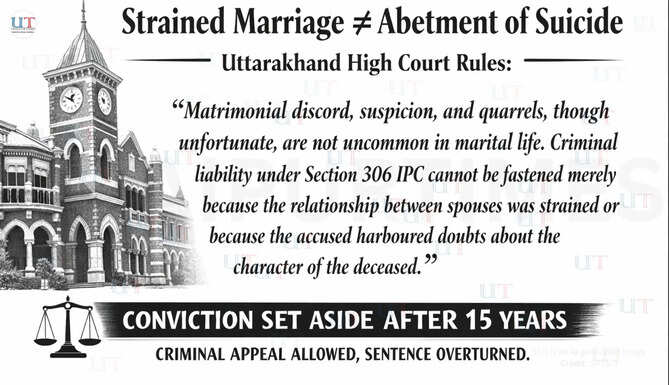
Matrimonial discord, suspicion, and quarrels, though unfortunate, are not uncommon in marital life. Criminal liability under Section 306 IPC cannot be fastened merely because the relationship between spouses was strained or because the accused harboured doubts about the character of the deceased.
Proximity Requirement
The Court stressed the necessity of a live and proximate link between conduct and suicide.
There was:
- No immediate provocation.
- No active instigation.
- No intentional aiding.
- No legally admissible evidence proving mens rea.
Principle Reaffirmed
The Court cautioned:
- Suspicion cannot replace proof.
- Moral blame cannot be equated with criminal liability.
- Courts must strictly apply statutory ingredients.
- Section 306 IPC cannot be expanded beyond legislative intent.
Final Order
The High Court held that:
- Essential ingredients of abetment under Section 107 IPC were not proved.
- Conviction under Section 306 IPC was unsustainable.
- The Sessions Court judgment dated 30.08.2011 was set aside.
- The appellant was acquitted.
The appeal was accordingly allowed.
Why This Judgment Matters
This ruling reinforces key criminal law principles:
- Proof beyond reasonable doubt is mandatory
- Mens rea must be clearly established
- Proximate instigation must be demonstrated
- Strained marital relations alone do not constitute abetment
- Suspicion cannot substitute legal proof
The judgment strengthens safeguards against over-expansion of Section 306 IPC and ensures that criminal liability is imposed only when statutory ingredients are strictly satisfied.
#UttarakhandHighCourt #Section306IPC #AbetmentOfSuicide #IndianPenalCode #CriminalLawIndia #MensRea #LegalNewsIndia #CourtJudgment #Judgment2026 #UdhamSinghNagar #NainitalCourt #UttarakhandNews #IndiaLaw #CriminalAppeal #LegalUpdate
