


WB Election Results 2026: Five Main Reasons Behind Trinamool Congress’ Downfall
West Bengal Election Results 2026: A detailed analysis of five key reasons behind the decline of the Trinamool Congress, including anti-incumbency, political shifts, governance issues, and identity politics.
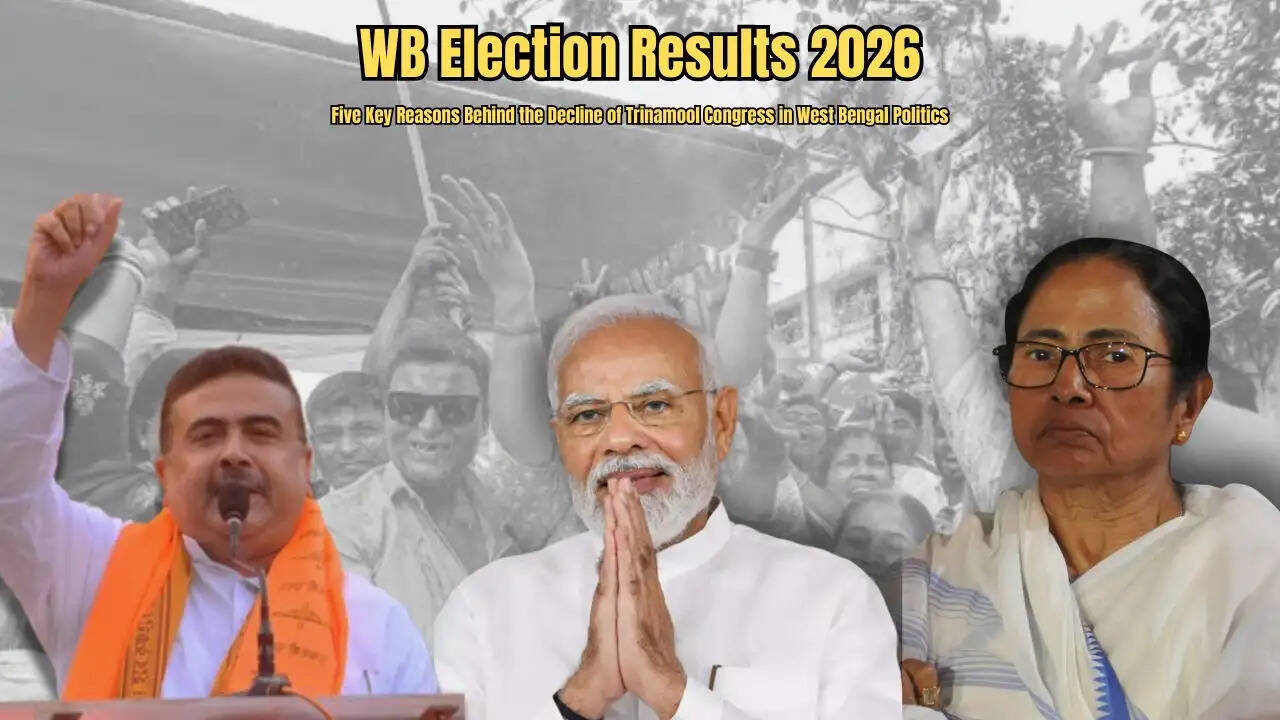
May 05, 2026: The year 2011 marked a major political shift in West Bengal, when the Trinamool Congress came to power after ending 34 years of Left Front rule. This began a long period of governance that continued for 15 years. However, in 2026, the political scenario has changed once again, with the ruling party now facing a strong wave of opposition, as the Bharatiya Janata Party emerges as a key challenger in the state.
This shift has raised important questions about the performance and challenges of the ruling party. Analysts are examining the reasons behind the loss of support and identifying the key areas where the government may have fallen short. The changing political environment has made the contest in West Bengal more competitive and uncertain.
At the same time, Bengali culture and identity have become central to political narratives in the state. Both major parties are actively engaging with these themes to connect with voters. It is also observed that the BJP has been able to strengthen its presence by aligning more closely with regional sentiments. In this article, we will discuss five key reasons why the Trinamool Congress may struggle to form the government in West Bengal.
Victory Celebrations at BJP HQ, New Delhi. #ElectionResult2026 https://t.co/pBfn2ZthCR
— BJP (@BJP4India) May 4, 2026
Five Reasons Why the Trinamool Congress lost in West Bengal Politics
1. Anti-incumbency factor
One of the key reasons for the setback of the Trinamool Congress is strong anti-incumbency sentiment. The same “wind of change” that once brought the party to power has now turned against the ruling camp after 15 years in government. It is natural for anti-incumbency to develop after a long period in power. However, in this case, the sentiment appears to be stronger. Public concerns have grown over allegations of corruption, syndicate influence, money laundering, and extortion involving sections of lower-level party workers. These issues have contributed to a wider perception of administrative decline. Overall, a strong wave of anti-incumbency has developed across the state, which has significantly impacted the position of the ruling party.
2. 'Hinduism' wave and minority vote sharing
Another important factor behind the rise of the Bharatiya Janata Party in West Bengal is growing religious polarization in state politics. The Hindutva narrative gradually strengthened over time, beginning with political mobilization during the anti-CAA protests in regions such as Beldanga and Rejinagar.
In the following years, several incidents, including periodic communal tensions and Ram Navami-related clashes further contributed to the consolidation of this political sentiment. Over time, this evolving situation strengthened the Hindutva vote base, which eventually had a significant impact on electoral outcomes in the state. The Trinamool Congress also recognized the growing importance of religious and cultural identity in politics. In response, efforts were made to reinforce cultural symbolism, including announcements related to religious and cultural institutions such as the Jagannath temple and the proposed Mahakal temple.
However, the political narrative built by the BJP during campaigns, portraying the ruling party as biased or aligned with minority appeasement, proved difficult for the Trinamool Congress to counter effectively. This perception became deeply rooted among a section of voters and influenced political sentiment. At the same time, minority votes, which were once considered a strong consolidated base for the ruling party, also began to fragment. These votes were distributed among multiple political groups, including parties such as the Aam Janata Unnayan Party, ISF, AIMIM, and even sections of Congress and CPI(M). This division of minority votes weakened the traditional support structure of the Trinamool Congress in several constituencies. As a result, the combined effect of religious polarization and vote fragmentation contributed significantly to the changing political landscape in West Bengal.
पश्चिम बंगाल में कमल खिल उठा है!
वर्ष 2026 के पश्चिम बंगाल विधानसभा चुनाव अविस्मरणीय रहेंगे। जनशक्ति की जीत हुई है और भाजपा के सुशासन की राजनीति को यहां के लोगों का भरपूर आशीर्वाद मिला है। इस ऐतिहासिक विजय के लिए बंगाल के अपने भाई-बहनों का हृदय से आभारी हूं।
जनता-जनार्दन ने…
— Narendra Modi (@narendramodi) May 4, 2026
3. SIR Factor
Trinamool Congress leader Mamata Banerjee has often been associated with an opposition-style political approach, even while in power. Critics argue that she has frequently focused on countering the Bharatiya Janata Party rather than fully highlighting her government’s administrative performance. This pattern continued in the current political cycle as well.
In this context, the Special Intensive Revision (SIR) of voter lists became a major political issue. Mamata Banerjee repeatedly raised concerns and alleged that the Election Commission was acting in favour of the BJP through the SIR process. As a result, the issue of SIR gained significant political attention and became a central point in public discussions and party meetings.
However, critics point out that this focus on SIR gradually overshadowed the government’s own development record over the past 15 years. Instead of strongly presenting governance achievements or a future roadmap, much of the political messaging remained centered on SIR-related concerns. Additionally, reports of large-scale deletion or omission of voter names due to alleged discrepancies created further controversy, which negatively impacted the image of the ruling party.
4. Employment, corruption, and RG Kar hospital incident
In the lead-up to the 2026 election, the Trinamool Congress faced multiple serious allegations that affected public perception. These included claims of recruitment-related corruption, allegations against certain state ministers, and criticism over the limited success in attracting large-scale industries over the past 15 years. Concerns were also raised about a preference for allowance-based welfare schemes instead of creating stable and permanent employment opportunities.
Public anger was further intensified by issues such as the alleged irregularities involving around 26,000 jobs, dissatisfaction over delayed Dearness Allowance (DA) payments, and uncertainty surrounding pay commission implementation. These factors collectively created frustration, especially among the youth and working population, and contributed to growing dissatisfaction with the government.
Traditionally, the Trinamool Congress had a strong hold over the women’s vote bank, supported by welfare schemes such as Lakshmi Bhandar and Kanyashree. However, the RG Kar hospital incident became a turning point that weakened this support base. The issue triggered widespread public concern and further damaged trust among women voters.
In addition, political developments such as the entry of victims’ families into opposition campaigns added emotional weight to the issue. At the same time, the opposition’s promise of a ₹3,000 monthly allowance further challenged the ruling party’s welfare narrative. As a result, the combined impact of corruption allegations, employment issues, and the RG Kar incident created significant political pressure on the Trinamool Congress.
5. Bengali identity politics and its limited impact
The use of Bengali identity has remained an important part of the campaign strategy of the Trinamool Congress, similar to the 2021 elections. However, over time, this political tool appears to have lost some of its effectiveness. A strategy that is used repeatedly often becomes less impactful, especially when voter expectations and the political environment begin to change.
On the other hand, the Bharatiya Janata Party has actively worked to reduce its earlier image as an “outsider” party in West Bengal. Over the years, it has increased engagement with local culture and regional sentiments. Leadership changes, including the appointment of regionally connected leaders such as Shamik Bhattacharya as state president, also reflect this effort to strengthen its local presence.
In addition, national leaders of the BJP have made visible attempts to connect with Bengali culture during campaigns. Earlier, the party was often seen as dominated by outside leaders, with figures like Kailash Vijayvargiya frequently appearing in state politics. However, this image has gradually changed, and sections of the urban middle class, once hesitant, have also shifted their support. As a result, the Trinamool Congress has not been able to gain a clear advantage through Bengali identity politics alone, as its impact has now become more limited.
Along with these factors, the Trinamool Congress has also faced organisational challenges at the grassroots level, which have weakened its overall structure. The party has struggled to strengthen local networks and effectively connect with the younger generation, while also finding it difficult to match the large and well-organised election machinery of the Bharatiya Janata Party. At the same time, the growing appeal of the “double-engine government” narrative has influenced voter sentiment, with some believing that closer coordination between the state and the Centre could bring faster development. Long-standing political differences between the state government and the central government have further shaped this perception, leading sections of voters to feel that West Bengal may have missed out on certain central development opportunities, which has added to the broader political challenge for the ruling party.