

Trump Administration Can Seek Supreme Court Review of Order Striking Down Tariffs
US Appeals Court Deals Major Blow to Trump's Tariff Strategy
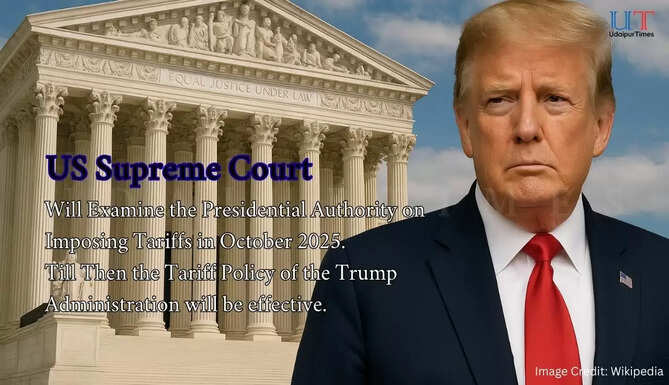
Udaipur, Aug 30, 2025: A US appeals court ruled 7-4 that President Trump overstepped his authority under the International Emergency Economic Powers Act (IEEPA). This ruling has impacted Donald Trump's tariff strategy. The case is set to be reviewed by the US Supreme Court in late October, where the Trump administration is expected to appeal the ruling. The decision reaffirms a previous ruling that invalidated certain tariffs, but those tariffs, affecting imports from countries like India, will remain in effect until October 14, allowing time for a potential Supreme Court review, as noted by the Indian think tank GTRI.
Congress Over President
The appeals court has affirmed that Congress holds tariff authority, not the President, dismissing challenges to tariffs implemented by the Trump administration. Various lawsuits contesting these tariffs were filed across the U.S. The ruling reinforces that executive emergency powers cannot override Congress's trade and taxation authority. The Supreme Court is expected to review the case later in October to decide if Trump's interpretation of the International Emergency Economic Powers Act will stand or if Congress's limitations on presidential trade powers will be reinstated. Supreme Court of the US will decide whether the order on tariffs will be under the domain of Congressional lawmking or an instrument of presidential geopolitics.
Reciprocal Tariff as Foreign Emergency
US President Donald Trump has placed reciprocal tariffs on numerous nations with which the US experiences a trade deficit. Since beginning his second term, President Trump has reaffirmed his position on tariff reciprocity, highlighting that his administration will align tariffs set by other countries, including India, to "guarantee equitable trade."
Trump utilized the International Emergency Economic Powers Act (IEEPA), a law from 1977 designed for implementing sanctions and financial controls during foreign emergencies, to establish reciprocal tariffs on numerous countries.
Explaining the above approach to tariff by the Trump administration, GTRI said that the 1977 IEEPA law grants presidents broad power to regulate transactions and limit property, although it does not explicitly mention tariffs or taxes. Trump implemented it in 2019 and renewed it in 2025, citing the U.S. trade deficit and alleged surges of fentanyl from China, Canada, and Mexico as national emergencies to justify imposing hefty tariffs.
Tariff vital for foreign policy
Donald Trump's Atorney General supported the tariff action by saying that the President identified a national emergency and took leag laction within the powers granted to the President of the United States. The AG said that the Federal Circuit judge haas undermined the President's role in foreign policy and that this ruling will be challenged.
Source: Media Reports
#USSupremeCourt #DonaldTrump #Tariffs #TradePolicy #USPolitics #GlobalTrade #SCOTUS #IEEPA #TradeDispute #CongressVsPresident
