

Rajasthan Chief Secretary Meets with Union Minister on Illegal Sand Mining
Chief Secretary V Srinivas briefs Union Minister Bhupender Yadav on compliance with Supreme Court directives and river conservation measures

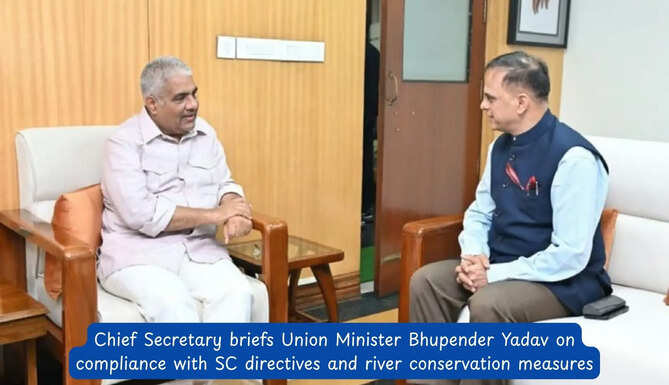
UdaipurTimes, Nov 3, 2026 - As part of the State's efforts to protect the environment and make rivers pollution-free under the leadership of Rajasthan Chief Minister Bhajan Lal Sharma, Chief Secretary V Srinivas met Union Minister for Environment, Forest and Climate Change Bhupender Yadav in New Delhi on Tuesday, November 3.
Discussions focused on preventing illegal sand mining in the National Chambal Sanctuary and addressing pollution in the Jojari River, according to a government press release.
The Chief Secretary informed the Union Minister that, in compliance with the Supreme Court's directives, 200 Border Home Guards have been deployed at 40 sensitive locations in the Chambal Sanctuary. A total of 65 CCTV cameras have also been installed for monitoring purposes.
Between January 2025 and June 2026, 536 FIRs were registered and 541 vehicles seized in connection with illegal sand mining and transportation. A State-level committee constituted under the chairmanship of the Chief Secretary is regularly reviewing the action taken by the concerned departments.
The meeting also discussed measures to prevent industrial pollution in the Jojari River and the Luni and Bandi river systems.
The Chief Secretary informed that, in accordance with the Supreme Court's directions, the Common Effluent Treatment Plant (CETP) in Jodhpur and the 306 textile industry units connected to it remain shut. Work is underway on a plan to upgrade the treatment plant in accordance with the Zero Liquid Discharge (ZLD) system.
Srinivas further said that the State Government has submitted a revised draft of a comprehensive action plan to the High-Level Committee constituted by the Supreme Court to find a permanent solution to pollution in the Jojari, Bandi and Luni river systems.
The meeting also deliberated on strengthening coordination for the conservation of both river systems and ensuring effective compliance with the Supreme Court's directives.
