

Didier Deschamps Questions Referee After France's World Cup Exit to Spain
Didier Deschamps' 14-year spell as France coach ended with a 2-0 World Cup semi-final defeat to Spain. The veteran manager questioned referee Iván Barton but ultimately accepted responsibility, bringing an end to one of the most successful eras in French football.

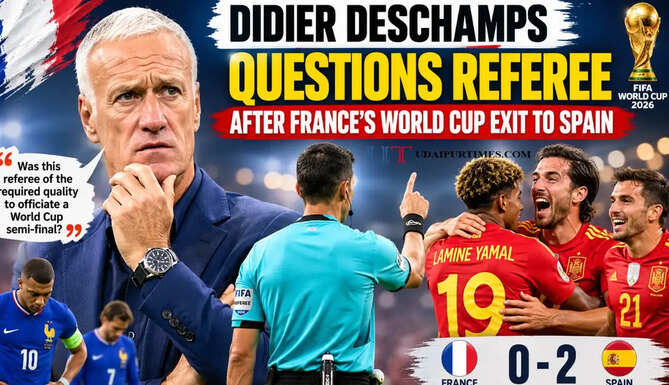
July 15, 2026: For 14 years as France's head coach, Didier Deschamps lived with constant scrutiny. Critics often accused him of being too defensive, preferring control and discipline over giving France's gifted attacking players complete freedom to express themselves. His teams were regularly described as pragmatic rather than entertaining, even when the results were consistently impressive.
However, in what proved to be his final tournament in charge of the national team, Deschamps made a noticeable tactical adjustment. While his calm and serious personality in front of the media remained unchanged, France approached the World Cup with far greater attacking ambition.
For several weeks, Les Bleus produced some of the most attractive football of the tournament. They played with rhythm, creativity and confidence, creating chances with ease and exciting supporters with their attacking style. Their performances reminded many observers of the celebrated French side of the early and mid-1980s. Some even went a step further, comparing this team to Brazil's legendary 2002 World Cup-winning squad.
Those comparisons, however, came to an abrupt end in Dallas. Spain completely disrupted France's rhythm in the semi-finals and deservedly secured a 2-0 victory. Against their first truly elite opponent of the tournament, France struggled to impose themselves and looked far from the vibrant side that had impressed throughout the competition.
🗣️ Didier Deschamps 🇫🇷 : « Maintenant, moi, je vous demande, et je ne vais pas y répondre : je ne veux pas passer pour une pleureuse parce qu’on a perdu, mais est-ce que l’arbitre de ce soir, avait le niveau pour arbitrer une demi-finale de Coupe du monde ? » pic.twitter.com/XAYrU8s0I0
— Mercato Blaugrana (@MercatoBlaugra) July 14, 2026
Ironically, this was perhaps the one match where France needed a little more of the disciplined, calculated football that had become the trademark of the Deschamps era. Instead, the team found itself caught between two identities. It lacked the attacking sharpness that had carried it through the earlier rounds while also missing the defensive solidity that had long been Deschamps' greatest strength.
A Remarkable Legacy Despite the Painful Exit
Regardless of the semi-final defeat, Didier Deschamps leaves behind one of the finest coaching records in international football. During his 14-year spell in charge, he guided France to the 2018 FIFA World Cup title, another World Cup final, and now a World Cup semi-final. He also led Les Bleus to one UEFA European Championship final and one semi-final.
Reaching the last four in four of the last five major international tournaments is an extraordinary achievement by any standard. Few national team coaches have managed to maintain such consistency over such a long period. Throughout his tenure, France remained one of the world's strongest footballing nations and were genuine contenders in almost every major competition they entered.
Yet there is another perspective that continues to fuel debate. Deschamps had the privilege of managing one of the most talented generations in French football history. With world-class players available in almost every position, many believe that winning only one major trophy fell short of what such a remarkable squad was capable of achieving.
Supporters, however, argue that international football is decided by the smallest of margins. Knockout tournaments often depend on a single mistake, one moment of brilliance or even a penalty shootout. Maintaining France among the world's elite for well over a decade required tactical intelligence, man-management and remarkable consistency. Those qualities have long been Deschamps' greatest strengths.
“THAT HURTS” 😖
— SBS Sport (@SBSSportau) July 15, 2026
Didier Deschamps reacts to France’s Semi Final loss to Spain, the mood in the dressing room and why they didn’t live up to their own lofty standards
🏆 #FIFAWorldCup | June 12 - July 20 | Every Match on SBS 📺 pic.twitter.com/XyXK40R285
Whatever side of the debate one chooses, his place in French football history is secure. His achievements will be remembered long after the disappointment of this World Cup has faded. At this moment, though, those accomplishments will offer little comfort after a painful and unexpected defeat. France not only lost 2-0 to Spain but also failed to truly challenge a side that controlled the contest from start to finish.
Speaking after the match, Deschamps admitted that his players were devastated by the result. At the same time, he questioned the performance of El Salvador referee Iván Barton.
"I will ask one question, but I will not answer it," Deschamps said. "Was this referee of the required standard to officiate a World Cup semi-final? I am not saying this because we lost today. There were several situations during the match that raised questions. Of course, some decisions also went in our favour."
The French coach was particularly frustrated by the first-half penalty awarded to Spain after Lucas Digne was judged to have fouled Lamine Yamal inside the box. While he stopped short of directly blaming the officials for the defeat, he suggested that several decisions throughout the match deserved closer examination.
Despite those comments, Deschamps refused to use refereeing as an excuse. Instead, he acknowledged Spain's superiority and accepted full responsibility for France's elimination.
"There is a lot of disappointment," he said. "Our players are heartbroken because our ambition was to reach the final. But we also have to accept reality. Today, Spain were better than us tactically. They controlled the match very well."
The veteran manager also made it clear that the responsibility rested with his own team rather than anyone else.
"First of all, this is our failure," Deschamps said. "I don't want to blame anyone else for it."
Those words perhaps summed up the man who spent 14 years leading France. Even in defeat, Deschamps chose accountability over excuses. His final match as France coach ended in disappointment, but his legacy—as one of the country's most successful managers—remains firmly intact.
