

Will Argentina Be Banned Before the World Cup Final? FIFA Investigates Falklands Banner Controversy
FIFA is investigating Argentina after players celebrated with a Falklands banner following their World Cup semi-final win over England.

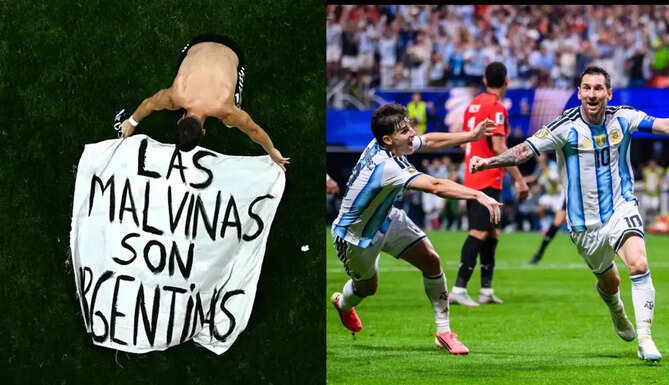
July 18, 2026: Argentina's victory over England in the FIFA World Cup semi-final has been overshadowed by controversy after players celebrated with a banner carrying a political message linked to the Falkland Islands dispute. FIFA has now launched an investigation into the incident, raising the possibility of disciplinary action against the Argentine team ahead of the World Cup final.
Before the match, Argentina head coach Lionel Scaloni had urged his players to focus only on football and leave the past behind. However, after the final whistle, the celebrations took a controversial turn.
As the players celebrated with fans, a banner thrown onto the pitch from the stands was picked up by several Argentine footballers. Images of the celebration quickly spread across social media, sparking widespread debate.
The banner read "Las Malvinas son Argentinas," which translates to "The Malvinas are Argentine." In Argentina, the Falkland Islands are known as the Malvinas, and the country has long claimed sovereignty over the islands. Many viewed the message as a political statement displayed on football's biggest stage.
#UK Urges #FIFA to Investigate #Argentina Over Falklands Banner#Britain demands a @FIFAWorldCup probe after Argentine players displayed a political banner declaring the disputed #FalklandIslands their sovereign territory. pic.twitter.com/fFG50GFG79
— Daily Euro Times (@dailyeurotimes) July 17, 2026
FIFA Reviews Incident Ahead of World Cup Final
The Falkland Islands, located in the South Atlantic Ocean around 500 kilometres from the Argentine coast, have been under British control since 1833. Argentina has never accepted British sovereignty and continues to claim the islands as its own.
The territorial dispute led to the Falklands War in 1982, when Argentina invaded the islands under then-President Leopoldo Galtieri. Britain, led by Prime Minister Margaret Thatcher, responded with a military campaign. After 74 days of fighting, Argentina surrendered. Around 650 Argentine and 255 British military personnel lost their lives during the conflict.
The rivalry between Argentina and England has often carried emotional and historical significance since the war. It became even more famous during the 1986 FIFA World Cup when Diego Maradona scored the iconic "Hand of God" goal, followed by his unforgettable solo effort, widely regarded as one of the greatest goals in football history.
FIFA regulations and the Laws of the Game prohibit the display of political messages, banners or symbols during official matches and tournament ceremonies.
Following the incident, the English Football Association and the British government publicly criticised the banner and called on FIFA to investigate the matter. They argued that the World Cup should not be used as a platform for political messages.
Sky's @RobHarris asks the White House World Cup chief Andrew Giuliani if Argentina's players were wrong to use celebrations in a stadium to claim the sovereignty of the Falkland Islands
Watch his response below⬇️ pic.twitter.com/hLJQrj3PEn
— Sky News (@SkyNews) July 17, 2026
A FIFA spokesperson confirmed that the organisation's Independent Disciplinary Committee has begun reviewing the case.
"FIFA's Independent Disciplinary Committee is currently reviewing the match reports and is assessing the overall situation before taking any further action in accordance with FIFA's rules," the spokesperson told Al Jazeera.
Investigators are also examining how the banner entered the stadium. It is believed that a spectator brought it into the venue and threw it onto the pitch after the match, where it was picked up during Argentina's celebrations.
If FIFA concludes that the players breached its disciplinary regulations by displaying a political message, the Argentine Football Association or the team could face sanctions, including a substantial fine or other disciplinary measures.
With the World Cup final approaching, Argentina now faces not only the challenge of competing for football's biggest prize but also the uncertainty of FIFA's disciplinary investigation.
