

France vs Iraq Tactical Masterclass: Mbappé, Olise & Half-Space Dominance Explained
France delivered a tactical masterclass against Iraq, using a 2-2-6 attacking shape and half-space control to break a deep defensive block. Mbappé’s freedom and Olise’s creativity stood out, while Argentina’s midfield dominance against Austria highlighted the limits of gegenpressing in tough conditions.

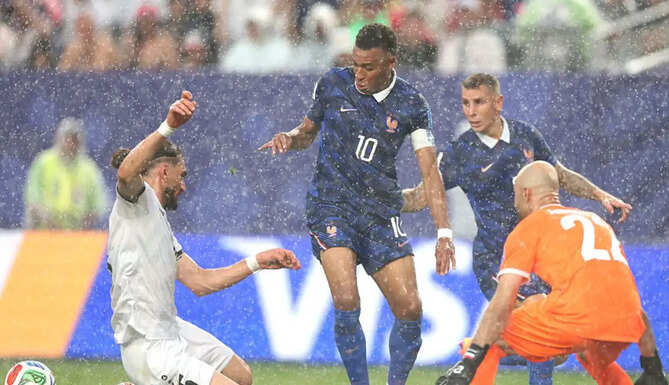
June 23, 2026: The World Cup is not only a fight for trophies, but it is also a tactical chessboard where the world’s best coaches constantly reshape modern football. Every match creates new ideas and new tactical lessons. The game is changing very fast, almost like a new system building on the old one. The France vs Iraq match clearly showed how football has now become a game of space control, movement, and smart positioning.
From the start, Iraq were pushed deep into their own half because of France’s high pressing and strong attacking pressure. Their original 4-1-4-1 shape quickly changed into a 6-3-1. This meant six players stayed behind the ball for most of the match. In coaching language, this is called a deep low block. It is one of the hardest systems to break in modern football.
But Didier Deschamps’ France showed a very clear and well-planned strategy. France completed 41 passes inside the opponent’s penalty box during the match, which is a record at this level of football. Normally, teams struggle to reach even 20–30 passes inside the box. France achieved this through a very aggressive 2-2-6 attacking shape, where six players stayed high in attacking positions at the same time. This constant pressure forced Iraq to make mistakes in positioning and decision-making. From those 41 box passes, France created five clear chances and scored two goals.
France’s main strength was their smart use of the half space. The half-space is the area between the full-back and the centre-back. In modern football, more than 70 percent of goals come from this zone. France used this area very well with constant movement and rotation between the wings and central channels. This made the Iraqi defence confused and unstable.
Tactical Focus: Half Space Control and Player Movement
In this tactical setup, Michael Olise played a very important role. He acted as the link between midfield and attack and helped connect different phases of play. He worked closely with Antoine Griezmann in creative areas, which gave France more control in tight spaces. At the same time, Kylian Mbappé also benefited a lot from this system. He was given freedom in a number 10-like role, where he could move from the half space into central attacking areas. When Olise attracted defenders, Mbappé found more space to attack the goal.
Now, coming to Mbappé, his impact is already huge in world football. With 16 World Cup goals, he is one of the most dangerous forwards in tournament history. His first goal against Iraq came from a powerful shot outside the box, showing his ability to score from long distance. He is very strong with both feet and can finish with accuracy under pressure. He is a rare combination of calm finishing and explosive attacking power.
But Mbappé’s biggest strength is his speed, game reading, and movement without the ball. While Lionel Messi is known for his technical beauty and dribbling style, Mbappé stands out for his timing, positioning, and ability to find space at the right moment. He constantly attacks the defensive line and stays ready for quick transitions.
Mbappé: ⚽️⚽️
Dembélé: ⚽️🎁
Olise: 🎁🎁
Just unstoppable. pic.twitter.com/gLK70dom9q
— B/R Football (@brfootball) June 23, 2026
Looking at another match, Argentina vs Austria gives us a different tactical picture. Ralf Rangnick’s famous gegenpressing system did not work properly against Argentina. There were two main reasons behind this failure. First, the high heat and humidity made it very difficult for Austria to maintain continuous pressing throughout the match. Second, Argentina handled the pressure calmly and used simple passing to escape tight situations.
Lionel Messi was heavily marked during the match, but Austria’s high pressing system left open space on the wings. Argentina quickly used these spaces to move forward. Their full-backs and midfielders helped in breaking the press with simple passes and smart positioning.
Modern football now has different pressing systems. High pressing is used to stop build-up play in the opponent’s half. Gegenpressing is when a team tries to win the ball immediately after losing it, usually with two or three players pressing together. Counter-pressing is focused on recovering the ball within five seconds or within a few passes after losing possession.
When Austria pushed high up the pitch, they often left wide areas open. Argentina used this very well. Their midfield control was very strong, especially from Alexis Mac Allister and Enzo Fernández. Both players used quick one-touch passing and smart rotation to break Austria’s pressing structure.
In the end, Argentina’s midfield looked one of the strongest in the tournament. They showed balance, patience, and simple but very effective football under pressure.
