

Railways Rule Change From July: From Smoking to Ticketless Travel, 14 Railway Rules Change, Fines Up to ₹10,000
Indian Railways has rolled out major changes under the Public Trust (Amendment) Act, 2026. From higher fines for ticketless travel to stricter penalties for smoking, trespassing and reserved coach violations, here's everything passengers need to know.
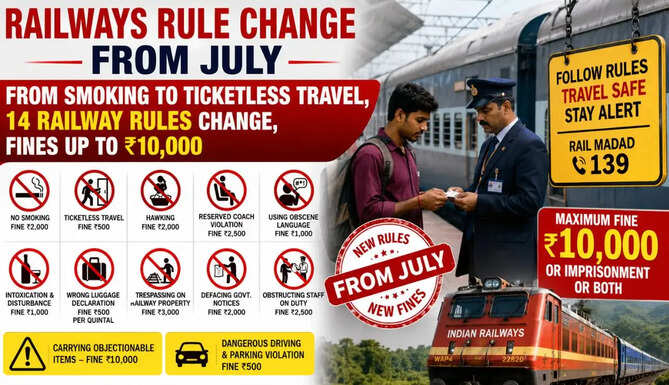
July 01, 2027: Passengers travelling on Indian Railways should be aware of a major update. The Public Trust (Amendment) Act, 2026 has introduced significant changes to railway rules, penalties, and passenger regulations across the country. The new provisions aim to improve passenger safety, maintain discipline, and reduce ticket-related offences.
The railway administration has warned that violating these rules could result in heavy fines, imprisonment, or both.
Stricter Action Against Ticket-Related Offences
The amended law introduces tougher penalties for ticket-related violations.
Under Section 137, passengers found travelling without a valid ticket must pay the applicable fare along with an additional charge of at least ₹500. If the passenger refuses to pay, they may face imprisonment for up to six months, a fine of ₹500, or both.
According to Section 138, passengers travelling without a proper ticket will also have to pay an additional penalty of at least ₹500.
Meanwhile, Section 142 makes travelling on a ticket issued in another person's name a punishable offence. In such cases, the ticket may be confiscated, and the passenger can be fined at least ₹500 or even face imprisonment.
Tougher Penalties for Misconduct on Railway Premises
Indian Railways has also strengthened its rules against misconduct inside trains and on railway premises.
Under Section 144, begging or creating a public nuisance is now punishable with a ₹2,000 fine for first-time offenders. Repeat offenders may face imprisonment of up to one year.
Intoxication and Obscene Behaviour
According to Section 145, passengers who create disturbances while under the influence of alcohol or drugs, or use obscene language, may face up to 24 hours of imprisonment, a ₹1,000 fine, or both.
Smoking in Trains
Smoking inside trains is now treated more seriously under Section 167. Offenders will be fined ₹2,000, their ticket or pass may be confiscated, and they can be removed from the train.
Reserved Coaches and Passenger Safety
To improve passenger safety, especially for women, Indian Railways has introduced stricter rules for reserved coaches.
Under Section 162, male passengers found travelling illegally in coaches reserved for women can be fined ₹2,500.
Similarly, Section 155 imposes a ₹2,000 fine on passengers who forcibly enter reserved coaches or illegally occupy reserved seats.
Trespassing into restricted railway areas, such as railway tracks or yards, remains a punishable offence under Section 147, carrying imprisonment of up to three months, a fine of up to ₹3,000, or both.
Updated List of Fines
Indian Railways has revised penalties for several common offences:
- Travelling without a ticket – ₹500
- Travelling on someone else's ticket – ₹500
- Illegal begging or public nuisance – ₹2,000
- Creating a disturbance while intoxicated – ₹1,000
- Using obscene language – ₹1,000
- Obstructing railway employees on duty – ₹2,500
- Entering railway premises without permission – ₹500
- Refusing to vacate a reserved coach without valid authority – ₹2,000
- Disobeying the instructions of the driver or conductor – ₹500
- Male passenger travelling in a women's coach – ₹2,500
- Carrying luggage with incorrect declaration – ₹500 per quintal
- Transporting prohibited or objectionable items – ₹10,000
- Defacing government notices or railway property – ₹2,000
- Smoking inside trains or railway premises where prohibited – ₹2,000
Obstructing Railway Staff
Under Section 146, anyone found obstructing a railway employee while they are performing official duties may face imprisonment of up to three months, a ₹2,500 fine, or both.
However, the railway administration has clarified that simply recording a video is not an offence, provided it does not interfere with the employee's work.
Other Important Changes
The amended law also introduces several additional changes:
- Section 158 has been completely abolished.
- Section 159: Violating parking rules or driving dangerously within railway premises may attract a ₹500 fine and imprisonment.
- Section 165: Transporting dangerous goods without permission can result in a fine of up to ₹10,000 and imprisonment for up to one year.
- Section 166: Distributing advertisements, pamphlets, or leaflets without permission will attract a ₹2,000 fine for first-time offenders.
Indian Railways' Advisory to Passengers
Indian Railways has urged passengers to travel only with valid tickets, follow all railway regulations, and respect fellow travellers. The administration has also appealed to passengers to maintain cleanliness and cooperate with railway staff to ensure a safe and comfortable journey.
For assistance, complaints, or railway-related information, passengers can contact the Rail Madad helpline at 139.
