

Nepal Records Historic First T20 World Cup Win, Beats Scotland by 7 Wickets
Nepal secured their first-ever T20 World Cup win by defeating Scotland by seven wickets at Wankhede Stadium. Dipendra Singh Airee starred with an unbeaten 50 as fans celebrated this historic victory.

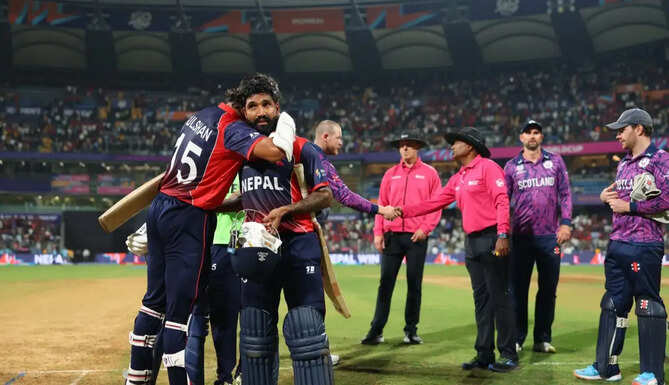
February 18, 2026: Nepal won its last match in the T20 World Cup 2026. After losing to England by just one run, Nepal defeated Scotland by seven wickets in the 33rd match of the tournament. Scotland batted first and scored 170 for 7. Nepal won this Group C match in the final over. This is Nepal's first T20 World Cup win since 2014. The team also played in the 2024 tournament but did not win any match.
Nepal started well with Kushal Bhurtel and Aasif Sheikh. They scored 56 runs without losing a wicket in the powerplay. But Michael Leask brought Scotland back into the game by taking three wickets. Bhurtel scored 43 off 35 balls, and Sheikh made 33 off 27 balls. Captain Rohit Paudel added 16 runs. When Rohit was out in the 14th over, Nepal’s score was 98 for 3.
Dipendra Singh Airee played brilliantly and added an unbeaten 50 off 23 balls. He and Gulshan Jha shared an unbroken 73-run partnership for the fourth wicket. Nepal needed 65 runs from the last 31 balls. Dipendra hit four fours and three sixes, while Gulshan scored 24 off 17 balls.
Unreal scenes at Wankhede. A monumental victory for Nepal! 🇳🇵
— Star Sports (@StarSportsIndia) February 17, 2026
After 12 long years, their fans celebrate a victory that will be remembered for ages!
Watch highlights ➡️ https://t.co/NirqGCQvuM pic.twitter.com/lfsXGipmFA
Nepal’s Bowlers Make a Comeback
Nepal captain Rohit Paudel won the toss and asked Scotland to bat first. George Munsey and Michael Jones gave Scotland a good start, scoring 80 runs in 10 overs. Munsey scored 27 off 29 balls with four fours. Then Michael Jones and Brendon McMullen (25) added 52 runs off 32 balls for the second wicket. Scotland reached 132 runs.
Nepal bowled very well in the last five overs. Scotland managed only 39 runs in that period. Michael Jones made 71 off 45 balls, including eight fours and three sixes. Sompal Kami took 3 wickets, and Nandan Yadav took 2 wickets.
