

Spain Dominate Argentina in Extra Time to Lift the FIFA World Cup 2026 Trophy
Spain defeated Argentina 1-0 in the FIFA World Cup 2026 final with a dominant tactical display. Here's a complete analysis of what went wrong for Lionel Messi's side.

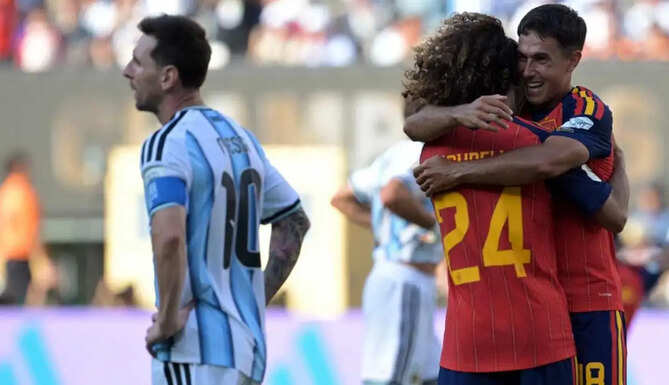
July 20, 2026: In 1930, two Spanish-speaking nations, Uruguay and Argentina, met in the first-ever FIFA World Cup final in Uruguay. Since then, 96 years have passed, and 22 World Cups have been played. Finally, in the 23rd edition in 2026, history repeated itself as Spain and Argentina faced each other in the FIFA World Cup final. It was more than just a battle for the world title. It was a clash between two footballing giants that share the same language but follow different football philosophies.
Many expected a close contest, but the final turned out to be surprisingly one-sided. Argentina looked completely outplayed against a dominant Spanish side. As a result, Lionel Messi's dream of winning back-to-back World Cup titles came to an end, while Spain lifted the trophy for the second time and became world champions again after 16 years.
Spain controlled the match from the very beginning. They dominated possession, dictated the tempo with quick passing, and pressed Argentina relentlessly whenever they lost the ball. Their high pressing prevented Argentina from building attacks from the back and forced repeated mistakes. The South American side struggled to keep possession and rarely looked comfortable throughout the game. Spain created chance after chance and constantly kept Argentina pinned inside their own half.
Despite Spain's complete dominance, goalkeeper Emiliano Martinez kept Argentina in the contest for as long as possible. Before the final, he had never made more than four saves in a match during the tournament. However, in the final, he was forced into action repeatedly, making seven saves in the first 75 minutes alone and finishing the game with an incredible 15 saves. His heroic performance delayed the inevitable, but he could not stop Ferran Torres, who calmly finished from Nico Williams' cross in the second half of extra time to score the only goal of the match.
President Donald J. Trump presents the World Cup Trophy to Spain, the 2026 @FIFAWorldCup Champions! 🏆 pic.twitter.com/SHsoBhYm1b
— The White House (@WhiteHouse) July 19, 2026
Spain's Tactical Masterclass Left Argentina With No Answers
One of the biggest reasons behind Argentina's defeat was Spain's excellent plan to stop Lionel Messi. Rodri and Aymeric Laporte stayed close to the Argentine captain throughout the match, giving him very little space to influence the game. Messi was unable to play at his usual pace or create the moments of magic that Argentina rely on. The final once again showed how difficult it becomes for Argentina when their captain is successfully marked out of the game.
Argentina also failed to execute their usual counter-attacking style. Spain's organised defence and disciplined midfield prevented them from launching quick transitions. In fact, Argentina failed to register a single shot on target until the second half of extra time, highlighting just how dominant Spain were. Lionel Scaloni tried to change the game by introducing Nico Gonzalez in place of Leandro Paredes before later bringing on Cristian Romero, Rodrigo De Paul and Giuliano Simeone for Medina and Simeone. However, none of the substitutions changed the flow of the game as Spain continued to control possession and dictate play.
Argentina's midfield and defence looked completely overwhelmed by Spain's relentless attacks. Nicolas Otamendi fought hard to keep the team alive, but the pressure never eased. Lamine Yamal repeatedly troubled the Argentine defence with his pace, dribbling and creativity down the right wing, while Marc Cucurella constantly overlapped to create more attacking opportunities.
Spain continued to create chances, although Yamal, Cucurella and Mikel Oyarzabal were unable to add more goals. Argentina's problems became even worse in stoppage time when Enzo Fernandez received a red card after a late challenge on Pau Cubarsí, forcing the defending champions to finish the match with 10 men.
Overall, Argentina produced one of their poorest performances of the tournament. Their display was so below par that many fans questioned how the team had reached the final. Spain remained calm under pressure, controlled every area of the pitch, and fully deserved their 1-0 victory through Ferran Torres' extra-time winner. The triumph gave Spain their second FIFA World Cup title and ended a 16-year wait to become world champions once again. For Lionel Messi and Argentina, it was a heartbreaking end to their campaign as their dream of retaining the World Cup title ended in tears against a superior Spanish side.
