

Bajaj Pulsar NS400Z vs TVS Apache RTR 310: Price, Power, Features and Which Bike Is Better?
The Bajaj Pulsar NS400Z and TVS Apache RTR 310 compete in the premium naked motorcycle segment. While the Pulsar offers more engine power and a lower starting price, the Apache stands out with advanced rider assistance features, lower weight and higher ground clearance. Here is a detailed comparison of their prices, specifications, performance and features to help you choose the right bike.

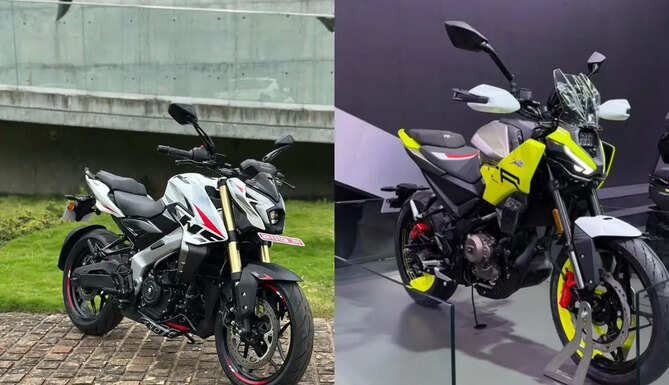
November 10, 2026: A powerful engine, sporty design and modern features are three major attractions in the premium naked motorcycle segment. However, the Bajaj Pulsar NS400Z and TVS Apache RTR 310 have different strengths.
On one hand, the Pulsar NS400Z offers a more powerful engine at a comparatively lower price. On the other hand, the Apache RTR 310 stands out with its advanced rider assistance features, lower kerb weight and higher ground clearance.
Let's compare both motorcycles across key aspects, including price, engine, performance, design, braking system and technology, to find out which one offers better value for money.
Price and Variants: Bajaj Pulsar NS400Z Is More Affordable
Bajaj Pulsar NS400Z
-
Ex-showroom price: ₹1,91,254
TVS Apache RTR 310
-
Starting ex-showroom price: ₹2,29,990
The Bajaj Pulsar NS400Z is priced at ₹1,91,254. The motorcycle is available in four colour options: Brooklyn Black, Pearl Metallic White, Glossy Racing Red and Pewter Grey.
On the other hand, the TVS Apache RTR 310 starts at ₹2,29,990. This means buyers will have to spend ₹38,736 more for the Apache's base variant compared to the Pulsar NS400Z.
The Apache RTR 310 is available in multiple variants and colour options. Their prices are as follows:
| Variant | Ex-showroom Price |
|---|---|
| Arsenal Black Base | ₹2,46,990 |
| Fury Yellow Base | ₹2,46,990 |
| Black Diamond Edition Base | ₹2,48,990 |
| Fiery Red Base | ₹2,51,990 |
| Sepang Blue Base | ₹2,52,990 |
| Anniversary Edition | ₹2,97,290 |
The Pulsar NS400Z is clearly ahead in terms of affordability. It could be an attractive option for buyers looking for a powerful motorcycle without spending too much.
Design and Dimensions: Which Bike Is More Convenient?
Both motorcycles feature a streetfighter design. The Bajaj Pulsar NS400Z carries the familiar muscular bodywork and aggressive styling of the NS series. In comparison, the TVS Apache RTR 310 has a more modern and futuristic design, along with a compact rear section.
Here is a comparison of their dimensions:
| Dimensions | Pulsar NS400Z | Apache RTR 310 |
|---|---|---|
| Wheelbase | 1,346 mm | 1,358 mm |
| Ground clearance | 165 mm | 180 mm |
| Fuel tank capacity | 12 litres | 11 litres |
| Seat height | 805 mm | 800 mm |
| Kerb weight | 176 kg | 169 kg |
The Apache RTR 310 has a wheelbase that is 12 mm longer than that of the Pulsar NS400Z. A longer wheelbase can generally contribute to better stability at higher speeds. Meanwhile, the Pulsar's shorter wheelbase may offer some advantages when changing direction or navigating city traffic.
The Apache is also ahead in terms of ground clearance. Its 180 mm ground clearance is 15 mm higher than the Pulsar's 165 mm. This could make it more convenient to ride over tall speed breakers and uneven roads.
The Pulsar NS400Z has a slightly larger fuel tank, with a capacity of 12 litres compared to the Apache's 11 litres. This may offer a small advantage in terms of the distance covered between refuelling stops, depending on riding conditions and fuel efficiency.
The difference in seat height is only 5 mm. The Apache has an 800 mm seat height, while the Pulsar has an 805 mm seat height. Therefore, the Apache may be slightly more comfortable for shorter riders.
The Apache is also lighter, with a kerb weight of 169 kg. This makes it 7 kg lighter than the Pulsar NS400Z, potentially making it easier to handle while parking and riding at low speeds.
Suspension and Braking: Larger Front Disc on the Pulsar
Both motorcycles feature USD front forks and a monoshock rear suspension. However, there are some differences in their braking setups.
| Features | Pulsar NS400Z | Apache RTR 310 |
|---|---|---|
| Front suspension | 43 mm inverted fork | USD fork |
| Rear suspension | Monoshock | Monoshock |
| Front brake | 320 mm disc | 300 mm disc |
| Rear brake | 230 mm disc | 240 mm disc |
| ABS | Dual-channel | Dual-channel |
| Front tyre | 110/70-17 | 110/70-R17 |
| Rear tyre | 150/60-17 | 150/60-R17 |
The Pulsar NS400Z has a larger front brake disc measuring 320 mm, while the Apache RTR 310 uses a 300 mm front disc. However, the Apache has a larger rear brake disc measuring 240 mm, compared to the Pulsar's 230 mm disc.
Both motorcycles come with dual-channel ABS. However, braking performance cannot be judged by disc size alone. Factors such as brake callipers, brake pads, tyre grip and the overall braking setup also play an important role in stopping performance.
Features: Apache RTR 310 Is Ahead in Technology
Both motorcycles offer full-LED lighting, Bluetooth connectivity, USB charging and a TFT instrument console. However, the TVS Apache RTR 310 has an advantage in terms of advanced electronic rider assistance features.
Bajaj Pulsar NS400Z Features:
-
5-inch TFT display
-
Smartphone connectivity
-
Google Maps mirroring
-
Music controls and navigation
-
Document storage and lap timer
-
Road, Rain, Sport and Off-Road riding modes
-
Traction control
-
Sports Shifter
-
Panic Brake Alert
The Pulsar NS400Z comes with four riding modes that allow riders to adjust the motorcycle's performance according to different road and riding conditions.
Its Sports Shifter allows clutchless gear changes, while the Panic Brake Alert feature flashes the lights during sudden braking to warn vehicles approaching from behind.
TVS Apache RTR 310 Features:
-
5-inch TFT display
-
TVS SmartXonnect
-
Five riding modes
-
Bidirectional Quickshifter
-
Cruise Control
-
Glide Through Technology
-
Cornering ABS and Cornering Traction Control
-
Wheelie Control
-
Rear-wheel Lift Protection
-
Cornering Cruise Control
-
Climate-controlled seat
-
Adjustable levers
-
GoPro integration
The biggest attraction of the Apache RTR 310 is its advanced electronic rider assistance package. Features such as Cornering ABS and Cornering Traction Control are designed to help riders maintain better control while cornering.
The motorcycle also offers Wheelie Control and Rear-wheel Lift Protection. Cruise Control helps maintain a set speed on longer rides, while Glide Through Technology allows the motorcycle to move slowly at low speeds with minimal throttle input when the clutch is released.
Another notable feature is the climate-controlled seat, which offers both heating and cooling functions.
Overall, the Apache RTR 310 is ahead in terms of advanced electronic rider assistance and additional technology.
Engine and Performance: Bajaj Pulsar Takes the Lead
The Bajaj Pulsar NS400Z has an advantage over the TVS Apache RTR 310 in terms of engine capacity, power and torque.
Here is a comparison of their engine specifications:
| Engine Specifications | Pulsar NS400Z | Apache RTR 310 |
|---|---|---|
| Engine capacity | 349.13 cc | 312 cc |
| Engine type | Single-cylinder, liquid-cooled | Single-cylinder, liquid-cooled |
| Maximum power | 40.6 PS | 35.6 PS |
| Maximum torque | 33.2 Nm | 28.7 Nm |
| Gearbox | 6-speed | 6-speed |
| Clutch | Slipper clutch | Slipper clutch |
The Bajaj Pulsar NS400Z is powered by a 349.13 cc engine that produces 40.6 PS of power at 9,000 rpm and 33.2 Nm of torque at 7,500 rpm.
On the other hand, the 312 cc engine of the TVS Apache RTR 310 produces 35.6 PS of power at 9,700 rpm and 28.7 Nm of torque at 6,650 rpm.
This means the Pulsar NS400Z produces approximately 5 PS more power and 4.5 Nm more torque than the Apache RTR 310. On paper, this gives the Bajaj motorcycle an advantage in terms of acceleration, overtaking and overall power delivery.
Meanwhile, the Apache RTR 310 produces its maximum torque at a comparatively lower engine speed, although its overall torque output is lower than that of the Pulsar.
Both motorcycles feature a 6-speed gearbox and a slipper clutch.
Final Verdict: Which Motorcycle Should You Buy?
Both the Bajaj Pulsar NS400Z and TVS Apache RTR 310 have their own strengths. However, the right choice will depend on your budget, riding preferences and expectations from a premium naked motorcycle.
Choose the Bajaj Pulsar NS400Z if:
-
You want a powerful motorcycle at a comparatively lower price.
-
You prioritise higher power and torque.
-
You prefer a larger fuel tank.
-
You are satisfied with essential connectivity features and riding modes.
Choose the TVS Apache RTR 310 if:
-
You want advanced electronic rider assistance features.
-
You need Cruise Control and a Bidirectional Quickshifter.
-
You prefer a lighter motorcycle with higher ground clearance.
-
You want additional features such as a climate-controlled seat.
Overall, the Bajaj Pulsar NS400Z is a more attractive option in terms of affordability, engine performance and power output. However, if you are willing to spend more for advanced technology, electronic rider assistance and additional comfort features, the TVS Apache RTR 310 is worth considering.
Ultimately, your choice should depend on whether you prioritise performance and value for money or technology and additional riding features.
