

Google Apps Script Abuse: TraceX Labs Reports Phishing, Malware, SEO Spam and Suspected CSAM Risks

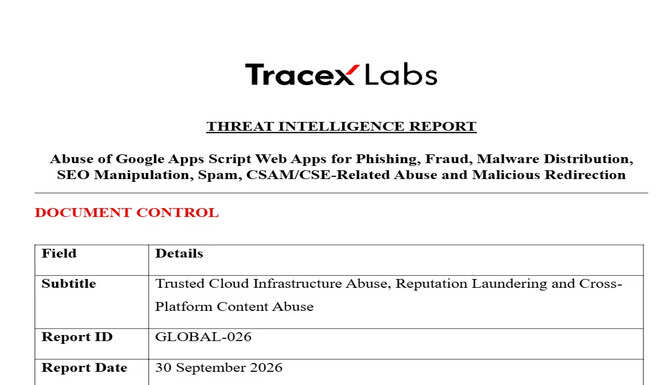
UdaipurTimes, October 01, 2026 | Technology Update: TraceX Labs has published a new threat intelligence report examining the abuse of Google Apps Script Web Apps in phishing, fraud, malware distribution, SEO manipulation, spam and other malicious or potentially harmful online activity.
The report, titled “Abuse of Google Apps Script Web Apps for Phishing, Fraud, Malware Distribution, SEO Manipulation, Spam, CSAM/CSE-Related Abuse and Malicious Redirection,” was published on September 30, 2026, under report ID GLOBAL-026. TraceX Labs classifies the overall threat assessment as high.
Google Apps Script Web Apps and the abuse problem
Google Apps Script is a legitimate cloud-based development platform that allows users to create applications and automate tasks using Google services. Web Apps can process HTTP requests, generate HTML content, accept parameters and interact with external resources.
According to TraceX Labs, these capabilities can also make Web Apps useful as intermediate infrastructure in abuse campaigns. A typical chain may involve a victim reaching an Apps Script URL through search results, social media, email or messaging platforms before being redirected to another website or resource.
The report stresses that the presence of a Google-hosted URL does not by itself indicate malicious activity.
Phishing, fraud and malware distribution
TraceX Labs identified phishing and fraud as important abuse categories involving Apps Script infrastructure. Potential campaigns include credential harvesting, investment scams, employment scams, fake payment pages and other forms of social engineering.
The report also documents observations and correlations involving malicious Android APK distribution and malware delivery. It notes that malware-related conclusions should be supported by malware analysis or reliable reputation data rather than being based only on the URL or hosting platform.
The report describes a common architecture in which an Apps Script Web App acts as an intermediate page or redirector before sending users toward external infrastructure.
SEO manipulation and search spam
Another major area examined by TraceX Labs is search-engine abuse.
The report identifies keyword-heavy pages, doorway pages, automatically generated content, repeated page templates, large numbers of outbound links, unrelated keywords and redirect chains as indicators that may be relevant when investigating SEO manipulation.
TraceX Labs notes that when such infrastructure is deliberately used to manipulate search visibility, the activity may correspond to the MITRE ATT&CK technique T1608.006, SEO Poisoning.
The report recommends examining behaviour and campaign relationships instead of treating every Apps Script URL as malicious.
Spam and other abuse categories
The research also covers gambling and betting spam, adult and NSFW spam, drug-related spam, deepfake and synthetic-media spam, Google video and search spam, and movie-piracy-related search spam.
TraceX Labs states that the presence of keywords associated with gambling, drugs or piracy is not automatically sufficient to classify a website as cybercrime. Context, behaviour and supporting evidence are required.
Suspected CSAM and CSE-related infrastructure
One of the most sensitive findings in the report concerns suspected CSAM/CSE-related infrastructure.
TraceX Labs classifies this area as “Suspected / Corroboration Required”, rather than presenting the activity as conclusively established. The report states that stronger evidence and careful validation are required for such cases.
The report also advises investigators not to unnecessarily download, reproduce or redistribute suspected illegal material. Public reporting should rely on appropriately redacted evidence.
A Google domain does not guarantee legitimate content
A central point in the TraceX Labs report is that the reputation of the underlying cloud provider should not be treated as proof that a specific hosted page is safe.
The report states that a Google-owned URL does not establish that Google created or endorsed the content, operates the final destination, or that external infrastructure reached through the URL is trustworthy. HTTPS encryption similarly does not establish legitimacy.
This distinction is important for security teams investigating cloud-hosted infrastructure because legitimate services can be abused without representing malicious intent by the platform provider.
How security teams can investigate Apps Script abuse
TraceX Labs recommends combining multiple sources of evidence during investigations.
At the URL layer, analysts can examine suspicious Apps Script URLs, unusual parameters, repeated deployment identifiers and known malicious destinations. Web proxy telemetry can then be used to identify redirect chains, final destinations, downloaded files and MIME types.
Endpoint telemetry can provide additional evidence, including unexpected APK downloads, suspicious file execution, browser-originated downloads and credential-submission activity.
The report recommends correlating Apps Script URLs with destination domains, IP addresses, autonomous systems, certificates, URL parameters, file hashes and related campaign infrastructure.
Evidence-based classification
TraceX Labs uses several evidence categories in its research, including Observed, Correlated, Suspected, Potential, Benign and Unknown.
The report warns that screenshots or isolated URLs do not establish attribution, criminal intent, ownership or affiliation with Google. Similarly, infrastructure association should not automatically be interpreted as attribution to a specific actor.
The report recommends an investigation model of:
Discover → Validate → Correlate → Classify → Report
This approach is intended to help security teams distinguish legitimate cloud usage from infrastructure that may be participating in phishing, fraud, malware distribution, search manipulation or other abuse.
TraceX Labs report
The new TraceX Labs report provides a security-focused examination of how legitimate cloud-hosted services can become part of broader abuse infrastructure. It calls for behavioural analysis, destination analysis and infrastructure correlation rather than indiscriminate blocking based only on the hosting provider.
The full report is available through the TraceX Labs reports section
https://tracexlabs.com/reports/google-apps-script-abuse-threat-report-2026.html
