

India’s 2026 IT Rules Amendment: What It Means for AI-Generated Content and the Content Industry

Contributed by: DA Sachin Sharma
Udaipur, Feb 17, 2026: On 10 February 2026, the Government of India notified amendments to the Information Technology (Intermediary Guidelines and Digital Media Ethics Code) Rules, 2021, explicitly defining and regulating “synthetically generated information” . This is the first time India has formally carved out a legal category for AI-generated audio, visual, or audio-visual content that appears real or indistinguishable from real-world events or persons. The move shifts the conversation from voluntary disclosures to enforceable due diligence.
At the core of the amendment is clarity. The rules define “synthetically generated information” as content created or altered using computer resources in a way that can appear authentic or depict real individuals or events convincingly . Crucially, the definition excludes routine and good-faith edits-colour correction, compression, transcription, accessibility improvements, educational formats, and draft content-so long as these do not materially alter context or create false records . This distinction matters for the content industry because it separates professional post-production from deceptive fabrication.
From Platform Discretion to Mandatory Due Diligence
The rules require intermediaries that enable AI content creation or dissemination to deploy “reasonable and appropriate technical measures,” including automated tools, to prevent unlawful synthetic content-especially content involving child sexual abuse material, non-consensual intimate imagery, false documents, weapons/explosives guidance, or deceptive portrayals of real persons/events . This converts what was previously best practice into compliance obligation.
For the content industry, this will reshape platform workflows. Upload pipelines will increasingly include automated risk detection before publishing. Significant social media intermediaries must require users to declare whether content is synthetically generated and must deploy technical measures to verify the accuracy of that declaration . If confirmed as synthetic, the content must carry clear, prominent labelling; audio must include a prefixed disclosure; and, to the extent technically feasible, permanent metadata or technical provenance markers (including a unique identifier) must be embedded . Platforms cannot enable modification or removal of such labels or embedded provenance once applied .
This signals a structural shift: platforms are no longer neutral conduits for synthetic media. They are compliance actors responsible for verification and traceability. The risk of losing safe-harbour protection if due diligence fails heightens this obligation.
Compression of Timelines and Escalation of Accountability
The amendment tightens response windows. Removal/disablement timelines linked to certain directions are shortened-most notably, “thirty-six hours” replaced with “within three hours” in specified contexts . Grievance and response timelines are also compressed in multiple places . For content companies and creator-led channels, this means incident response must be faster, documented, and operationally ready.
The rules also require intermediaries to inform users at least every three months about consequences of non-compliance, including suspension/termination, removal, and potential legal liability . When synthetic content violates law-such as under the Bharatiya Nyaya Sanhita, POCSO, or other listed statutes-reporting to appropriate authorities may be triggered . This embeds a compliance culture into user onboarding and retention.
Economic Impact: Production, Distribution, and Trust
1) Production Economics.
Mandatory labelling and embedded provenance will likely standardise AI-assisted workflows. Studios and independent creators will increasingly adopt toolchains that preserve verifiable metadata and support watermarking/provenance frameworks. Compliance-friendly tools will gain market advantage. Production houses that build with traceability in mind will reduce takedown risk and platform friction.
2) Platform Gatekeeping.
Verification obligations and automated detection will make distribution more curated. Expect higher pre-publication friction for high-risk formats-real-person voice cloning, political simulations, or realistic reenactments. This may slow some viral cycles but can also elevate trust in labelled, compliant synthetic media.
3) Brand Safety and Advertising.
For advertisers, clearer labelling reduces brand risk around deceptive or unlawful synthetic content. Over time, inventory that adheres to provenance standards may be priced differently. A compliance premium can emerge.
4) Creator Professionalisation.
The industry will bifurcate between hobbyist AI usage and professional pipelines that incorporate declarations, model logs, consent documentation for likeness use, and immutable provenance layers. Agencies and studios may introduce synthetic-content registers and internal review boards.
5) Risk of Over-Removal.
Tighter timelines and automated tools can increase false positives. Creators working in satire, parody, docudrama, or educational simulations must be careful with contextual disclosures and metadata, or they risk removal despite lawful intent. The exclusion for good-faith edits helps, but documentation is now essential .
What Creators and Publishers Must Keep in Mind
First, treat AI labelling as non-negotiable. If content is synthetically generated in a way that could be perceived as real, it must be prominently labelled, and where feasible, carry embedded provenance that cannot be stripped downstream . Build this into your export presets.
Second, document consent and context when depicting real persons-especially likeness, voice, conduct, or events. The rules explicitly address deceptive portrayals of natural persons and real-world events . Maintain release forms, prompt logs, and model usage notes.
Third, anticipate faster takedown cycles. With shortened timeframes and automated monitoring, internal escalation protocols should be tight. Appoint a compliance lead, track user declarations, and maintain an audit trail.
Fourth, separate routine editing from synthetic fabrication. The amendment protects routine and good-faith formatting, enhancement, and accessibility improvements that do not materially distort context . Make this distinction explicit in your workflow documentation.
Fifth, avoid high-risk categories. Content involving minors, non-consensual intimacy, false documents, weapons/explosives guidance, or deceptive impersonation will face zero tolerance and likely reporting to authorities .
Finally, invest in tooling. Use platforms and generation tools that support watermarking, cryptographic provenance, and unique identifiers. Do not rely on manual captions alone if your distribution partners require embedded markers.
Bottom line:
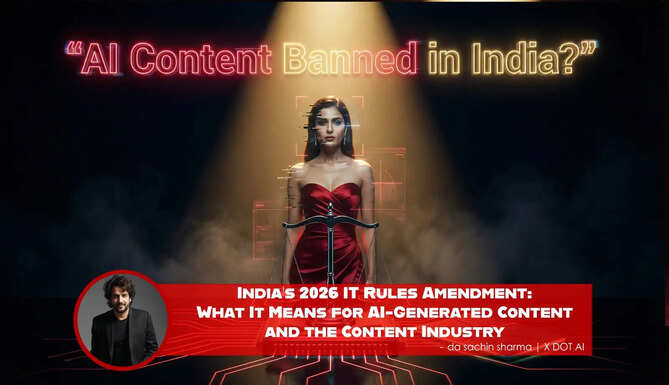
India’s 2026 IT Rules amendment does not ban AI-generated content. It formalises it. The content industry can continue to innovate-but only within a framework of disclosure, traceability, and rapid accountability. In this new environment, trust becomes infrastructure.
#IndiaTechPolicy #AIRules2026 #SyntheticMedia #DeepfakeRegulation #DigitalMediaLaw #AICompliance #ContentCreatorsIndia #TechRegulation #PlatformPolicy #MediaEthics #RajasthanNews #UdaipurNews #UdaipurTech #DigitalIndia
