

Tesla Flying Car Demo: Elon Musk’s Roadster Stuns Tech Fans
Tesla’s latest Roadster demonstration has sparked fresh interest in flying-car technology. Here’s what happened in Texas, how the technology may work and whether flying cars could become a reality.

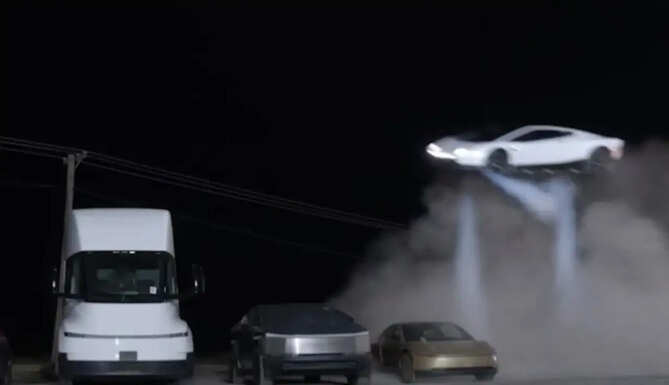
October 16, 2026: Cars drive on roads, but what if they could also fly in the sky? For a long time, such scenes were mainly seen in science fiction movies. However, Tesla has now surprised people with a demonstration of its new Roadster. The car was seen moving upside down on a specially designed curved ramp, briefly lifting into the air and landing safely on the ground. This demonstration by Elon Musk's company has sparked curiosity among technology lovers. The big question is whether the era of flying cars is finally approaching.
The demonstration took place at a SpaceX facility in McGregor, Texas, USA, on October 15. The newly designed Tesla Roadster moved up a huge curved ramp before travelling upside down along it. The car then appeared to lift into the air briefly before landing safely again.
Elon Musk shared a video of the demonstration on the social media platform X, suggesting that flying cars could become a reality in the future. Tesla's official account also released footage of the demonstration. However, this does not mean people can start planning to fly their own cars just yet.
How Is This Possible? What Does Science Say?
The technology behind this demonstration reportedly involves combining rocket technology with automotive engineering. The new Roadster is expected to feature cold-gas thrusters developed by SpaceX. In simple terms, these systems release high-pressure gas in one direction to generate thrust in the opposite direction. The same basic principle is used in rocket propulsion.
A conventional car engine moves a vehicle by turning its wheels. Thruster technology, however, could offer new possibilities for controlling a vehicle's movement. Still, making a car function as a true flying vehicle involves several major challenges. These include maintaining balance, controlling direction, ensuring safe landings, managing the power supply and protecting passengers.
Will Tesla Cars Fly on Public Roads?
This is the biggest question. The demonstration took place in a controlled environment, and there is no confirmed information about approval for using the car in flight on public roads. Safety requirements, legal permissions and everyday usability remain major challenges.
Tesla first announced its next-generation Roadster in November 2017. After a long wait and several delays, the company has started discussing its production plans again. The latest demonstration has renewed interest in the future of flying-car technology. What seems like a science fiction fantasy today could eventually influence the future of transportation. However, there is still a significant gap between demonstrating a flying car and making it safe and practical for everyday use.
