

India’s First LNG-Powered Train Flagged off from Sabarmati
Union Home Minister Amit Shah inaugurates projects worth Rs 1,472 crore and flags off country’s first LNG-powered train from Sabarmati Railway Station

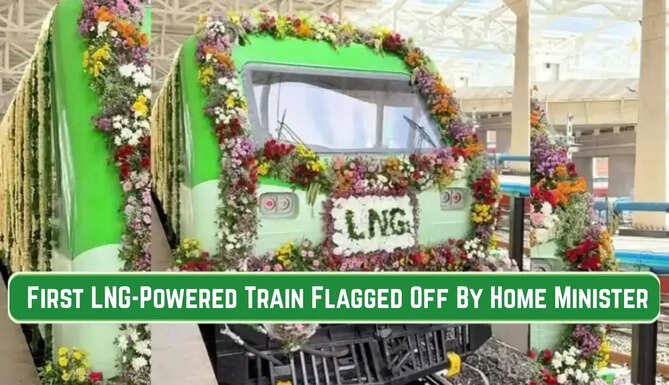
UdaipurTimes, Sept 28, 2026 - Union Home Minister and Minister of Cooperation Amit Shah on Sunday, September 27, inaugurated development projects worth Rs 1,472 crore and flagged off the country’s first Liquefied Natural Gas (LNG)-powered train from Sabarmati Railway Station in Ahmedabad, Gujarat. He also inaugurated the WAG-12 Maintenance Shed being constructed at a cost of Rs 700 crore for the maintenance of railway locomotive engines. Gujarat Chief Minister Bhupendra Patel and several other dignitaries were present on the occasion.
Addressing the programme, Union Home Minister Shah said the development works inaugurated will prove to be highly significant for the region in the coming days.
The Kavach train protection system has been introduced on the Sabarmati–Kalol–Sabarmati rail section at a cost of Rs 48 crore to enhance safety. In addition, works have commenced for the implementation of Kavach on the Ahmedabad–Palanpur and Ahmedabad–Samakhiali rail sections, as well as the doubling of the Sabarmati–Sarkhej railway line.
The LNG-powered train has been developed by the Integral Coach Factory (ICF) in Chennai and will operate from Sabarmati Junction to Mehsana. The use of LNG will also help lower fuel costs. LNG is cheaper than diesel, and according to Indian Railways' estimates, each DPC could help save approximately Rs 11.9 lakh per year. Accordingly, an eight-coach train could save around Rs 23.9 lakh annually.
According to the Ahmedabad Railway Division, Indian Railways is using an LNG-based fuel system in a train’s Driving Power Car (DPC) for the first time. Under this technology, the engine can run on both LNG and diesel. Depending on fuel availability, the engine can use either of the two fuels.
The new technology is expected to reduce diesel consumption by up to around 40% and also help reduce pollutants such as carbon dioxide (CO₂), nitrogen oxides (NOx) and particulate matter (PM).
Two 1,400 HP DPCs have been converted to an LNG-diesel dual-fuel system. More than 2,000 km of field trials have already been conducted on both converted DPCs. Each DPC has been fitted with an LNG tank with a capacity of approximately 2,200 litres. The tank can hold around 950–1,000 kg of LNG. With this quantity of fuel, the train can travel approximately 440 km.
