

Breakthrough Discovery: Sperm Whales Use Structured Language Similar to Humans

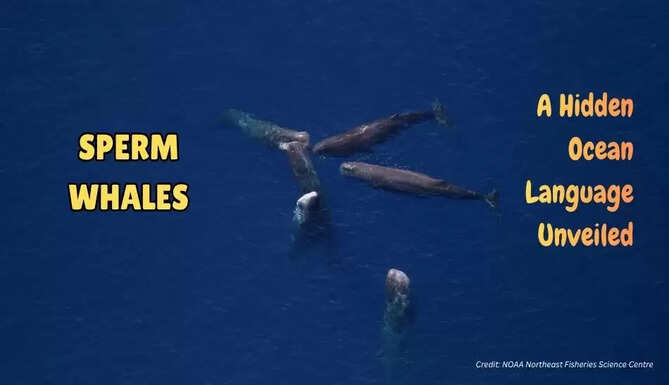
Nov 14, 2025 - In the deep blue ocean, where human voices cannot reach, a language has been echoing — one that was a mystery until now. Artificial intelligence has now decoded the clicking sounds exchanged between sperm whales, and scientists are amazed to find that this language is very similar to human language.
In a new study from UC Berkeley’s Linguistics Department and Project CETI (Cetacean Translation Initiative), scientists from discovered that whales communicate in patterns called codas — sequences of clicks that contain two vowel-like sound types: an a-vowel and an i-vowel These are not random; instead, the length, pitch and rhythm of each click follow a deliberate structure, much like how we form words and sentences.
Just as the meaning of words in human languages can change with vowel length, whales also follow “linguistic rules.” Codas with the “a” sound resonate in longer rhythms, while those with the “i” sound appear in both short and long forms.
Whales use this language within family groups — such as communication between mothers and calves, coordinating while searching for food, or maintaining group identity.
Scientists working on Project CETI has spent the last five years studying sperm whale communication and behaviours. They used tags, buoys, aquatic drones and aerial drones. In the Caribbean Sea, researchers attached small suction-cup devices called D-tags to 15 sperm whales and recorded nearly 4,000 codas.
These findings can revolutionise the human’s understanding of the animal world. Researchers hope that one day AI will be able to fully translate this language.
Source: Media Reports
#WhaleLanguage #AIDecoding #SpermWhales #ProjectCETI #OceanMysteries #AnimalCommunication #MarineScience #DeepSeaResearch #WhaleCodas #AIBreakthrough #WildlifeDiscovery #ScienceNews
