

An Open Letter to My Gen Z
An Open Letter... from author Rajesh Chaplot to the generation in India born between 1997 to 2012
Rajesh Chaplot is the recipient of:
- Pravasi Bhartiya Samman Award 2019, the Highest Non-Resident Indian Award, conferred upon him by the President of India
- Golden Jubilee Award 2020, the Highest Civilian Award, conferred upon him by the President of Uganda
Dear Gen Z,
I admire you... I admire you as you want logic before believing. I admire you as you want results, not promises or excuses. I admire you as you believe that the system can be changed. I admire you as you want to change the system quickly, and that too, within your own active lifetime. I admire you as you refuse to take part in tax evasion. I admire your emphasis on socially-conscious behaviour, on climate change and sustainability. I admire you for your strong belief in global connectivity. I admire you as you want people in power to be held accountable. I admire you as you value work-life balance and reject the hustle culture that leads to burnout. I admire that you care more about the purpose of your life than the size of your paycheque. I admire you as you do not judge people based on their caste and ethnicity. I admire you for your dressing sense .
I am you...
I was not born in the era of smartphones, high speed internet and social media like you are. But I treat myself as Gen Z in spirit. I wear torn jeans. I make silly jokes. I question my parents. I challenge the system and the society I live in. I do not believe anything until it has logic behind it. I left a well-paying job in Africa to pursue my passion. I like sitting in bars and coffee shops. I want to live for myself, too. I do not get pushed by society rules.
Today, your age is somewhere between 14 and 29 years. You are a mix of people standing at some of the most interesting turning points of life i.e., in high school, in university, into careers or stepping into the systems of the Nation. You belong to the generation which is best placed to talk about education, career and the system.
Biggest issues you face...
• Society and family who do not understand you
• An old, redundant and corrupt system that eats away your opportunity, your ease of life and your time
Solution: Your Demand for Change
Now let us talk about bringing and managing change…
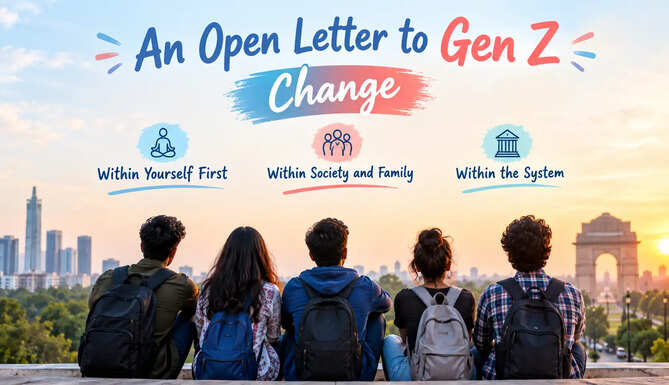
Change - Within Yourself First
Whatever change you want to bring, adopt it within yourself first. Very soon, you will have the system of your country in your own hands and, if you do not like corruption, tax chori, bad governance, destroying public property, let all such traits stop with you. Ensure you too are not becoming a part of the same redundant system which you have been challenging. Make sure the buck stops here.
Change - Within Society and Family
Most of this gap is not because your parents do not love you or you do not love them. It is because they grew up being told that respect means silence and believing what has been told to them by theirs elders while you grew up being told that respect means good ethics like honesty. It is because you believe in the value of time and hence, want results quickly. It is because you believe in science and logic instead of what parents and grandparents have been telling. It is because you believe in living in the present with freedom without the shackles of society. It is because you believe that rules and system of society need to be evolved for the betterment of society in view of technology change and logic. It is because you believe leaders to be chosen project-by-project based on expertise and not based on who is elder in the family. It is because you treat boys and girls equal. It is because you do not choose leader by birth and instead choose them by capability.
Bridge that gap by explaining your reasoning instead of simply rejecting theirs. Invite them into your world in small doses - a video, an article, one honest conversation at a time, instead of expecting them to accept it all at once. Change at home rarely comes from a single argument. It comes from a hundred small moments where you choose patience over proving a point.
Change - Within the System
In order of preference, from the first option to the last:
- Elect the right government.
- Push for policy change through advocacy and dialogue with those concerned.
- Use the legal framework available to you.
- Turn to peaceful activism, but under the leadership of your own people, not political parties or politically-affiliated people.
Where are you most vulnerable…
Misinformation
- Social media scams and AI-generated misinformation.
- Social media algorithms used by hidden interests to provoke you.
- Lack of fact checking before sharing further.
- A tendency to trust a headline more than the full story behind it.
Leaderless Activism
Leaderless activism is excellent at toppling a system, but far less structured when it comes to rebuilding one. It is hard for a movement without leaders to sit at a negotiating table with a government. Leaderless activism can lead to unpredictable results... results that can set a Nation back by a decade. Peaceful activism under good leadership is the better answer.
Your Movements Taken Over by Outside Interests
- Foreign actors may use you without you ever realising it.
- Protests taken over by mob mentality, State brutality or political hijacking.
Loss of Life and Loss of National Assets
- Damage to public property or violence against law enforcement or civilians during activism.
- Protests that break the law of the land, or excessive force from law enforcement that can put your life or someone else's in danger.
- A movement remembered for the damage it caused, instead of the demand it made.
Social and digital media... A big source of information, data or content
A powerful tool for you, Gen Z, but a disaster if not used with care.
In the generation before you, public opinion was shaped by traditional media, radio, television, newspapers and the experiences of the people around us. Your generation is the first to form its opinions mainly through short videos and feeds on social and digital media.
You, and many of us older than you, feel that traditional media is paid and biased. That is often true. Most media around the world, including India, is influenced by money - whether from political outfits, business interests or other parties with something to gain. For the last few decades, even foreign governments have used the media of other countries to destabilise them.
But does it mean that social media is the foolproof answer? Some argue that when millions of people are posting on social media, the problem of paid influence becomes minimum.
A large number of Gen Z form an opinion after watching ten short reels, four videos and a couple of online clips. Ten reels and four videos are not research, they are a mood. The algorithm in social media does not care what is true. It cares what keeps you watching more and more.
Many of these short reels are made or amplified by AI. They rarely explain what happened before that moment or what happened after. They run on algorithms and if you belong to one school of thought, you will keep being fed reels that match it. You may never see the other side of the story. Even social media algorithms are managed to favour whoever pays for that reach.
So how sure can you, or anyone, be that what you are seeing and hearing is accurate?
You already challenge everything that comes your way. So, challenge the content on social media with the same energy. You will often be surprised by what you find.
Traditional media is regulated by the laws of the country it operates in. Social media is fed by millions of people across the globe, including from countries that may not wish your country well, which makes it very difficult to regulate, by the government or by the platforms themselves.
Traditional media houses carry the weight of large investment and tend to behave more responsibly and face more regulation. Here is a simple example. On Instagram, a post claiming that Mr and Mrs X gave birth to a baby dog can collect thousands of likes. Would you ever see a story like that on a licensed television news channel?
A peaceful movement or protest is a right. Violence is a choice.
Hold this line without bending it. A peaceful protest is a right that nobody should take from you. Breaking the law is not part of that right. Someone in uniform is also someone's son or daughter, someone's parent, going home every day to a family that worries about them. Fighting for justice should never mean deciding that another person's safety does not matter.
Here is something nobody tells you enough. Before you decide to burn down a system, ask yourself honestly… do you have something better to put in its place, or just the anger to tear it down? Anger is easy. Building is hard. You are capable of the second one. Do not let anyone convince you that the first one is enough.
A simple test for peaceful protest
Any protest that breaks the law of the land cannot be called peaceful just because no one throws a punch. Ask yourself this. Would you allow this same action if you were the one running the government? Do only what you would allow if you were the one in charge.
The system has a right to stop any unlawful activity or a march towards an unauthorised venue. And if it cannot be stopped with a warning then force needs to be used and its intensity can increase. Who is to blame? This movement or protest cannot be called peaceful by any means.
Unlawful Movement/Protest that Turns Violent - The Consequences
- Economic consequences: Post protest violence often leads to instant instability, capital flight and the collapse of local businesses, which in turn hurts the working class and young job seekers the most.
- Loss of public property: Schools, buses, stations and hospitals built with public money take years to repair and the cost of rebuilding them falls on everyone, including you.
- Loss of life: Protestors, law enforcement personnel and civilians with no stake in the cause can lose their lives, and no policy win is worth a life that does not come back.
Methods of Peaceful Movements or Protests
- Suggesting a solution to the problem: Draft the policy you want to see and put it in front of the people, media and the governing body.
- Electoral mobilisation: Choose that political party to lead you which you believe can serve your purpose the best.
- Exposing the system digitally, challenging it legally: Educate the unaware through media and social media, challenge the governance legally wherever it is possible.
- Economic boycotts and strikes: Forcing policy change by disrupting cash flow peacefully rather than damaging physical infrastructure
- Protesting at a designated venue: Keep the protest at one agreed location, and, if marching, stay on the authorised route
Why some of your colleagues have considered suicide: Who can help to avoid such acts!
When you ask your parents and society hard questions - how, why, why not - you are often met with silence instead of answers. The older generation is not used to being challenged, and when they have no answer to a fair question, some create distance instead of engaging with it. At the same time, parents, family and society may keep expecting just as much from you as before. That combination, distance plus high expectation, can leave you frustrated and alone.
If you are carrying any type of pressure at home related to exams, exam scores, career, comparisons, or other related issues, please know this is not a flaw in you. Too many young lives have been lost to such pressure that was never theirs to carry alone. If you are struggling, you do not need to have everything figured out before you ask for help. You need one person willing to sit with you without judging you.
In most cases, it is not the school, the coaching centre, the system or Fate which has led many of your friends to commit suicide. That could have been avoided or can be avoided if parents offer their child a shoulder to cry on! If parents do not put undue pressure on their child! In that case, no child will lose his/her life!
It may be argued that sometimes children put themselves under self-created pressure because of external factors or commit some mistake. But such cases also can be avoided if parents offer an open door to their children to communicate or share their sorrows with them. Parents also need to talk regularly with their children and tell them that they love them unconditionally and will support them under all circumstances!
Children do not need perfect parents. They need a safe place to come back to. They need acceptance more than expectation!! Let them feel that they are not alone .
Gen Z and your voting power...
As of now, Gen Z makes up nearly thirty percent of India's electorate. By 2029, Gen Z, together with young millennials, are projected to cross half of all voters in the country. You have the power in your hand. Use it wisely. Do not avoid the electoral process. Rejecting is easy, choosing difficult and taking responsibility even more difficult. You are supposed to either choose or take the responsibility. Take on the leadership role if you are not happy with the choices in front of you.
Immediate Past and Historical Past - Understanding the Difference
I know you are not so keen in knowing much about the past. Which is fair. However, let us understand the difference between the immediate past and the historical past. Historical past has only academic value and there is no need to react based on that. But, the immediate past needs to be considered in decision making. Many of you do not want to consider the facts which existed between your age zero and 15. You just see what is happening after you started understanding life. And you are prompt in rejecting instead of choosing. Compare the options and choose the best for you OR create the best for you.
To conclude....
Question everything, but build something, too. Protest when you must but propose when you can. Ask for every form of media to be held to a higher standard and question old beliefs using science and logic. Change for something better, not for the unknown. Doubt the system but do not let anyone hollow out your doubt and use it against you.
Between paid media and unpaid outrage, the truth usually needs more from you than a scroll allows. Before you back any call for regime change, decide honestly who is actually better, not just who is louder. Paid and biased media should be called out and regulated harder, and any platform that manipulates its algorithm for a price should be penalised. Listen to both sides of a story before you form an opinion. Do not become the puppet of any political party, unless you are choosing, with open eyes, to join one. Stay out of movements built on political loyalty instead of policy. And remember, a movement that destroys a country's infrastructure and costs hundreds of lives cannot be called a pure victory, no matter what it wins.
You are not the problem this country has. You might be the answer it has been waiting for... if you stay sharp enough to tell apart the people using you from the people actually standing with you.
This is my letter to you and to all who need to understand you!
With real respect
Rajesh Chaplot
The author is the recipient of:
- Pravasi Bhartiya Samman Award 2019, the Highest Non-Resident Indian Award, conferred upon him by the President of India
- Golden Jubilee Award 2020, the Highest Civilian Award, conferred upon him by the President of Uganda
