

The Judiciary-NCERT Row: Decoding Accountability & Ethics
A Class 8 NCERT Social Science chapter on judiciary accountability sparks Supreme Court intervention, apology from NCERT; Razia Sanwari reviews the nationwide debate on textbook revisions, censorship and institutional integrity

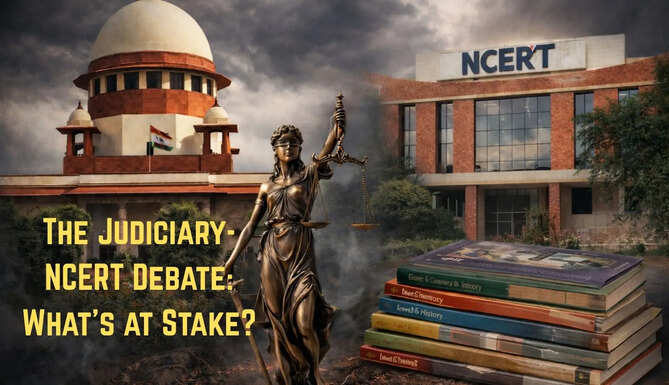
Udaipur, March 4, 2026 - Recently, a seemingly routine NCERT textbook update snowballed into a national debate lasting days and involving the judiciary, the Education Ministry and the NCERT. A chapter in a Class 8 Social Science textbook titled The Role of Judiciary in Our Society included a section referring to corruption and systemic challenges within India’s judiciary, such as alleged misconduct and extensive case backlogs. What was framed as a lesson on institutional accountability also appeared to question the integrity of a judiciary highly revered in our country.
With feathers of judges rightly ruffled, the matter quickly drew sharp scrutiny from the Supreme Court of India, which questioned the tone and implications of the content. A three-member Bench of Chief Justice of India (CJI) Surya Kant and Justices Joymalya Bagchi and Vipul M Pancholi, while hearing a suo moto case on the matter, ordered the book’s urgent seizure, removal of all digital copies and warned that accountability must be sought and “Heads must roll”.
NCERT subsequently tendered an apology, regretted the “inappropriate textual material” and “error in judgement” and immediately withdrew the book. The Education Ministry issued a statement saying it would conduct an inquiry into the matter and that responsibility for this will be fixed and action taken against the erring officials.
So, while the matter appears to have been sorted out, at least for the time being, it has, however, raised a couple of very significant questions in many minds.
Why should NCERT take it upon itself to guide young minds in a certain direction?
AND/OR
Why has the judiciary not taken cognisance of earlier textbook amendments which have largely been deemed unnecessary and controversial?
NCERT textbooks are used by millions of students nationwide, not just in schools but also as reference material for competitive exams. Changes to what is taught — especially in History and Civics — have often become focal points for larger debates about national identity, politics and how historical narratives should be represented… calling for greater care in how Constitutional bodies are portrayed to young students.
Let us look at some past instances where chapters or content were removed from NCERT textbooks and sparked public controversy, especially around how History and Social Science topics are presented:
In 2021-2022, during a major “curriculum rationalisation exercise”, NCERT deleted or dropped several chapters from Secondary School textbooks, which led to widespread debate and criticism from students, teachers, historians and political figures. The education body said the syllabus rationalisation exercise was to reduce the burden on students after the Covid-19 pandemic
What Were Removed
Class 10 (Democratic Politics - II):
Chapters Democracy and Diversity, Popular Struggles and Movements and Challenges to Democracy were deleted.
Class 11 (Themes in World History):
Chapters such as Central Islamic Lands, Confrontation of Cultures and The Industrial Revolution were dropped.
Class 12 (Themes of Indian History Part II):
The chapter Kings and Chronicles: The Mughal Courts (c.16th-17th Centuries) was removed from the Class 12 History textbook (NCERT explained that the topic is repetitive because it is already covered in other classes and had been removed to reduce the burden on students during Covid.)
In 2016-2019, sections on Caste Conflict and Dress Change, cricket’s link to caste and region politics and colonial impact on peasants/farmers were removed.
NCERT removed references to the 2002 Gujarat riots, the chapter The Rise of Popular Movements and details regarding the 1975 Emergency from the Class 12 Political Science textbook, Politics in India since Independence, as part of a curriculum rationalisation process.
For the academic year 2023-24, there was a revision in some editions of the Class 12 Political Science and History textbooks' references to Mahatma Gandhi’s assassination context and the RSS being banned temporarily after Gandhi’s death.
Deletions Questioned
Critics argued that these deletions alter the narrative of history and politics, reducing context on struggles, democracy challenges and global affairs, and potentially skewing education toward a "particular perspective".
Additionally, in 2003, NCERT was hit by plagiarism accusations from the Frontline Magazine when a Class 12 textbook Contemporary World History was found to contain several sections taken from World Civilizations – Their History and Their Culture, written by Edward MacNall Burns, Philip Lee Ralph, Robert E. Lerner and Standish Meacham.
While now, the NCERT has come under the scanner following the public reprimand from the Supreme Court, there have also been voices raised in favour of the education body.
NCERT former director JS Rajput has criticised the Supreme Court's handling of the matter lamenting that “the Supreme Court's observations have unfortunately lowered the image of the NCERT”. He argues that the matter could have been resolved through dialogue rather than immediate rejection of the NCERT's apology. Rajput believes that the Court acted in haste and “could have done it in a much better way”.
Corruption Charges?
On the other hand, there are those who have also voiced their opinion on the judiciary’s taking offence to the “judicial corruption” mention in the book asking if it was not true that there have been corruption charges against judges in the past?
If we do some research, there have been instances of judges implicated in alleged corruption, misconduct or related controversies. More than 8,600 complaints were received by the office of the Chief Justice of India against sitting Supreme Court and High Court judges between 2016 and 2025. These included allegations of corruption, misconduct and other improprieties — though not all specific cases have been publicly detailed. This data came from the Union Law Minister’s reply in Parliament in February 2026. And reports say the grievances have increased in recent times with almost half of all such complaints received between 2022 and 2025.
Between 2017–2020, the judiciary was rocked by the medical college admission scandal involving an Allahabad High Court Judge Narayan Shukla. He was alleged to be involved in irregularities and bribery in medical college admission scam.
In March 2025, a large amount of cash (reportedly several crore rupees) was alleged to have been found in a storeroom at the official Delhi residence of Justice Yashwant Varma during a fire response. A committee recommended impeachment proceedings. Justice Varma’s petition challenging this was rejected by the Supreme Court in late 2025, noting his conduct “does not inspire confidence.”
Conclusion
All said and done, the NCERT should not be the one to judge about how to present topics - sensitive or not - to young minds. Let the facts be known to them, the way they are. Because history cannot be rewritten. Let us give credit to our education system to help students develop a discerning mind and form their own opinion.
On the other hand, many want the judiciary to be equally proactive when other Constitutional bodies are also being questioned.
Maybe this incident will act as a precedent. Time will tell.
(All above examples cited are based on sources)
#NCERT #SupremeCourtOfIndia #JudiciaryDebate #EducationPolicy #TextbookControversy #CurriculumRationalisation #IndianJudiciary #AcademicFreedom #ConstitutionalInstitutions #EducationNews #IndiaNews #RajasthanNews #UdaipurNews
