

Stray Animals: The Politics of Compassion
In the first of his two-part series, Udaipur-based author and entrepreneur Rajesh Chaplot analyses the hypocrisy that has spilled over from the stray animal debate in India

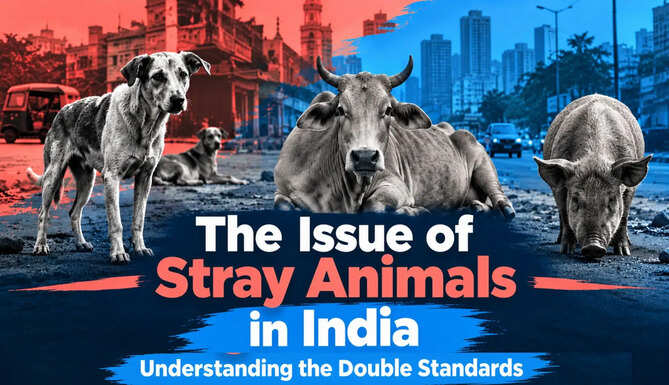
UdaipurTimes, Oct 18, 2026 - This article sets out to identify the various stakeholders connected to the stray animal issue in India, to define them clearly, to help each side understand the other's feelings and to honestly lay out the concern and danger the issue of strays poses for children and the public at large. It compares India's experience with that of the developed world and looks closely at the role government, NGOs and street stray animal lovers must each play if the problem is to be genuinely solved rather than merely argued about.
This article is not against animals nor against protecting them. It is written with one simple conviction: prioritise human beings on the streets of our cities and villages, and prioritise animals inside the jungle that belongs to them. Every living being has a territory meant for it. The crisis before us is largely one of both sides encroaching on each other's space. Let us not encroach on each other's territory.
The Kinds of Animal Lovers
Before going any further, let us define a few categories of stakeholder, because people often use these terms interchangeably even though they mean slightly different things. It is also worth noting that one stakeholder can belong to more than one category at the same time.
Animal lover is someone whose care extends broadly to animals of every kind - at home, on the street, in the wild or on a farm.
Pet lover is a little more specific. It is someone whose deepest affection is directed at the particular animal living in their own home.
Then there is the person who simply loves their own pet without necessarily extending that feeling any further.
Animal dislike-r is someone who feels discomfort or dislike toward animals in general.
Stray animal dislike-r feels that same discomfort more specifically toward animals living on the streets, rather than toward animals as a whole.
Non-vegetarian is simply someone who eats meat as part of their diet, a personal and cultural choice shared by a large part of the country.
Who are the strays on Indian streets?
Across Indian cities and towns, the animals most commonly seen living on the streets are dogs, pigs and cows, along with occasional sightings of other creatures depending on the region, such as snakes, leopards, elephants, wild boars and nilgai (blue bull), among others, who wander in from nearby forests or rural fringes. There are also pigeons and other birds who do not live on the street per se but fly in and settle on our balconies.
Stray animals of immediate concern
● Street dogs have lived in the same lane or market for generations, often informally fed by residents.
● Pigs are frequently found near garbage collection points and open gutters, usually owned by someone even though that ownership is rarely visible.
● Cows are often let loose to graze freely during the day, particularly in smaller towns. Some do have an owner who benefits from their milk, while others are abandoned once their milk production falls and they are no longer commercially viable.
Stray animals NOT of immediate concern
These animals will not be discussed in great depth in this article, since the magnitude and frequency of harm they cause are comparatively low, or because they are difficult to handle directly, or because wildlife authorities are already equipped to catch and return them to the forest.
● Birds in the air: They have lived alongside human beings for ages. Pigeons in particular are fed by people in keeping with certain religious traditions.
● Animals visiting from nearby jungles: Animals like leopards occasionally wander in from nearby forests.
● Creatures coming out of the ground: Reptiles such as snakes and monitor lizards have always lived close to our homes, mostly underground or in the undergrowth.
How strays affect human life
This is a subject worth discussing honestly, because pretending a challenge does not exist rarely helps anyone, including the animals themselves.
This section discusses only those animals whose presence has a significant impact on human life, human health and the aesthetics of Indian streets, and for whom humane, non-lethal removal is genuinely possible.
So, we will look more closely at street dogs, cows and pigs.
Cows left on the loose, resting near busy roads contribute to a considerable number of highway accidents, some of them fatal, especially at night and routinely slow down highway traffic. In villages, cows, buffaloes and other stray animals also frequently damage standing crops.
Street dogs are a cause of dog bites, road accidents and slowed traffic. Members of the public walking the street are sometimes attacked and injured by them, occasionally tragically, with even small children losing their life.
According to data reported by Al Jazeera drawing on the Ministry of Health and Family Welfare figures, dog bite cases in India rose to nearly 3.7 million in 2024, and dog bites are behind almost every rabies death recorded in the country. These numbers explain why the issue receives so much public attention. As recently as 2025, the death of a six-year-old girl in Delhi from rabies after a stray dog bite prompted the Supreme Court to take suo motu cognisance of the wider crisis.
Street pigs majorly make streets unhygienic which can lead to various community diseases. They spoil the aesthetics of the street, contribute to vehicle accidents and force traffic to slow down.
Streets shared with larger numbers of animals feel less tidy and less safe.
Stray animals in the developed world
In developed countries, it is genuinely rare to spot a stray animal wandering the streets. And this did not happen by accident. It has come from steady, long-term investments in a few key systems.
Every pet is linked to a national database through universal microchipping, which makes it easier to trace an animal back to its owner. This discourages abandonment. Breeding is closely regulated through licensing and fees, which naturally limits the number of accidental litters being born. High capacity, well-funded shelters ensure that any animal that does become lost or homeless is quickly taken in and cared for until it finds a family.
Human first or animal first?
Feeding, protecting and saving human life takes priority before responsibility is extended to animals. Not because animals matter less but because, like charity, responsibility must begin at home before it can be genuinely and sustainably extended further.
We need to feed and protect human beings first because we all know how many humans die each year of hunger!
Yes, animals need to be protected in the space meant for them - a pet inside the owner's home or a wild animal in the jungle. But, if a stray dog, cow or pig enters a town or village street, human safety must come first. Similarly, in the jungle, if a person enters without following proper protocol and an animal attacks him, the fault lies with that human.
In cities and villages, human safety and hygiene must come first, ahead of animals. The clearest example is how we deal with cockroaches at home - by eliminating them with a spray. Killing that very same cockroach inside a jungle would rightly be seen as an offence against that ecosystem.
Tomorrow Part II: The Questions We Rarely Ask Ourselves
Rajesh Chaplot is the recipient of:
- Pravasi Bhartiya Samman Award 2019, the highest Non-Resident Indian Award, conferred upon him by the President of India
- Golden Jubilee Award 2020, the highest Civilian Award, conferred upon him by the President of Uganda
