

New Dental Implant Design Could Reduce Surgical Intervention
Researchers develop a bi-layered structure integrating titanium alloy and zirconia components for dental applications

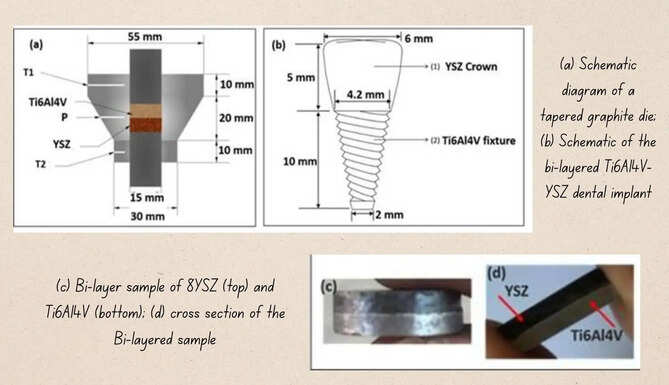
Sept 9, 2026 - There is positive news for those requiring dental implants. Researchers have developed a bi-layered structure integrating titanium alloy and zirconia components for dental applications that enhances durability, interfacial stability and biocompatibility while reducing surgical complexity.
As per a press release by the Ministry of Science & Technology, Scientists at the International Advanced Research Centre for Powder Metallurgy and New Materials (ARCI), an autonomous institute of the Department of Science and Technology (DST), have designed a functionally integrated bi-layered structure that integrates titanium alloy (Ti6Al4V) and yttria-stabilised zirconia (YSZ) into a unified structure to address persistent limitations of conventional implants.
In the structure, the Ti6Al4V serves as the load-bearing fixture for strong jawbone integration and YSZ forms the crown region to provide superior wear resistance and aesthetics.
Traditional dental implants consist of three components: a fixture embedded in the jawbone, an abutment connecting the fixture and crown and the crown itself. These multi-component assemblies are susceptible to micro-movements at the abutment interface, which can compromise osseointegration and lead to implant loosening.
Furthermore, such systems typically require two to three surgical procedures, increasing patient discomfort and clinical complexity. Although titanium alloys and zirconia are widely used due to their biocompatibility and mechanical strength, each material has inherent limitations. Ti6Al4V can be susceptible to corrosion and gum recession in the moist environment of the mouth, while zirconia, although aesthetically appealing and corrosion-resistant, may degrade over time due to hydrolysis, affecting its long-term stability.
The overall fabrication approach remains highly reproducible and suitable for scaling up to industrial production.
By integrating mechanical robustness, corrosion resistance, aesthetic performance, and biological safety into a single-piece architecture, ARCI’s bi-layered implant reduces the need for surgical interventions while improving long-term stability and patient outcomes. The innovation aligns with India’s growing demand for affordable, high-performance dental implants and strengthens indigenous biomedical device development.
This work has been published in the journal Materials Letters on ScienceDirect.
