

MLSU Team Gets Patent for Oral Cancer Drug Delivery Technology
The research was conducted under a project funded by the Ministry of Human Resource Development (MHRD) through the Rashtriya Uchchatar Shiksha Abhiyan (RUSA)

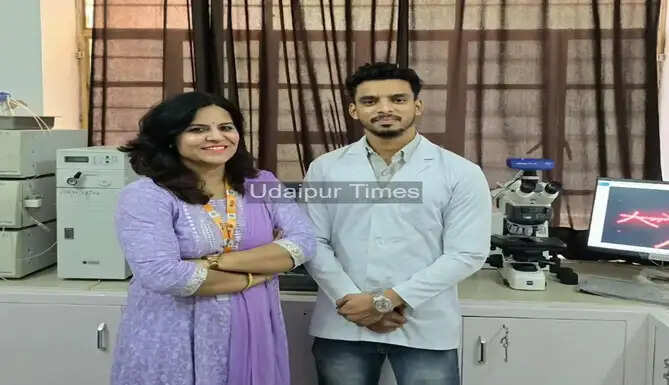
UdaipurTimes, Oct 20, 2026 — A research team from the Department of Pharmacy at Mohanlal Sukhadia University (MLSU) has achieved a significant milestone in making administering of cancer medications more convenient. The team has developed a specialised nano-formulation technology designed to deliver cancer drugs orally. The technology has received an Indian patent in 2026.
The research was conducted under a project funded by the Government of India’s Ministry of Human Resource Development (MHRD) through the Rashtriya Uchchatar Shiksha Abhiyan (RUSA). Professor Dr Garima Joshi of the Department of Pharmacy was the principal investigator of the project titled Design, Development and Characterisation of Oral Nano-formulation for Treatment of Cancer. Dr Deepak Chaudhary and Dr Harish served as co-principal investigators, while Sheikh Shahnawaz Qadir was appointed as a Junior Research Fellow.
Research Focussed on Pancreatic Cancer
The research involved the development of Nano-Structured Lipid Carriers (NLCs) and PLGA nanoparticles. The objective was to deliver anti-cancer drugs, such as gemcitabine hydrochloride and paclitaxel, into the body through oral administration. Currently, many chemotherapy drugs are administered intravenously, requiring patients to visit hospitals repeatedly and may also carry risks of side effects, including hair loss and bone marrow toxicity.
Dr Joshi explained, “The objective of our research was to develop an oral nano-formulation technology that could improve the absorption of anti-cancer drugs in the body, maintain their effects for longer periods and enhance the potential for delivering them to tumor cells.
According to the research team, the gemcitabine-loaded NLCs demonstrated sustained drug release for up to 72 hours. In laboratory tests involving PANC 1 cells associated with pancreatic cancer, the formulation showed approximately five times greater cytotoxic activity than conventional gemcitabine.
Animal studies recorded a 10.5-fold increase in the oral bioavailability of the drug, meaning that a substantially greater amount became available in the body after oral administration. Drug levels were maintained for up to 24 hours.
In an animal model involving DMBA-induced pancreatic lesions, the treated group showed indications that disease progression had been halted. No PanIN-3 lesions or invasive carcinoma were observed in this group. Studies using Caco-2 cells, a model of the intestinal barrier, also produced results suggesting improved drug absorption.
However, all these findings are based on laboratory and animal studies.
Indian Patent Granted in 2026
Based on the research, Indian Patent No. 579413 was granted in 2026 for an invention titled Nano-structured Lipid Carrier with Acidic Aqueous Phase for Enhanced Gemcitabine Hydrochloride Entrapment. The project also contributed to the development of modern laboratory facilities and research equipment at the university, creating opportunities for further research in pharmaceutical nanotechnology.
Findings from the research have also been published in international scientific journals, including the Journal of Drug Delivery Science and Technology.
Research Opens Doors to International Opportunities
Researcher Sheikh Shahnawaz Qadir received an international travel grant from the Government of India’s Science and Engineering Research Board (SERB). Through this grant, he presented his research findings at the BioNanoMed conference held in Graz, Austria, in 2023. The research also contributed to the development of his subsequent academic career. He was awarded a Commonwealth Split-site PhD Scholarship in the United Kingdom. Under the guidance of Professor Imran Saleem at Liverpool John Moores University, he expanded his research to investigate siRNA-based nanocarrier delivery systems for breast cancer treatment.
Clinical Trials Needed Before Technology Reaches Patients
According to the research team, the technology is currently at the preclinical stage. Further extensive studies and clinical trials will be necessary to establish its safety, appropriate dosage and effectiveness in humans. Therefore, the technology cannot yet be considered an established cancer treatment or an alternative to conventional chemotherapy. If subsequent studies and clinical trials are successful, this technology could contribute to the development of more convenient methods of administering cancer medications in the future.
