

Udaipur AQI Hits 195, Highest in Five Years on Nov 9
Rajasthan’s Sri Ganganagar tops the list of the world’s most polluted city with an AQI of 671

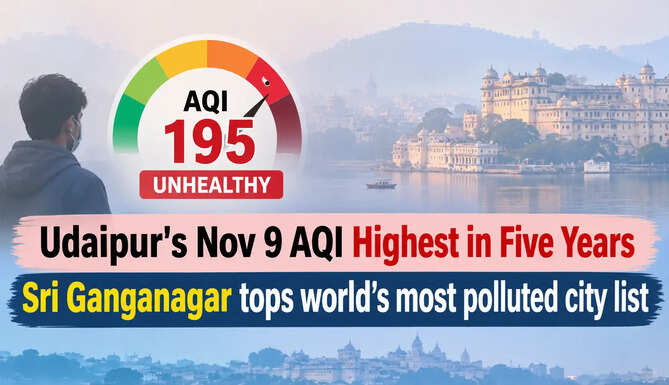
UdaipurTimes, Nov 10, 2026 - With the onset of winter, the looming worry across northern India is the alarming rise in the Air Quality Index (AQI). For the past few years, Delhi and NCR, Rajasthan and Haryana have reached ominous levels on the AQI index signifying hazardous pollution of the environment. This has led to concerns of extreme health issues like respiratory problems, heart diseases and skin issues, particularly among children and the elderly.
This year, too, vehicular emissions, stubble burning and firecrackers during Diwali have led to a sharp rise in air pollution across several North Indian States, including Rajasthan, Haryana, Uttar Pradesh (UP), Jammu and Kashmir and Delhi.
In fact, of the world’s 50 most polluted cities 47 are placed in India, as per reports quoting live air quality rankings on AQI.in. Rajasthan’s Sri Ganganagar tops the list of the world’s most polluted city with an AQI of 671 which places it in the “hazardous” category. The others among the top five are Haryana’s Hisar (428), Sirsa (400) and Bhiwani (395) and UP’s Budaun (381).
Delhi, which has in the past reached alarming levels on the AQI index, is ranked 13th after its AQI dropped to 282, putting it in the “severe” category. On November 8 (Diwali day), the air quality over Delhi and NCR was recorded as “very poor” with an AQI of 376. And cities in neighbouring Uttar Pradesh like Prayagraj, Gorakhpur and Lucknow crossed 500 on the AQI index early next day of Diwali.
Meanwhile, Udaipur city is seeing a gradual rise in air pollution over the years, and witnesses a serious spike in AQI levels in November 2026. Data analysed for November 9 across five years reveals that the highest AQI (“unhealthy” at 195) was recorded on November 9, 2026. In comparison, the lowest AQI recorded was on November 28, 2023, at 93.
Data analysed over the last seven days for Udaipur show a drop on November 4 and sharp rise again on November 8 and 9. Of the 313 days recorded in this year, 2% has been within the WHO’s safe air quality limits while 37% is in the “poor” category.
With Media Inputs
