


𝐋𝐢𝐦𝐢𝐭𝐞𝐝 𝐎𝐩𝐩𝐨𝐬𝐢𝐭𝐢𝐨𝐧 𝐄𝐝𝐢𝐭𝐢𝐨𝐧, 𝐃𝐞𝐥𝐢𝐦𝐢𝐭𝐞𝐝 𝐁𝐉𝐏 𝐇𝐨𝐫𝐢𝐳𝐨𝐧 𝐛𝐲 𝐒𝐚𝐲𝐢𝐧𝐠 “𝐍𝐎”
The real delimitation, it seems, is not just of constituencies—but of accountability
It’s a thought that has survived centuries, yet feels curiously relevant today. Because when policy arrives with applause but without immediacy, the question is not just what is being done—but why now, and why not fully?
In a political theatre where timing is everything, the Women’s Reservation Bill arrives like a grand promise—carefully gift-wrapped, but with a “Do Not Open Until Delimitation” tag attached.
At first glance, it’s historic: 33% reservation for women in legislatures. But look closer, and the architecture becomes more revealing than the announcement itself.
Undeniably, intent is significant. Greater representation of women in legislatures - long overdue.
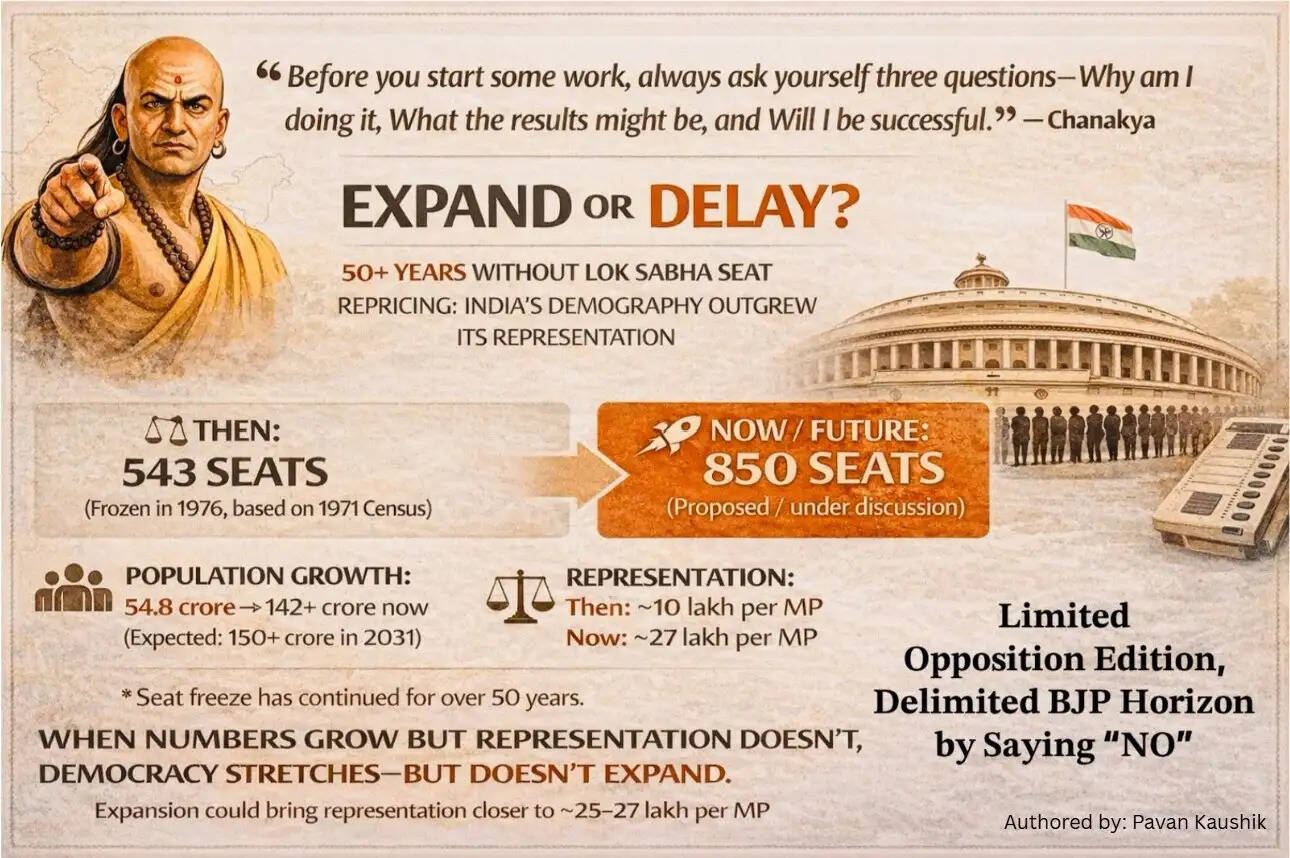
Based on the Constitution (One Hundred and Thirty-First Amendment) Bill, 2026, the government proposes to expand the strength of the Lok Sabha from 543 to around 850 seats (as proposed / under discussion)—with approximately 815 from states and 35 from Union Territories. Of these, around 33% (~270–280 seats, depending on final strength) are expected to be reserved for women.
On paper, it’s reform. In practice, it’s redesign—on a delayed timeline.
The proposal aims for a broad ~50% expansion in seat capacity, using the 2011 Census as the basis for redefining constituencies. It is targeted for implementation by the 2029 general elections, as part of the larger delimitation exercise.
And yet, the numbers raise as many questions as they answer.
The real question remains: when were the 543 seats in the Lok Sabha decided—and what was India’s population then? The freeze traces back to the 1970s, when India had nearly one-third of today’s population. Today, constituencies have swollen, but representation has stayed still.
Even with the proposed expansion to ~850 seats, the arithmetic still trails the demographic reality. A proportional adjustment, purely by population growth, would push the number far higher.
Seats may not need to change every decade—that’s reasonable. But they haven’t changed for over 50 years.
For the ruling establishment, this is a calibrated move: expand representation, deliver on women’s reservation, and control the pace of structural change. For the opposition, the dilemma persists—support the intent, question the timing.
Thus, disagreement is no longer about whether, but when and how.
Ironically, by saying “no” to the timeline rather than the idea, the opposition may be drawing clearer boundaries than the bill itself. In doing so, they sharpen the central question: is this empowerment—or structured postponement?
The real delimitation, it seems, is not just of constituencies—but of accountability.
Because when action is postponed long enough, reform stops being policy—and becomes politics.
(Pavan Kaushik is a Corporate Communication & Reputation Advisor working with promoters and CXOs in high-stakes sectors including mining, metals, and infrastructure)