

Stray Animals: The Questions We Rarely Ask Ourselves
In the concluding part of his two-part series, Udaipur-based author and entrepreneur Rajesh Chaplot questions the double standards of the stakeholders

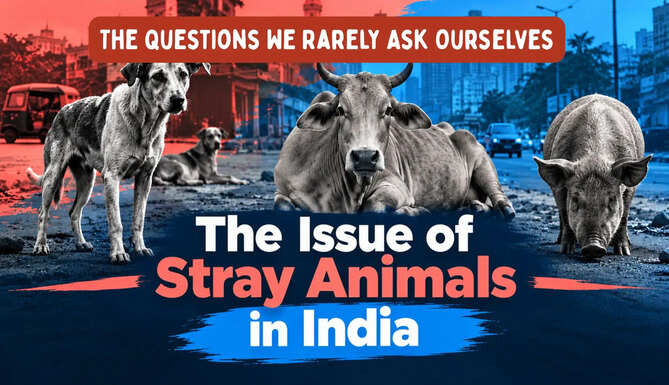
UdaipurTimes, Oct 19, 2026 - The issue of stray animals across India is a serious matter and needs speedy resolution. For this, all relevant parties - government, NGOs, animal lovers, pet owners - need to come together without any bias.
To read Part I, click here
Double Standards: The questions we rarely ask ourselves
A number of thoughtful queries come up in everyday conversation and they deserve a fair, unhurried answer rather than a dismissal.
Animal lover but eating meat? One question often arises: how can an animal lover eat chicken, fish or goat while protesting the removal of stray dogs as cruelty toward animals? Isn’t this love for animals selective? Meat eaters cannot excuse themselves calling it a matter of "food habit," because in some countries eating dog meat is considered equally normal.
Cow is sacred but a homeless/hungry cow not an issue? If we truly respect the cow, we cannot abandon her once she stops giving milk, leaving her to die in a road accident or to go hungry and eat garbage.
Protesting stray dog removal but where is the donation for a dog shelter? Those who revere the cow often donate generously toward gaushalas, but street dog lovers rarely donate toward building shelters for the dogs they protest for. If one truly loves street dogs, the natural next step is to help the government, or raise funds and build a suitable shelter around every neighbourhood.
Protecting stray dogs but letting our children suffer? Given the bite and rabies figures cited earlier, how justified is it to protect stray dogs and let our children and fellow human beings bear the cost for it? Who should be given priority in inhabited areas?
● Cockroaches in the kitchen unhygienic but dogs on the street fine? Just as cockroaches are considered unhygienic in a kitchen, stray dogs and other animals crowding a street pose the same hygiene risk and a greater safety risk, to children and the public. We use sanitiser and soap to kill germs on our own hands without a second thought, yet raise objections when it comes to relocating street dogs. It is worth noting that even those who follow Jainism strictly and do not kill a cockroach at home do not force this choice upon others.
● Dog lovers keep their own pets away from a newborn baby for hygiene or safety. Why should the same caution not apply to stray street dogs, for the hygiene and safety of children walking the same street?
● Feeding meat to dogs is not cruelty against animals? Manhandling a stray dog is cruelty but feeding meat to dogs is not cruelty
● A stray dog biting a human is justified but a hungry man stealing for food is not. Animal lovers are quick to offer justification for a dog's bite. Yet, would an equally reasonable justification from a person accused of stealing food be accepted just as readily?
● A horse in a stable, or a small dog in a lady's purse, is acceptable, but a parrot in a cage or an animal in a circus cage, is not. Let us not set the limits of an animal's freedom purely for our own convenience. It is much like taking a pen home from one's own office and treating it as a small privilege but when a household helper takes the same pen it is called theft.
It has also been argued that a circus is simply a repeated performance, yet a pet dog at home performs many of the same tricks repeatedly and no one calls that cruelty.
Confusion to be Removed
- Relocating stray street animals is not against the principles of animal protection.
- Prioritising human safety cannot be construed as cruelty toward animals.
- Human beings have the first right to safety in the city, just as animals have the first right to safety within the jungle. Neither should be made to bear the risk that belongs to the other's territory.
- Any trespasser, human or animal, should be warned and guided back to their own territory.
- One person's personal conviction cannot be forced upon another, just as those who follow Jainism choose not to kill or harm any animal themselves, without forcing that choice on others.
Way Forward
Bringing all of this together, a clear and positive direction stands out.
● Many who follow Jainism, while choosing not to harm animals themselves, also choose not to forcibly oppose those who eat meat. This quiet, personal consistency, living by a principle without demanding everyone else adopt it in exactly the same way, offers a thoughtful example of how deeply-held values and respect for other people's choices can exist side-by-side.
● Stray dog lovers need to come together and form NGOs in far greater numbers, raise funds and relocate street dogs into proper shelters.
● Individual adoption of street strays by dog lovers could resolve much of this issue on its own. A few inspiring examples already exist, but in general, protest is far more common than becoming a positive example for society to follow.
● Cow owners need to be identified and encouraged, or required, to take their animals back, pay toward a proper shelter for them, or face a meaningful penalty for abandonment.
● Pig owners, who almost always exist even when not visible, need to be identified and required to keep their animals on their own property or face a penalty.
● Society and its rules need to keep evolving with time.
● Indian law needs to be suitably amended to remove the flip flop seen in the Courts through 2025 - one order directing the removal of strays, followed by another favouring sterilisation and return. This inconsistency reflects real ambiguity in the law that urgently needs resolving.
● Government and municipalities must allocate proper, dedicated funding for this purpose, not occasional budget lines that dry up after a headline fades.
● Government should amend the law to enable systematic relocation, sterilisation and vaccination of stray animals from the street, protecting human beings on priority while also protecting the animals themselves. The laws of developed countries can be referenced here, particularly universal microchipping and the licensing of animals kept at home.
● Owners who, at some point, no longer wish to keep an animal should have access to a proper facility for transfer, with the cost borne by the owner. NGOs and government should jointly lead this effort.
● Every sterilised and vaccinated stray should carry a simple, verifiable marker, an ear notch along with a QR tag or microchip, so that citizens, NGOs and municipal bodies can transparently confirm coverage, much as developed countries already do.
● A single public helpline or App should let citizens report both unsterilised strays and instances of cruelty, so that safety complaints and welfare complaints each reach the right authority quickly, instead of being lost in general grievance channels.
● Until government, municipality or NGOs act decisively, let us first protect human life at first.
Closing Note
Let us do as we wish at home, and eat what we choose, but let us not allow that choice to interfere with, or compromise, the safety of our own children and the aesthetics of our own city.
This article has tried to walk through each aspect honestly and kindly, but readers are warmly encouraged to explore these topics further on their own, since laws, local programmes and on the ground realities will continue to change from city to city and year to year. A little independent reading alongside this article will only make the picture richer.
Appeal to Animal Lovers
An animal lover is different from a pet lover. Not every pet lover is necessarily an animal lover. An animal lover, in the fullest sense, would follow the principle of not harming any animal for food and would extend that love equally regardless of an animal's appearance or behaviour. It has also been reported in the media that, during certain protests, paid staff were seen standing in for genuine animal lovers at the protest site, which reveals its own kind of double standards. As the saying goes, people who live in glass houses should not throw stones at others.
Rajesh Chaplot is the recipient of:
• Pravasi Bhartiya Samman Award 2019, the highest Non-Resident Indian Award, conferred upon him by the President of India
• Golden Jubilee Award 2020, the highest Civilian Award, conferred upon him by the President of Uganda
